

You picked a keyword. You wrote one page. You hit the density, added the H2s, watched the rank. That playbook built a decade of traffic. It is now optimising for a machine that no longer reads the way you’re writing.
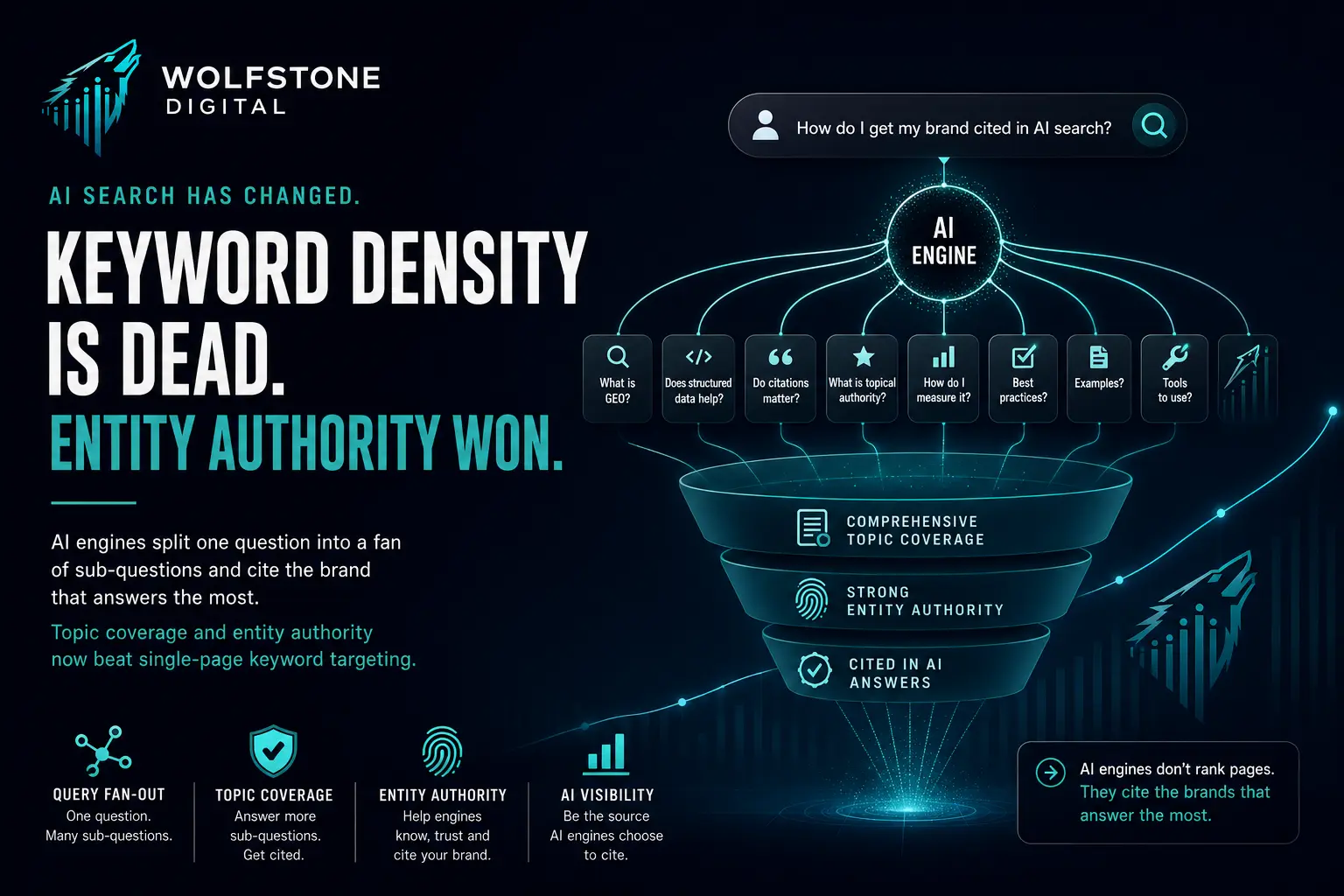
Here’s what changed. When someone asks an AI engine a question, it doesn’t run that one query. It shatters it into a fan of smaller ones, answers each from across the web, and stitches the result back together. The brand it cites is the one that answered the most of those sub-questions. Not the one with the best single page. The one with the most complete coverage.
That is the whole game now. Keyword density lost. Entity authority won. This is what that means and what to build.
Key takeaways
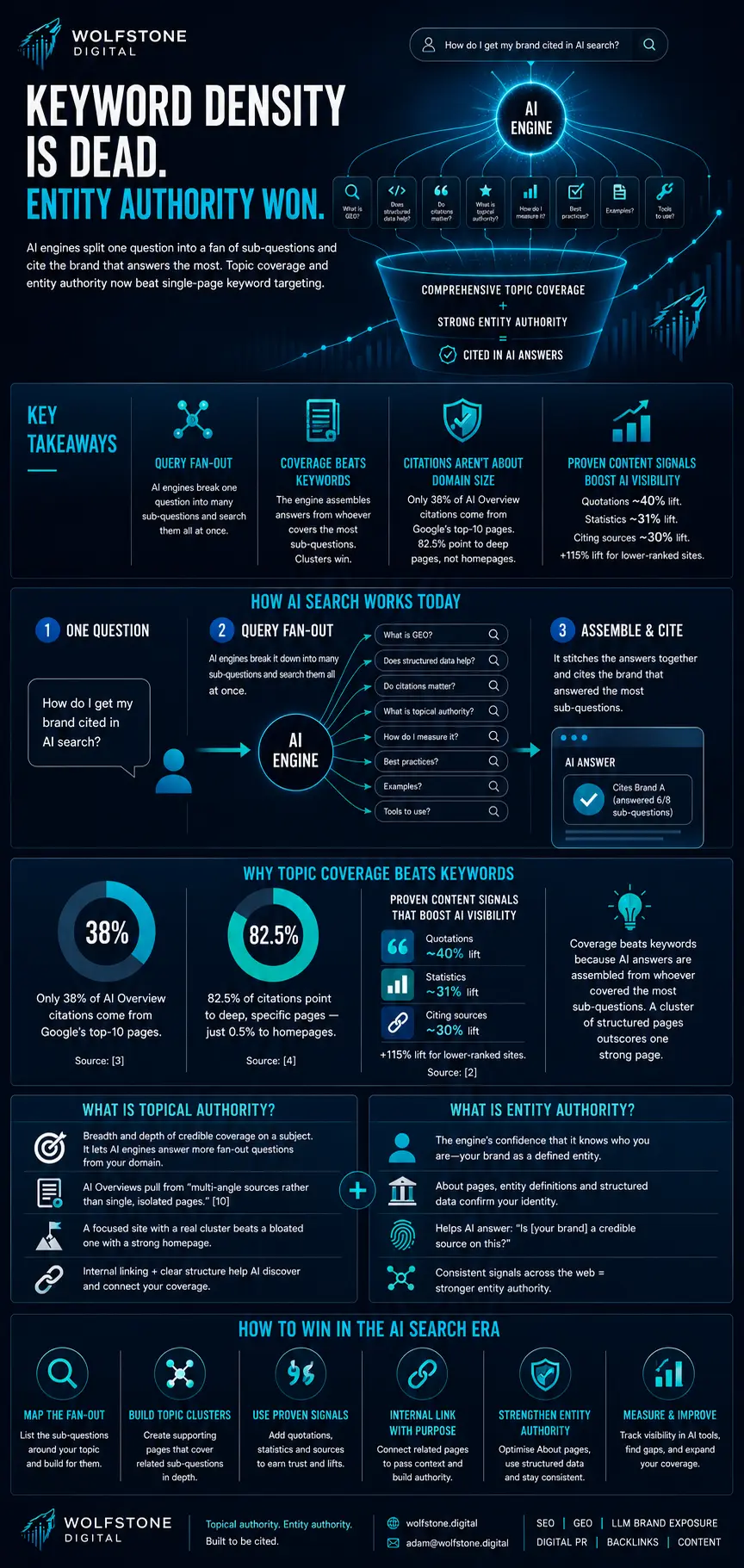
- AI engines use query fan-out, Google’s own term. AI Mode “break[s] down your question into subtopics and issues a multitude of queries simultaneously” [1]. One question becomes many.
- Coverage beats keywords because the engine assembles its answer from whoever covered the most sub-questions. A cluster of structured pages outscores one strong page.
- Citation isn’t won by domain size. Only 38% of AI Overview citations come from Google’s top-10 pages [3], and 82.5% point to deep pages, not homepages [4].
- The proven levers are specific: quotations lifted AI visibility ~40%, statistics ~31%, citing sources ~30% in controlled testing, +115% for lower-ranked sites [2].
Is keyword targeting dead?
Targeting a keyword on a single page is no longer enough, and on its own, it’s a losing bet. AI engines don’t match one query to one page. They decompose the question, source each piece separately, and cite the brand with the most complete coverage of the topic. Keyword research still tells you what people ask. It no longer wins you the answer.
We checked. We asked Perplexity (sonar-pro, web search on) on 29 June 2026 whether topical authority or keyword targeting matters more for AI search. Its verdict, unprompted: “optimise for topical authority first, and use keyword targeting to support that authority” [11]. It cited Ahrefs, Conductor, Velir and others. It did not cite a single brand that had merely targeted the keyword “topical authority” on one page. Coverage got cited. The keyword page didn’t.
What is query fan-out, and why it changes everything
Query fan-out is when an AI engine breaks your question into subtopics and issues many searches at once, then builds one answer from the results. It is documented, not theorised: Google states AI Mode “break[s] down your question into subtopics and issuing a multitude of queries simultaneously on your behalf” [1].
Picture a marketer asking, “how do I get my brand cited in AI search?” The engine doesn’t hunt for a page titled that. It fans the question out: what is generative engine optimisation? does structured data help? do third-party citations matter? what’s topical authority? how do I measure it? Then it shops each sub-question across the web and cites whoever answered it best.
And it isn’t hypothetical. Ask ChatGPT “who are the best SEO specialists in Suffolk” and look under the hood: the single prompt fans out into four separate searches before it writes a word of the answer.
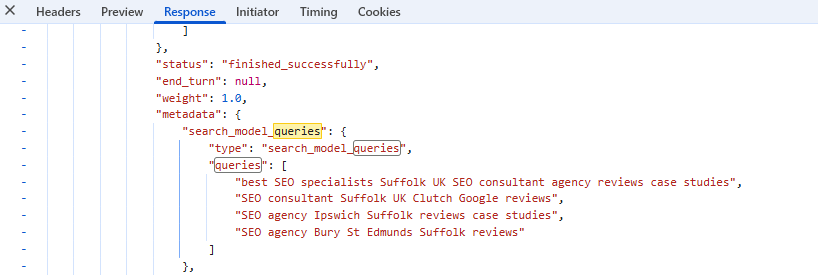
Four sub-questions from one prompt, Suffolk SEO consultants, Clutch and Google reviews, agencies in Ipswich, agencies in Bury St Edmunds. A single page optimised for “SEO specialists Suffolk” answers one of those four. The brand ChatGPT assembles into its answer is the one that covers all four.
So the unit of competition is no longer the keyword. It’s the sub-question. The brand that answers six of the eight fan-out questions gets assembled into the answer. The brand with one brilliant page on the head term answers one, and watches the others get cited around it. That is why a tidy cluster of pages now outperforms a single hero page. It’s not a content-marketing preference. It’s how the retrieval works, and it’s the foundation of generative engine optimisation (GEO).
What is topical authority in AI search?
Topical authority is the breadth and depth of credible coverage a site holds on one subject, and in AI search it’s the difference between being the source and being a link. Every generalist defines it as a Google ranking signal. That’s half the story. The other half: topical authority is what lets an engine answer five fan-out sub-questions from your domain instead of one.
Google’s live AI Overview says it plainly. On 29 June 2026, the AI Overview for “topical authority seo” stated that AI overviews “pull from… multi-angle sources rather than single, isolated pages” [10]. The engine is telling you, in its own answer, that it rewards coverage. Most sites are still writing isolated pages and wondering why they’re invisible.
Authority here is not domain size. Only 38% of AI Overview citations come from Google’s top-10 pages [3], and 82.5% point to deep, specific pages, just 0.5% to homepages [4]. A focused site with a real cluster beats a bloated one with a strong homepage. Depth wins. Bulk doesn’t.
What is entity authority, and why do About pages suddenly matter?
Entity authority is the engine’s confidence that it knows who you are, your brand as a defined thing, with clear attributes, consistent across the web. About pages, plain entity definitions and structured internal linking are how you give an engine that confidence. They were treated as housekeeping. They are now ranking assets.
Here’s the link the generalists miss. To answer a fan-out question like “is [your brand] a credible source on this?”, an engine has to resolve you as an entity first. If your About page is a paragraph of marketing fluff with no clear “we are X, we do Y, here’s the evidence”, the engine can’t resolve you, so it cites someone it can. Entity definitions, a real About page, consistent naming across your site and your profiles, and internal links that connect your cluster into one obvious topic: that’s the machine-readable proof that you cover this subject. It’s also why the GEO research found citing your own sources lifted visibility ~30% and statistics ~31% [2], those are entity and credibility signals an engine can verify.
One strong page or five structured pages?
Five structured pages win, and it isn’t close. A single page can answer one fan-out sub-question well. A cluster of five interlinked pages answers five, which is exactly what the engine assembles its response from. The same effort, redistributed from one hero page into a connected cluster, multiplies how many sub-questions you can be cited for.
This is why “topic clusters” stopped being a content-marketing nicety and became GEO infrastructure. A pillar page that frames the subject, spoke pages that each own a sub-question, and internal links that wire them into one entity, that structure maps directly onto how fan-out retrieves. You’re not writing for a reader who scrolls one page. You’re writing for an engine that pulls five. (And it can only pull the pages it can actually load, which is a trap in itself; see why your pages might be invisible to AI.)
Keyword targeting vs topic + entity authority
| Single-page keyword targeting | Topic + entity authority | |
|---|---|---|
| Unit of competition | The keyword | The fan-out sub-question |
| Wins when | One query → one page (old SERP) | One query → many sub-queries (AI) [1] |
| Structure | A hero page | A pillar + cluster, internally linked |
| What the engine sees | One isolated page | A resolved entity covering a topic [10] |
| Citation odds | Answers 1 of N sub-questions | Answers most of N sub-questions |
| Authority source | Density + backlinks to the page | Coverage, entity clarity, cited sources [2][4] |
| Failure mode | Invisible around the AI answer | Cited inside it |
What actually moves the needle
The strongest evidence on getting cited in AI answers is the “Generative Engine Optimization” study (Aggarwal et al., KDD 2024). It tested what changes whether a generative engine cites you. The wins were specific and repeatable: adding quotations lifted visibility ~40%, statistics ~31%, and citing your own sources ~30%, and the effect reached +115% for lower-ranked sites [2]. If you’re not already the biggest name in your space, that last number is yours.
So, concretely:
- Map the fan-out, not the keyword. For each topic, list the sub-questions an engine would split it into. Each one is a page or a section.
- Build the cluster. A pillar that frames the subject; spokes that each own a sub-question; internal links wiring them into one entity.
- Fix your entity. A real About page. Plain “we are X, we do Y” definitions. Consistent naming across your site, profiles and listings.
- Quote, count, cite. Add named quotations, hard statistics and visible source links. The GEO paper proved each lifts citation odds [2].
- Go deep, not broad. 82.5% of AI citations point to deep pages [4]. One thorough sub-question guide beats ten thin keyword pages.
- Earn the off-site mention. 82% of AI citations are earned, third-party media [5]; on Surfer’s data YouTube (~23%) and Wikipedia (~18%) lead the citation surfaces [6]. Coverage on your site plus mentions off it.
The honest caveat
One counter-point, because we don’t sell certainty. Yext’s analysis argues around 86% of AI citation sources are “brand-managed”, owned properties, not earned media [9]. That cuts against the “earned wins” finding [5]. The truth is you need both: a tightly structured, entity-clear owned cluster and earned third-party mentions. Anyone selling you one magic channel is guessing. Build the citable site first, then go earn the references.
And the click economics that make this urgent are contested too. Pew found users click roughly 8% of the time when an AI summary is present, versus 15% without [7]. Google disputes the methodology, note it. But the direction isn’t in doubt. Fewer clicks, more answers. The brand inside the answer wins; the keyword page outside it doesn’t.
See where you stand, free
You can’t fix what you can’t see. The question isn’t “do I rank for my keyword” any more. It’s “which of the fan-out sub-questions does an engine already cite me for, and which is it citing my competitor for?”
If your competitor is getting assembled into the answer and you aren’t, you’ll know in minutes, and you’ll know exactly which sub-questions to go and win.
FAQ
Is keyword targeting dead in 2026? Not dead, but no longer enough on its own. AI engines split a question into fan-out sub-questions and cite the brand that covers the most of them [1]. Keyword research still tells you what people ask; topic coverage and entity authority win the citation. Optimise for coverage first, use keywords to support it.
What is query fan-out? Query fan-out is when an AI engine breaks a question into subtopics and issues many searches at once, then builds one answer from the results. Google states AI Mode “break[s] down your question into subtopics and issuing a multitude of queries simultaneously” [1]. It’s why coverage beats single-page targeting.
How is topical authority different in AI search? In classic SEO it helped you rank one page. In AI search it decides whether an engine can answer several fan-out sub-questions from your domain instead of one. Only 38% of AI citations come from top-10 pages and 82.5% go to deep pages [3][4], coverage and depth beat domain size.
Why do About pages and entity definitions matter now? Because an engine has to resolve who you are before it cites you. A clear About page, plain entity definitions and consistent naming give it that confidence. They turn your cluster into one recognised entity, machine-readable proof you cover the subject, not just housekeeping.
One strong page or several structured pages? Several. A single page answers one fan-out sub-question; a connected cluster answers many, which is exactly what the engine assembles its answer from. Redistribute the effort from one hero page into a pillar-and-spoke cluster and you multiply your citation surface.
Sources
- Google, The Keyword (blog.google): AI Mode / AI in Search update, 2025. Query fan-out: AI Mode “break[s] down your question into subtopics and issuing a multitude of queries simultaneously.”
- Aggarwal et al., “GEO: Generative Engine Optimization,” KDD 2024: arxiv.org/abs/2311.09735. Quotations ~+40%, statistics ~+31%, citing sources ~+30%; +115% for lower-ranked sites.
- Ahrefs: 863k-keyword study; 38% of AI Overview citations from Google top-10 pages.
- BrightEdge (via Search Engine Land): 82.5% of AI Overview citations link to deep pages; ~0.5% to homepages.
- Muck Rack, December 2025: 82% of AI citations from earned/third-party media; 94% non-paid.
- Surfer SEO, 2025: ~36M AI Overviews / ~46M citations; YouTube ~23%, Wikipedia ~18% lead.
- Pew Research Center, July 2025: click 8% with AI summary vs 15% without (Google disputes methodology).
- Seer Interactive: ChatGPT referral converts ~15.9% vs ~1.76% organic (directional, single vendor).
- Yext (contested): ~86% of AI citation sources are “brand-managed.”
- DataForSEO Labs / live SERP (UK), 29 June 2026: “topical authority seo” fires an AI Overview (“multi-angle sources rather than single, isolated pages”).
- Perplexity (sonar-pro, web search on), Wolfstone baseline, 29 June 2026: “optimise for topical authority first… use keyword targeting to support it.”