Free · AI Visibility Checker
Does ChatGPT recommend you, or your competitor?
One live check against ChatGPT, Gemini and Claude. See the answers they give when someone asks for a business like yours, and what to fix first.
Three questions · results in under a minute · no card details
Built by the team behind the most-cited site in the UK trading niche.
How to use the AI visibility checker
Three steps, about a minute of your time.
-
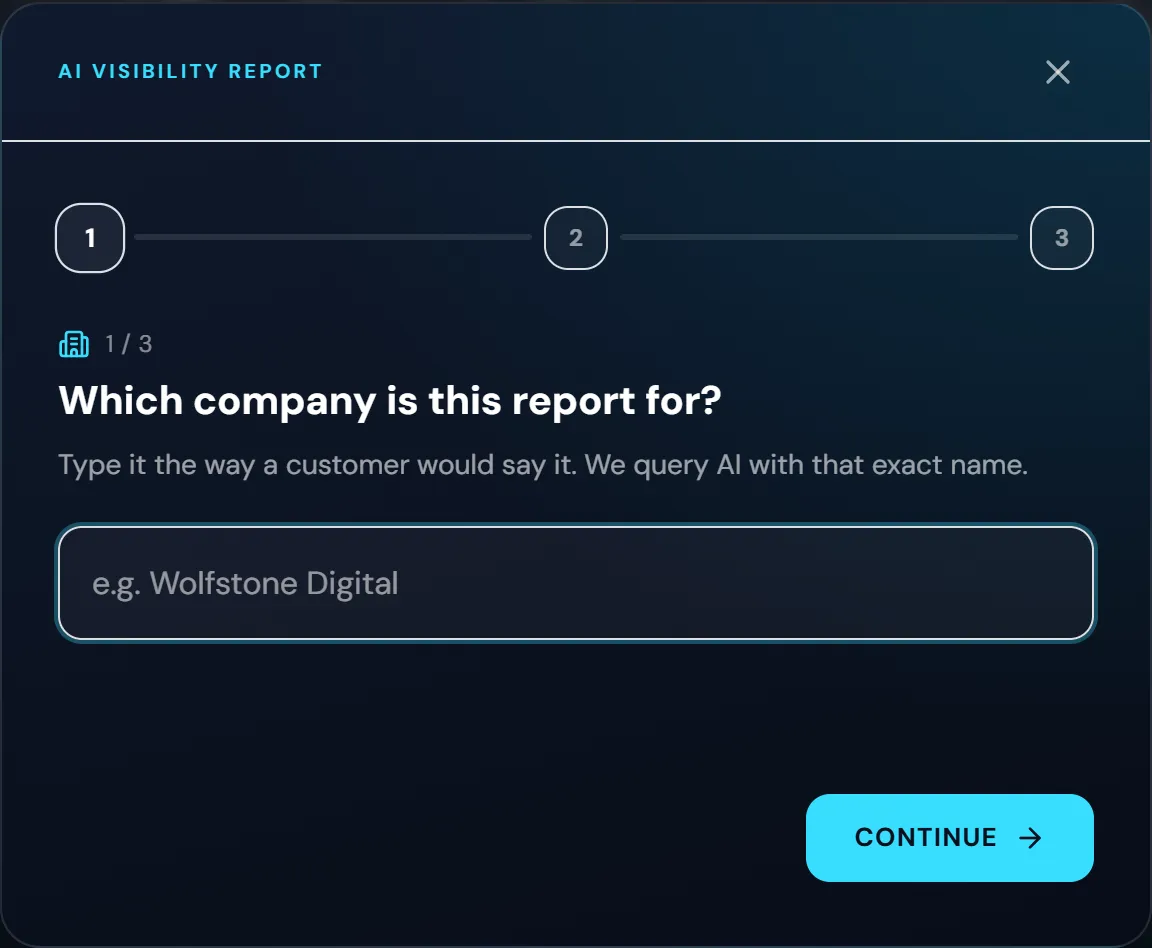
Answer three quick questions
Your company name, your website if you have one, and where to send the PDF. Nothing else.
-
We query ChatGPT, Gemini and Claude live
We generate test questions from your business context and put them to all three engines in real time. Takes 20 to 40 seconds.
-
Read the full report, keep the PDF
Your score, the platform-by-platform breakdown, strengths, gaps and a prioritised action plan, on screen immediately and emailed as a PDF.
Three questions, results in under a minute.
There is no page two any more
AI gives one answer, not ten blue links. Your brand is either in it, or it is invisible.
When someone asks ChatGPT for an accountant, a supplier or an agency, they get a short list and a recommendation. Not a page of options to work through. If you are not on that list you were never in the running, and nothing tells you the conversation happened.
And you cannot see it happening
There is no impression, no click, no referrer and no line in Analytics when an AI recommends someone else. Your rankings can look healthy while the answer sitting above them names a competitor.
- Nearly half
- of commercial Google searches now trigger an AI Overview. BrightEdge, 2026
- 900 million
- people use ChatGPT every week. OpenAI, Feb 2026
- 77%
- of ChatGPT users treat it as a search engine. Adobe survey, 2025
This is what invisible sounds like
Ask any of the three engines a category question and you get hedging, a couple of large names, and an admission that it does not know the smaller players.
Illustrative example, not a live query
Free, and you will have your score in under a minute.
Everything the report tells you
Every check runs live at the moment you ask, not against a stored index. Three engines scored separately, the answers they actually gave, and a ranked list of what to fix.
-
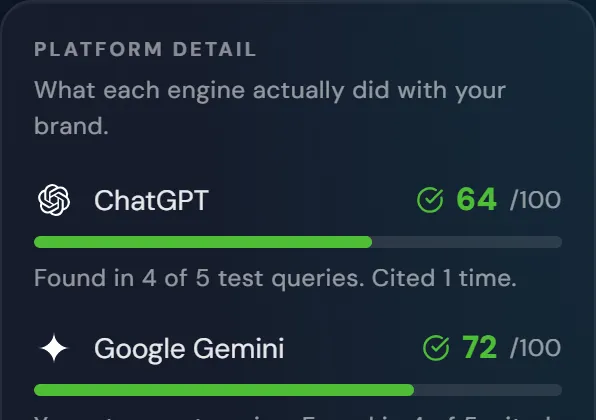
A separate score for every engine
ChatGPT, Gemini and Claude are scored independently. Being strong on one and invisible on another is the normal result, and an average would hide it.
-
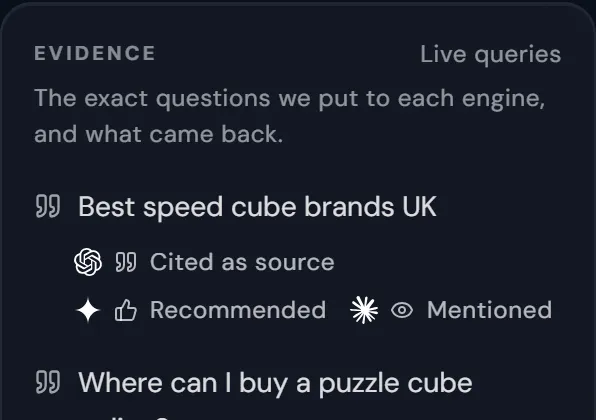
The answers, quoted back to you
Not a number you have to take on faith. You see the exact questions we put to each engine, and whether it cited you, recommended you, mentioned you, or returned nothing at all.
-
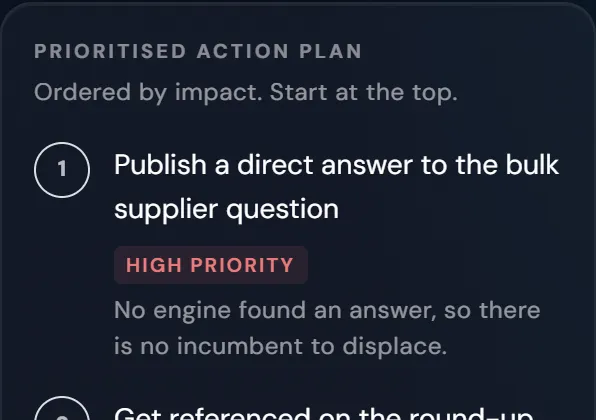
What to fix, in order
Ranked by impact and tied to the gap that produced it, so you start with the query no engine could answer rather than a list of everything.
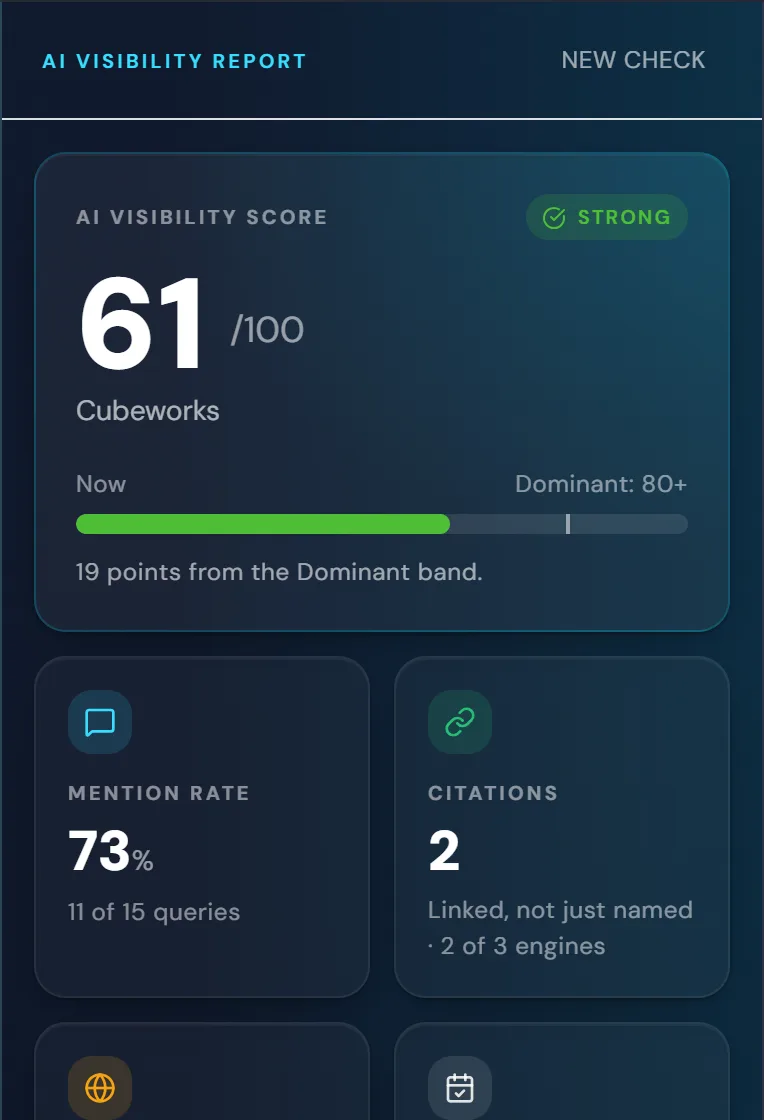
Panels shown are from an example report for a sample brand.
We grade AI visibility because we have won it
The team behind this checker built theInvestorsCentre.co.uk, our own trading comparison site, into the most-cited source in the UK trading niche. Same methods, our own money on the line first.
- 48.7%
- of tracked AI answers in its niche cite the site, across 21,483 AI chats in 30 days.
- 6×
- more AI citations than Forbes in the same niche.
- £1.5m
- annual revenue, built with £0 ever spent on ads.
“900+ new clients through a single campaign angle nobody else had identified.”
Why we built this, and why we changed our minds about it
When AI visibility first got talked about, we thought it was a buzzword. A red herring. Tracking it was a pain, the numbers were small, and SEO was still the thing that paid the bills. We were not in a hurry.
Two years on, that has changed, and not slowly. It matters for our own brands, which live and die on digital, and it matters for businesses of every size we speak to, from one-van operations to global names.
Here is how we think about it. The best lead you will ever get is a referral. Somebody who has used you, rated you, and passed your name to a person who already trusts them. Nothing beats that.
The second best is a referral from an AI. Someone types their actual situation, in their own words, with all their particular constraints in it, and the model comes back and recommends you. That is not the same as ranking first in Google, and in one respect it is better, because of the specificity. The person asking has already described exactly what they need, and your name is the answer.
So we started tracking it properly. Not just whether we get mentioned, but how much share of voice we hold, how much of the narrative is ours, and which models favour us over others. They do not agree with each other, and the disagreements are the useful part.
We built this tool for ourselves. We opened it up because the numbers are worth seeing even if you never speak to us. Two honest limits: it will not tell you how to fix what it finds, and it does not cover every engine. Running live queries against these models costs real money in tokens, so treat this as a guide rather than an exhaustive audit.
If you want the how, we have written it up separately. How to rank on ChatGPT and what GEO actually is are the places to start.
And if the numbers make you want to do something about it, talk to us. This is the thing we are best at. Our own brand is one of the most cited sources in its niche, ahead of Forbes and several other names you would recognise, and we got there on our own money before we sold it to anybody.
What is AI visibility?
AI visibility is whether an AI model names your business when someone asks it a question you should be the answer to. Not whether you rank. Not whether you have a website. Whether ChatGPT, Gemini or Claude actually says your name.
It is a separate problem from search rankings and it behaves differently. A business can sit at the top of Google for a term and be completely absent from the AI answer above it, because the model draws on how well a brand is documented across the whole web rather than on where a single page ranks today.
What is LLM visibility, and is it the same thing?
Broadly yes. LLM visibility, AI visibility and generative engine optimisation all describe the same problem: whether a large language model can find you, understand what you do, and repeat it back to somebody who asks.
The phrasing tends to follow who is speaking. Agencies say GEO, engineers say LLM visibility, and everybody else says AI visibility. This tool measures the same thing whichever you call it, and tracking it over time is what turns a one-off score into something useful.
Which AI platforms do we check?
Three engines, queried live. Each has its own training data and citation behaviour, so visibility often differs sharply between them.
-
ChatGPT
OpenAI's flagship model - the most widely used AI assistant.
-
Gemini
Google's AI - integrated into Search, Android, and Workspace.
-
Claude
Anthropic's AI - known for nuanced, detailed responses.
What is a good AI visibility score?
Above 60, the Strong band and up, means the engines name you consistently, including on category questions rather than just on your own brand name. That is where you want to be, and very few businesses are there.
40 to 59, the Moderate band, means you show up sometimes. Usually that is because a model knows your name but cannot confidently place you in a category, so you appear when asked directly and vanish when asked who somebody should use.
Below 40, Weak or Invisible, means the engines do not really know you exist. Most businesses running this for the first time land here on at least one engine. It is the normal starting point rather than a failure.
One thing worth doing with the result: do not average the three engines. A brand scoring 80 on ChatGPT and 20 on Gemini has a specific and fixable problem. A mean of 50 hides it completely, which is exactly why we score them separately.
What your score means
Your AI visibility score runs from 0 to 100, blended across ChatGPT, Gemini and Claude. Here is how to read it.
| Score | Grade | Rating | What it means |
|---|---|---|---|
| 80–100 | Strong green | Dominant | AI assistants consistently name and recommend you in your category. Defend the position. |
| 60–79 | Green | Strong | You appear often and are sometimes recommended, but not yet the default answer. |
| 40–59 | Amber | Moderate | You show up in some answers but are rarely recommended, with real room to grow. |
| 20–39 | Orange | Weak | AI rarely mentions you when people ask about your category. |
| 0–19 | Red | Invisible | AI assistants are not aware of or recommending your brand. Competitors own the answer. |
How to improve your AI visibility
AI assistants cite the brands with authority, structure and third-party validation. The levers that move your score:
Why are most businesses invisible to AI?
Usually because there is nothing for a model to read.
When we audited the websites of Suffolk's 100 largest companies in June 2026, only 17% had meaningful structured data. Another 49% had generic markup their content management system generated automatically, describing the page as a WebPage and nothing more, which tells a model nothing it could not already work out. 27% had none at all.
Structured data is not the whole story, but it is the part almost nobody has looked at. Nearly 7% of those same companies were also blocking at least one AI crawler in their robots file, which is a decision very few of them will have made on purpose.
You can check that side of it in a few seconds with our robots.txt and crawlability checker, or read the full study.
Frequently asked questions
What is an AI visibility checker?
An AI visibility checker tests whether AI assistants mention, cite or recommend your brand when people ask them questions in your category. Ours queries ChatGPT, Gemini and Claude in real time and scores how visible your brand is across all three.
Is the AI visibility checker free?
Yes, completely. Answer three quick questions (your company, your website if you have one, and where to send the PDF) and the full report appears on screen straight away: score, per-engine breakdown, the answers each engine gave, and a prioritised action plan. No account, no card details, and a limited number of free checks per day.
Which AI platforms does it check?
It runs live queries against ChatGPT (OpenAI), Gemini (Google) and Claude (Anthropic), the three most widely used AI assistants, and the engines increasingly answering questions that used to go to a search box.
How is the AI visibility score calculated?
For each platform we run a set of category questions and classify whether your brand is cited as a source, recommended, merely mentioned, or absent. Those signals combine into a 0–100 score per platform and an overall score, lightly weighted by your domain authority.
How do I improve my AI visibility?
Get cited by the third-party sources AI engines trust, publish structured and up-to-date content that directly answers category questions, build topical authority with content clusters, and earn brand mentions across the web. This is the discipline of generative engine optimisation (GEO).
Why does my brand appear on one AI platform but not another?
Each engine has different training data, citation behaviour and freshness, so visibility can vary dramatically between ChatGPT, Gemini and Claude. That is why we check all three rather than optimising for a single engine.
Is this the same as an AI SEO tool?
It is one part of it. Most tools sold as AI SEO tools are keyword or content tools with an AI feature attached. This one measures a single specific thing: whether the engines name you. If you want the work of getting cited rather than just the measurement, that is what our GEO service does.
Key takeaways
- AI visibility is whether a model says your name, not whether you rank.
- A referral from an AI is the closest thing to a personal referral, because the person has already described what they need.
- Above 60 the engines name you consistently, 40 to 59 is patchy, below 40 they do not really know you.
- Never average the engines. The gap between them is the useful part.
- Most invisibility comes down to nothing being readable, not to bad content.
Where you stand
Find out where you actually stand
Three questions, one live check against all three engines, and the full report on screen straight away with a PDF copy by email.
No card details. And if your score comes back strong, the report will say so: we do not manufacture a problem to sell you a fix.