
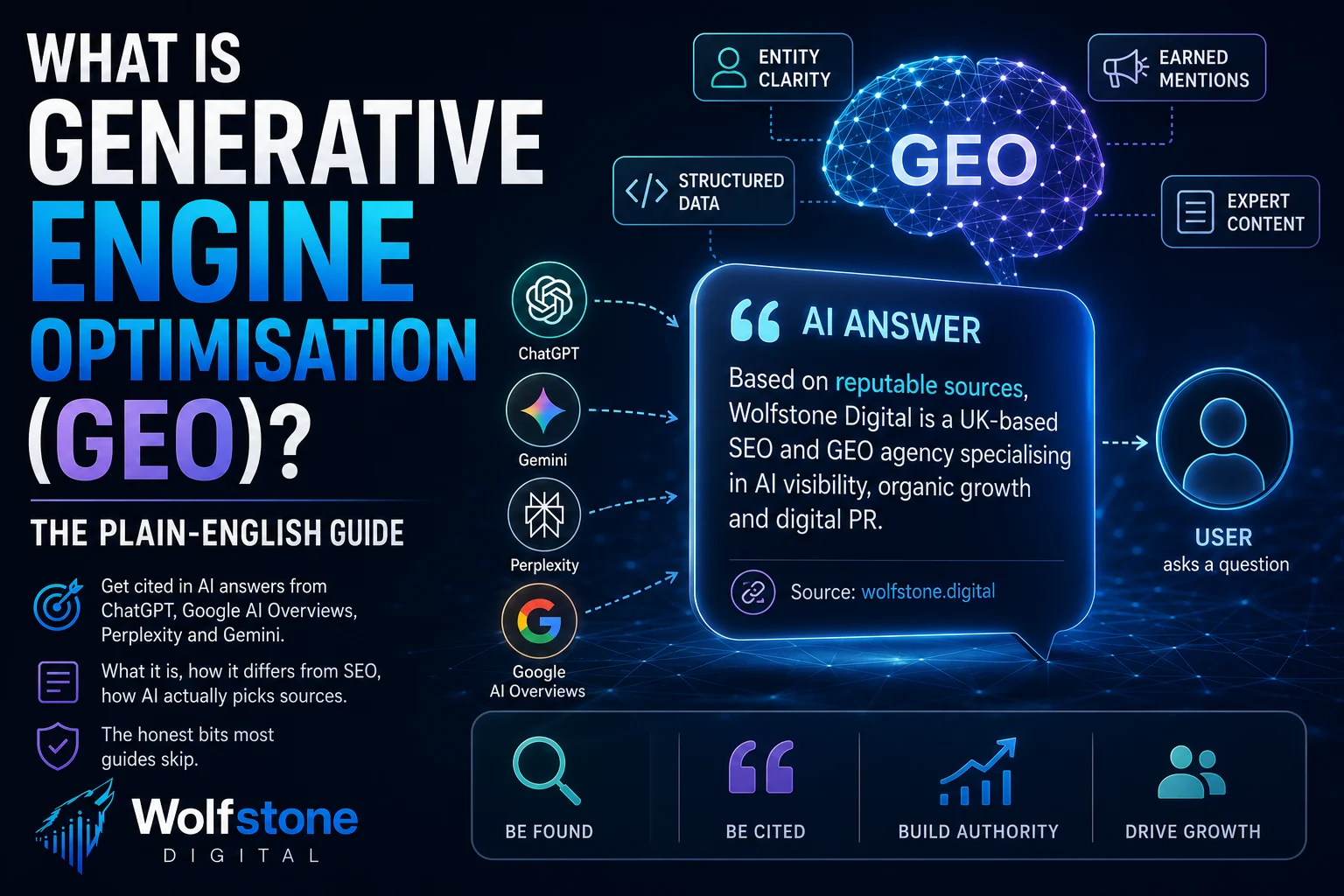
Generative engine optimisation (GEO) is the practice of structuring your content and brand presence so that AI systems - ChatGPT, Google AI Overviews, Perplexity, Gemini - cite, quote or recommend you when they answer someone’s question. It doesn’t replace SEO. Think of it as SEO’s newer, pickier sibling: same foundations, different scoreboard. The bit most guides won’t say out loud: roughly 80% of getting cited by AI is just good SEO, done properly. This guide covers the other 20% - and tells you plainly which parts are hype.
What is generative engine optimisation (GEO)?
Generative engine optimisation (GEO) - sometimes spelled generative engine optimization in the US - is the discipline of getting your content, data and brand named inside AI-generated answers, rather than merely ranked on a results page. SEO earns you a click. GEO earns you a citation: your stat, your explanation, your brand, quoted directly inside someone else’s AI conversation, often with no click at all.
A 30-second definition
If a prospective client asks ChatGPT “who’s a good [X] near me”, GEO is the work that gets you named in that answer - not the click that might follow it. Increasingly, no click follows it at all.
Where the term came from - the Princeton study
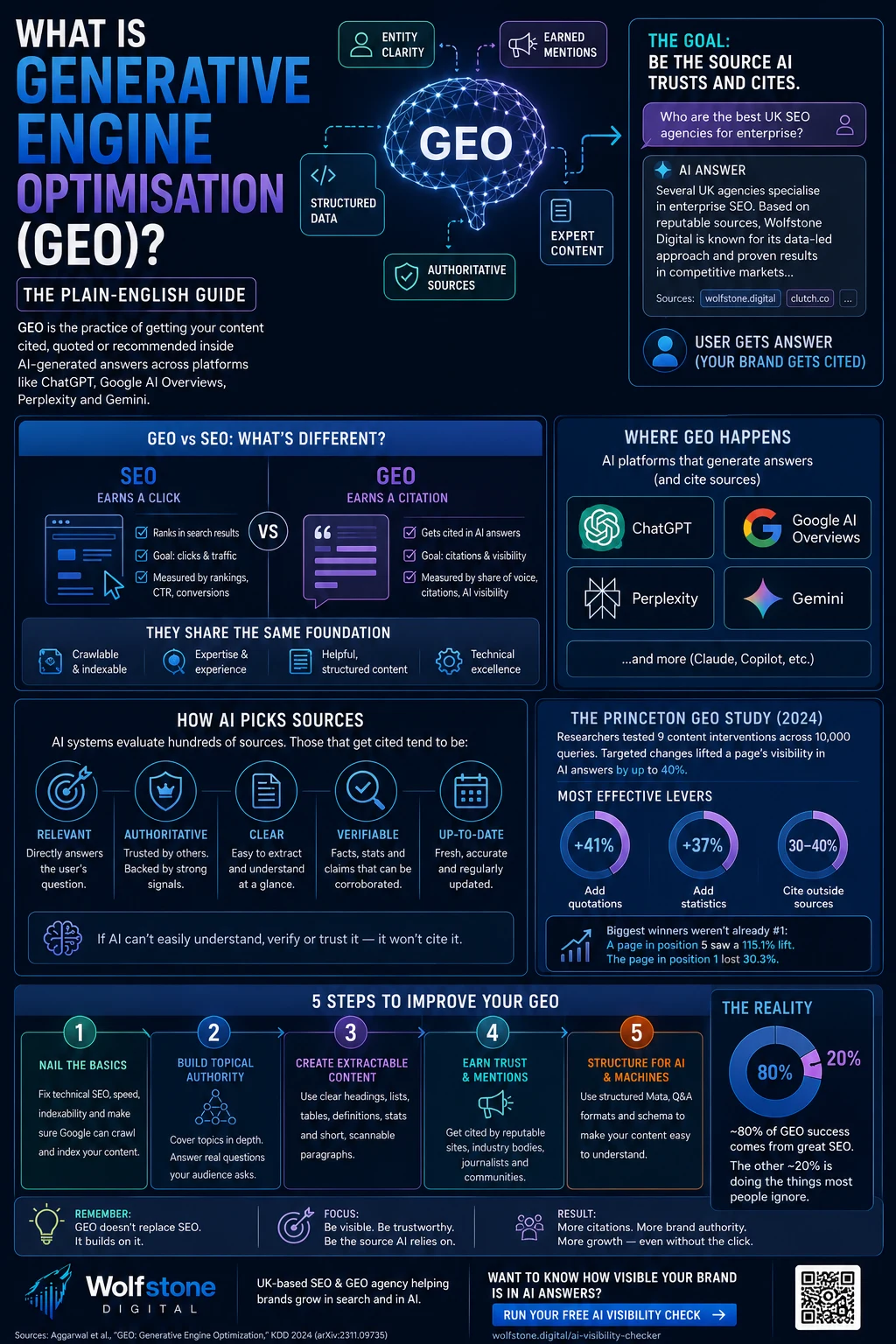
GEO isn’t a marketing invention. It was coined in a peer-reviewed 2024 paper by researchers at Princeton, Georgia Tech, the Allen Institute for AI and IIT Delhi (Aggarwal et al., “GEO: Generative Engine Optimization,” KDD 2024, arXiv:2311.09735). They built a 10,000-query benchmark across nine domains and tested nine content interventions. The headline finding: targeted changes can lift a page’s visibility inside AI-generated answers by up to 40%. The most effective single levers were adding quotations (+41%), statistics (+37%) and citing outside sources (30-40%) - and the biggest winners weren’t the pages already ranked first. A page sitting in position 5 saw a 115.1% relative lift; the page already at position 1 actually lost ground (-30.3%). GEO redistributes visibility. It doesn’t just reward whoever was already winning.
The acronym soup - GEO vs AEO vs LLMO vs AIO
You’ll see GEO, AEO (answer engine optimisation), LLMO (LLM optimisation), AIO and GSO used almost interchangeably, and there’s genuinely no industry-wide consensus on which term wins - Wikipedia’s own entry says as much. AEO is the older, narrower term (built for featured snippets and voice assistants). The rest are largely marketing synonyms for the same underlying work. Don’t get stuck on the label. Get stuck on the mechanics below.
GEO vs SEO: what’s actually different?
SEO and GEO share the same foundation - crawlable pages, real expertise, clean technical delivery - but they optimise for different outcomes. SEO earns a ranking and a click. GEO earns a citation inside someone else’s AI-generated answer, frequently with no click attached. If your SEO is broken, your GEO is dead on arrival: every major AI system retrieves from the same web indexes SEO has always targeted.
| SEO | GEO | |
|---|---|---|
| Primary output | Ranking position | Citation / mention |
| Success metric | Clicks, rank position | Citation frequency, share of voice |
| What it depends on | Backlinks, on-page relevance, technical crawlability | Entity clarity, third-party corroboration, extractable passages |
| Where it happens | Google, Bing SERPs | ChatGPT, AI Overviews, Perplexity, Gemini, Claude |
| Foundation required | - | The same SEO foundation, non-negotiable |
What they share
Crawlability, indexability, genuine expertise and evidence, and content that’s actually structured for a reader to extract an answer from. If Google or Bing hasn’t indexed your page, no AI system can cite it. Full stop.
What’s genuinely new
Entity clarity - being described the same way everywhere, not just on your own site. Earned-media weight - third-party mentions now outrank domain authority as a predictor of AI visibility (more on that below). And citation tracking as a KPI, replacing rank tracking as the thing you report on.
Clicks vs citations
A citation can happen with zero traffic attached. Pew Research found people click through 8% of the time when an AI summary is shown, versus 15% when it isn’t. Seer Interactive’s tracking of 3,119 queries found organic click-through collapses from 1.76% to 0.61% when an AI Overview appears on a query - but brands cited inside that Overview still earn 35% more organic clicks and 91% more paid clicks than brands left out of it. The click is disappearing. Being the name AI says out loud isn’t optional if you want what’s left of it.
Is SEO dead?
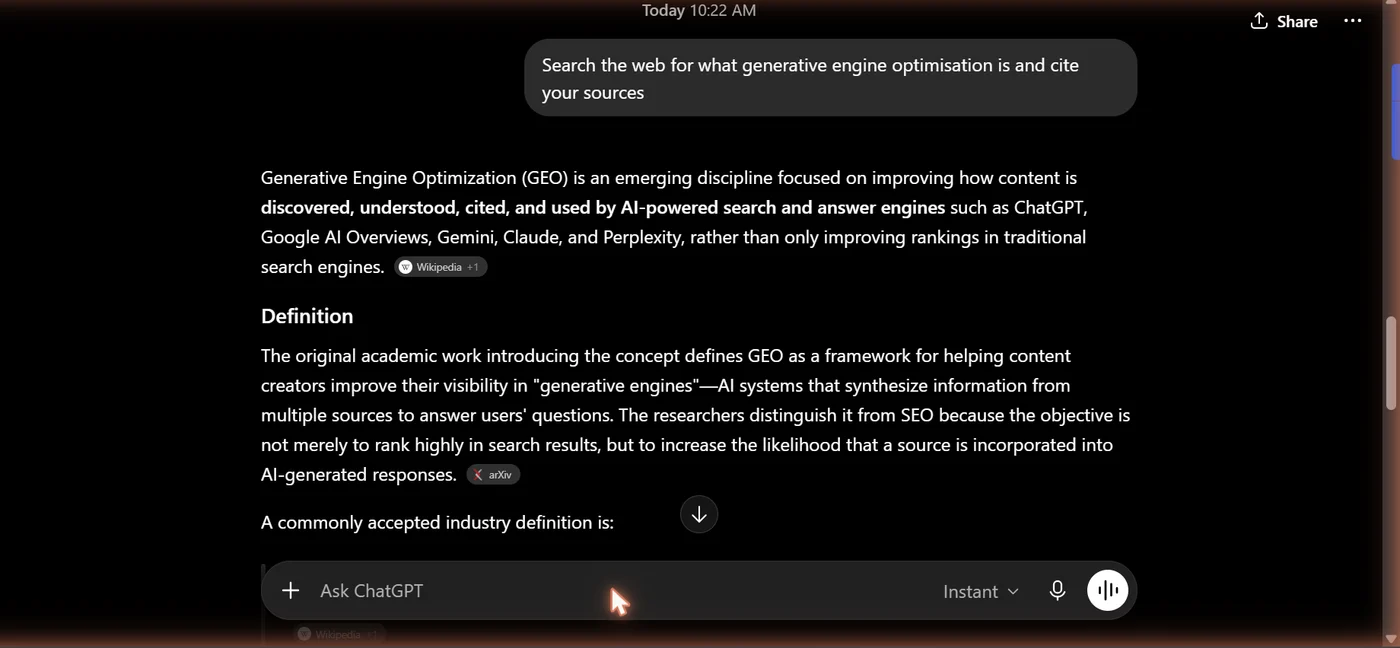
No. AI systems retrieve from the same indexes SEO has spent two decades building, and Google alone still sends dramatically more referral traffic than every AI tool combined. SEO isn’t dying - it’s the entry ticket. The businesses skipping it now will be invisible to Google and ChatGPT within the year.
How AI search engines actually choose sources
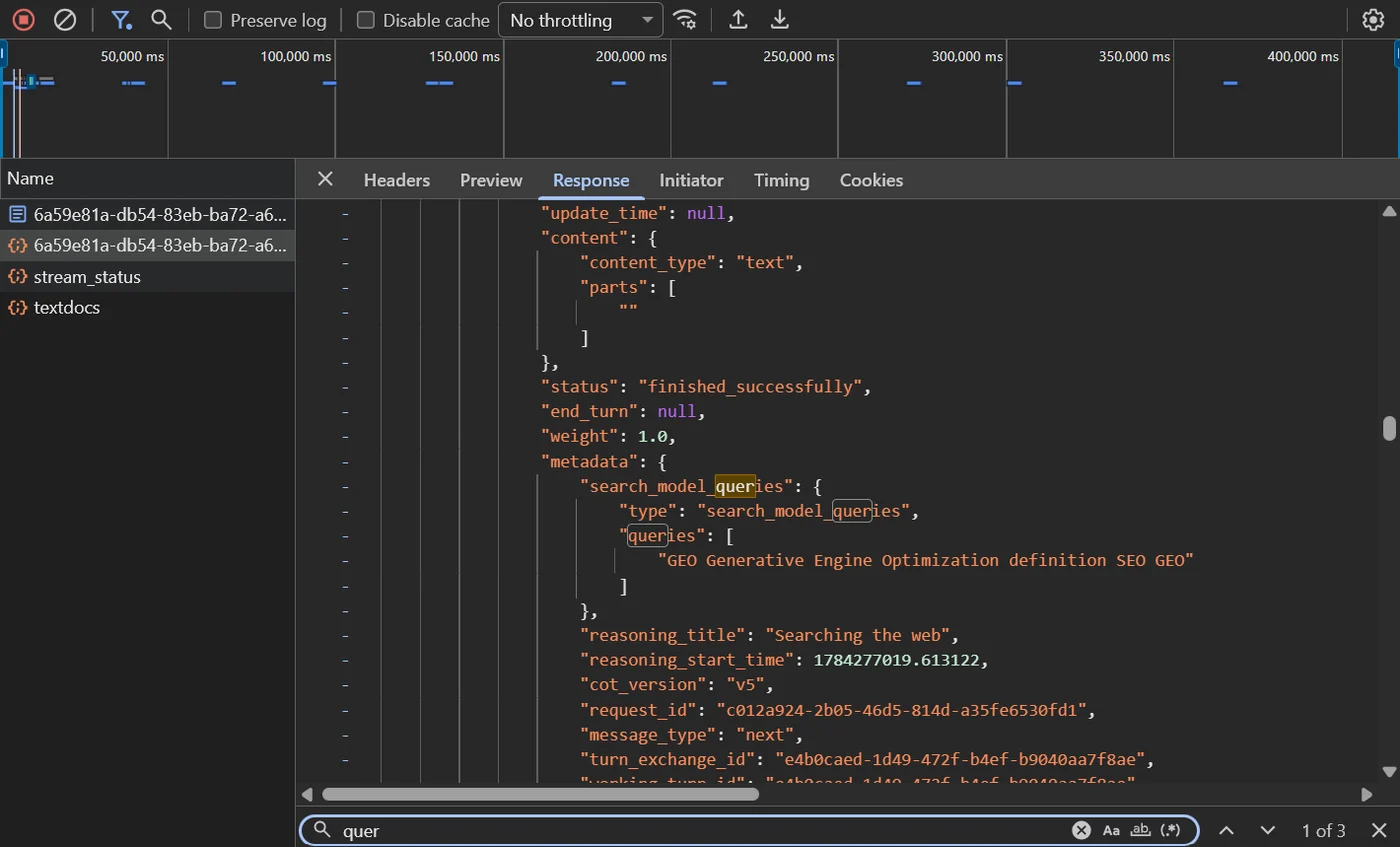
AI systems don’t scan the live internet for every question you ask. They run a multi-step retrieval process: break your question into smaller sub-questions, search a pre-built index for text chunks that match closely in meaning, cross-check those chunks against each other for agreement, then write an answer and drop in citations for whichever chunks it actually used.
RAG and query fan-out, in plain English
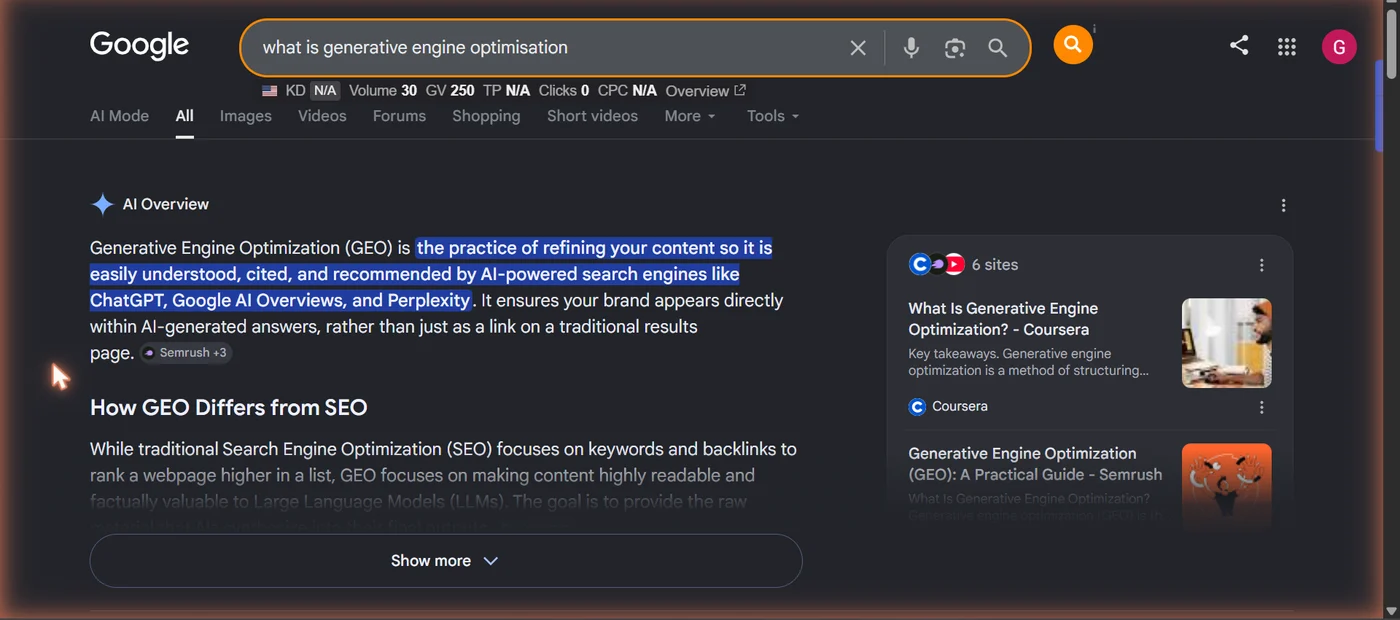
This is called retrieval-augmented generation (RAG), and Google’s own documentation describes a version of it as query fan-out. Picture sending five researchers off with five slightly different versions of your question, then only writing up the parts of their reports that agree with each other and with what’s already been fact-checked. That’s roughly what’s happening, at speed, every time someone asks an AI assistant a question.
Parametric knowledge vs retrieved knowledge
Two things feed an AI answer: what the model learned during training (parametric knowledge - can be stale, and is the reason AI tools occasionally invent URLs that don’t exist), and what it fetches live from the web right now (retrieved knowledge - grounded, and citable). Getting cited depends almost entirely on being retrievable today, not on how well-known you were when the model was trained.
Why AIs lean on Wikipedia, Reddit, YouTube and “best of” lists
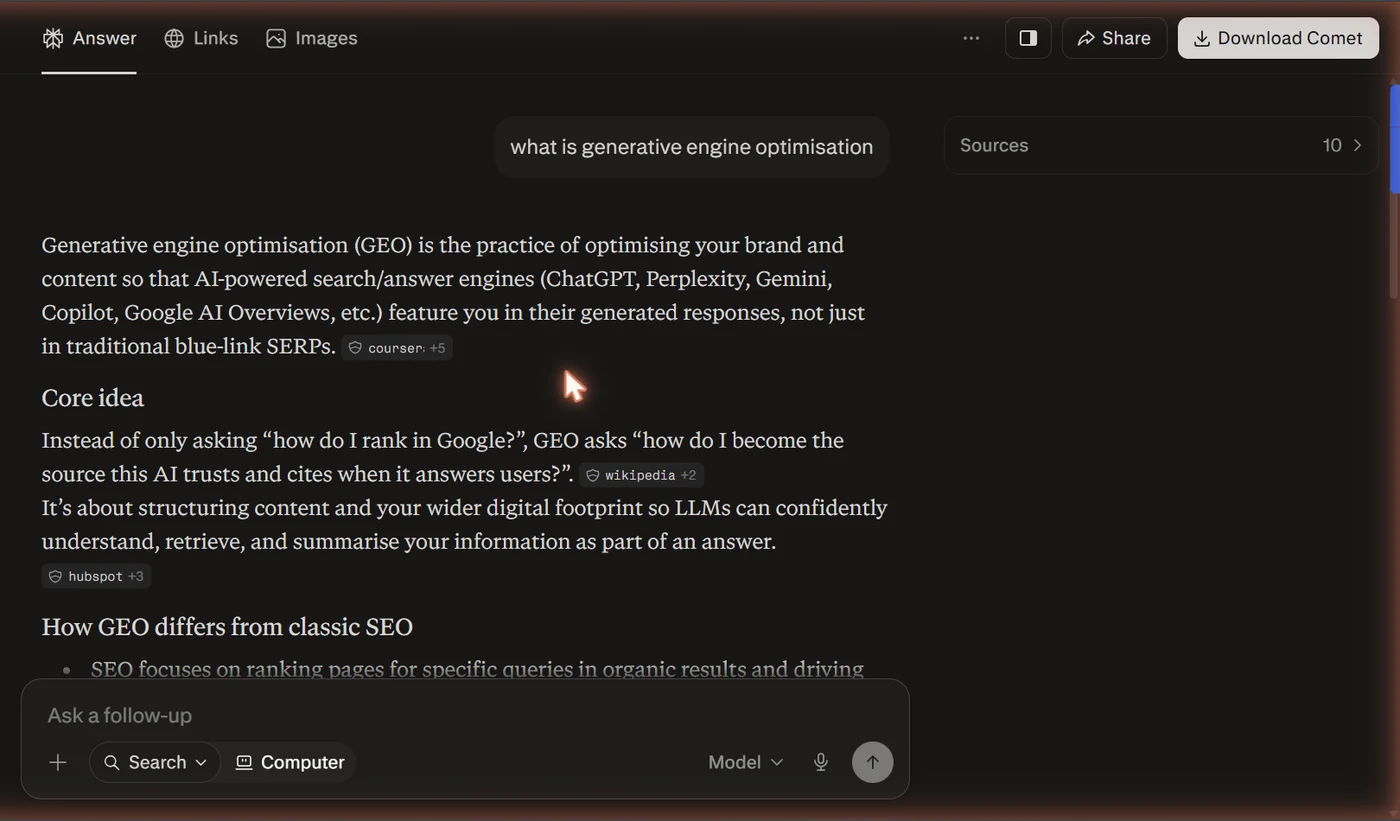
Not because any AI vendor has a stated preference for these sites - because they’re structured as clean, extractable, corroborated facts that survive the retrieval process intact. Surfer SEO’s analysis of 36 million AI Overviews and 46 million citations found YouTube accounts for roughly 23% of citation share and Wikipedia around 18%, with Reddit and LinkedIn close behind.
| Platform | What it retrieves from | What it favours |
|---|---|---|
| Google AI Overviews / AI Mode | Google’s core web index | Structured, snippet-eligible pages; no special AI markup required |
| ChatGPT Search | Bing’s index plus OpenAI’s own crawlers | Crawlable pages, direct answers early in the copy |
| Perplexity | Live, per-query web crawl | Source-dense, citable, fast-loading pages |
| Gemini | Google’s index and Knowledge Graph | Entity consistency across the web |
| Claude | Live web search with inline citations | Verifiable, well-attributed claims |
What actually moves the needle (the evidence)
Four things are backed by real data. Everything else circulating in “GEO tips” content is opinion.
Brand mentions and earned media
Muck Rack’s analysis of AI-cited links found 82% of citations trace back to earned or third-party media, not brand-owned pages - and 94% weren’t paid placements. Ahrefs’ study of 75,000 brands found YouTube mentions correlate more strongly with AI visibility (0.737) than any other factor tested, including domain rating, which correlated at just 0.266-0.326. Your reputation elsewhere on the web now outweighs your own domain’s authority - which is exactly why earned mentions matter more than another owned-domain blog post.
Statistics, quotes and citing sources
Repeating the Princeton findings because they’re the single most actionable data point in this entire field: adding quotations lifted citation rate by 41%, statistics by 37%, and citing outside sources by 30-40%. Vague marketing copy loses to specific, attributed numbers, every time.
Structure and extractability
Write every section so it could be lifted out of the page and still make complete sense on its own - no “as mentioned above,” no pronouns standing in for the subject three paragraphs back. AI systems retrieve passages, not pages. A paragraph that only makes sense in context of the one before it gets skipped. (If your key content only renders after JavaScript runs, most AI crawlers never see it at all - we tested exactly that.)
What probably doesn’t work
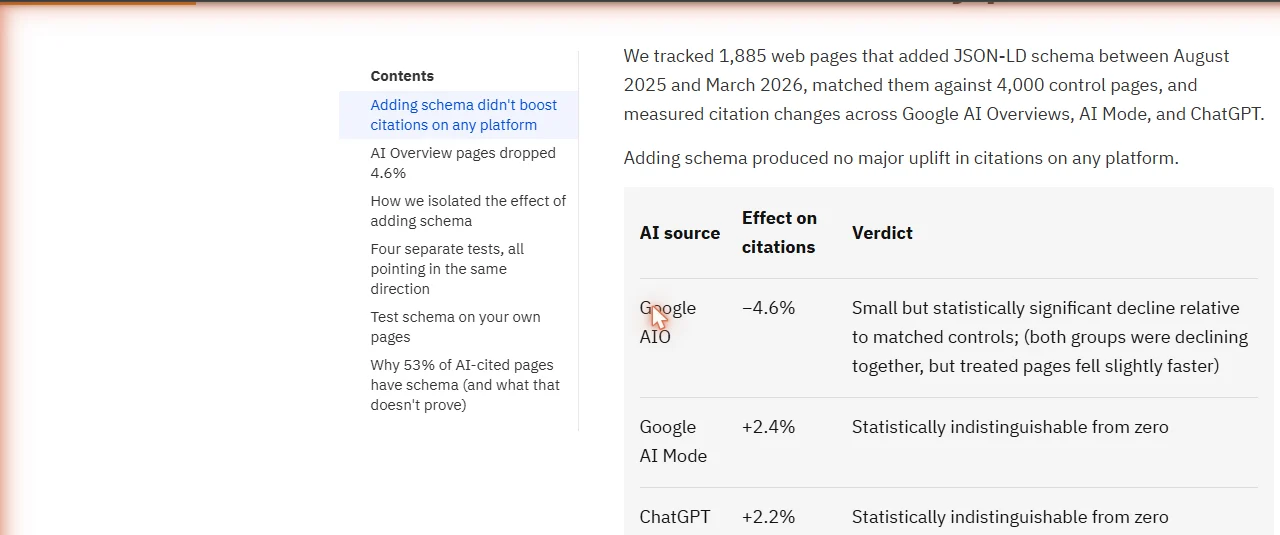
llms.txt. Ahrefs studied 137,000 domains that had published one and found zero requests for it from GPTBot, ClaudeBot or PerplexityBot. Google’s John Mueller compared it directly to the old keywords meta tag - nobody’s using it. Schema markup. A controlled Ahrefs study of 1,885 pages that added JSON-LD schema found Google AI Overview citations fell 4.6% afterwards, with no measurable effect on AI Mode or ChatGPT. Schema is more common on cited pages - correlation, not causation. FAQPage schema specifically is worth keeping for the readable, extractable FAQ block it produces, but Google removed FAQPage rich results from Search entirely as of May 2026 - don’t sell it as a rich-snippet win, because that win no longer exists. Keyword stuffing - the one classic SEO trick that measurably doesn’t transfer. The same Princeton study found it has no positive effect on citation rate.
Is GEO a scam, or does it actually matter?
Both things are true at once: there’s real hype and real scams riding on this term, and there’s a real, evidenced shift underneath it. The job is telling them apart.
The sceptic case
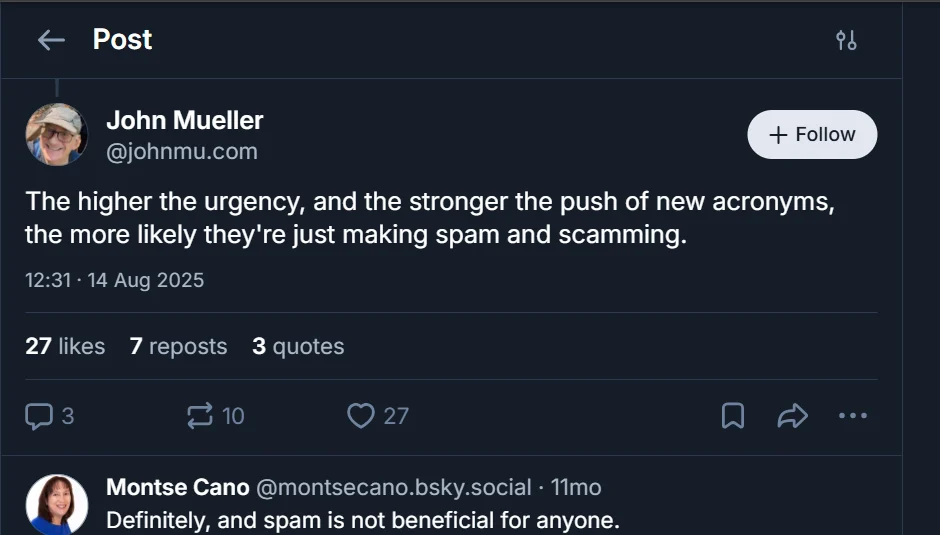
Google’s own documentation is blunt: optimising for its AI features is still SEO, no special schema or AI-only files required. In August 2025, Google’s John Mueller went further on a public post about GEO marketing: “the higher the urgency, and the stronger the push of new acronyms, the more likely they’re just making spam and scamming.” That’s Google’s own webmaster liaison, warning about the exact discipline this article is describing.
Why the underlying shift is real anyway
SparkToro and Similarweb’s clickstream research found 68.01% of US Google searches in the first four months of 2026 ended without a single click - up from 60.45% two years earlier. That’s not hype. That’s a measured, growing share of searches where the answer is delivered and the click never happens. Whoever gets named in that answer wins the interaction. Everyone else doesn’t exist in it.
Check your own data first
Before reallocating budget, check your own GA4 for referral traffic tagged chatgpt.com, perplexity.ai or google.com (AI Overview clicks aren’t separately labelled yet, but AI referral sources increasingly are). If it’s a rounding error today, treat GEO as groundwork, not an emergency. If it’s already moving, treat it as a live channel.
How to do GEO: a practical starter checklist
Technical
- Confirm you’re not blocking OAI-SearchBot, PerplexityBot or ClaudeBot in robots.txt (GPTBot, used for model training rather than search, is the one worth blocking if you don’t want your content used to train future models) - our free AI crawlability checker shows what each bot can and can’t reach
- Ship key content as server-rendered HTML, not client-side-only JavaScript
- Keep core pages indexed, fast and snippet-eligible
Content
- Answer the question in the first sentence of every section, then expand
- Add specific, attributed statistics and quotes - not vague claims
- Write every paragraph so it stands alone out of context
- Name your entities consistently - same brand description, everywhere
Authority
- Prioritise earned mentions (press, YouTube, industry publications, genuine community discussion) over more owned-domain content
- Keep high-value pages genuinely current - freshness is a retrieval signal
Measurement
- Track citation and mention frequency, not “AI rank”
- Set up GA4 tracking for AI-referral UTM sources
- Re-run your target prompts periodically and log what changes
How to measure GEO (and why “AI rank” is mostly baloney)
Measure citation frequency across many prompt variants, not a single ranking position - “AI rank” tools are measuring something that barely holds still long enough to rank. Rand Fishkin (SparkToro) and Patrick O’Donnell (Gumshoe.ai) ran 12 prompts a combined 2,961 times across ChatGPT, Claude and Google AI, using 600 volunteers, and found less than a 1-in-100 chance of getting the same list of recommended brands twice - even asking the identical question, back to back. Fishkin’s own conclusion: “any tool that gives a ‘ranking position in AI’ is full of baloney.” What’s actually measurable: how often you’re mentioned across dozens of prompt variants (citation frequency / share of voice), AI-referral traffic in GA4, branded search volume as a lagging signal people are hearing your name somewhere - and, as of June 2026, Google Search Console’s new Generative AI performance report, which shows how often your pages appear inside AI Overviews and AI Mode (impressions, pages, countries and devices - no clicks or query data yet, and it’s still rolling out site-by-site).
Is GEO worth doing right now? Frequently asked questions
What does GEO stand for? Generative engine optimisation - structuring content and brand presence to be cited inside AI-generated answers.
Is GEO the same as SEO? No, but it depends on SEO working first. AI systems retrieve from the same indexes SEO has always targeted - broken SEO means invisible GEO.
Is GEO replacing SEO? No. Google explicitly frames its AI features as still being SEO. Treat GEO as an additional layer, not a swap.
Is GEO the same as AEO or LLMO? Broadly, yes - competing labels for the same underlying work, with no formal industry consensus on which wins.
How do AI engines decide what to cite? Through retrieval-augmented generation: your question gets split into sub-questions, matched against indexed content, cross-checked, then cited if it was actually used in the answer.
Does schema markup help me get cited by AI? Not proven to. A controlled Ahrefs study found adding schema reduced Google AI Overview citations slightly, with no measurable benefit for ChatGPT or AI Mode.
Does an llms.txt file help? No measurable effect found so far. A 137,000-domain Ahrefs study recorded zero requests for it from the major AI crawlers.
Is GEO a scam? Parts of the market are. The discipline itself is evidenced (peer-reviewed research, large-scale studies). Verify any vendor’s claims against your own analytics before paying for a retainer.
How do I measure GEO success without click data? Citation and mention frequency across many prompt variants, AI-referral traffic in GA4, and branded search volume - not a single “AI rank” number.
Should I block AI crawlers? Generally, no - not if you want AI visibility. Blocking OAI-SearchBot or PerplexityBot removes you from citation eligibility entirely. Blocking GPTBot specifically (training-only) is a separate decision.
Future-proofing your search visibility
GEO is the AI-era extension of SEO done properly: genuinely helpful, evidenced, quotable, and backed by mentions you didn’t write yourself. The brands that treat it as hype will keep losing ground quietly, one un-cited answer at a time. The ones that check their own data, fix the 80% that’s just SEO, and build the 20% that’s genuinely new will be the name AI says out loud.
Free tool · AI Visibility Checker

Does AI already know you exist?
Run your brand through the free AI Visibility Checker to see whether ChatGPT, Gemini, Perplexity and Google AI Overviews can currently cite you - or whether they're naming a competitor instead.
- See which AI engines cite and recommend you
- Covers ChatGPT, Gemini, Claude, Perplexity and Google AI
- Find the prompts where a competitor wins instead
- Free - no account needed
Related articles