

How many UK adults use AI for search?
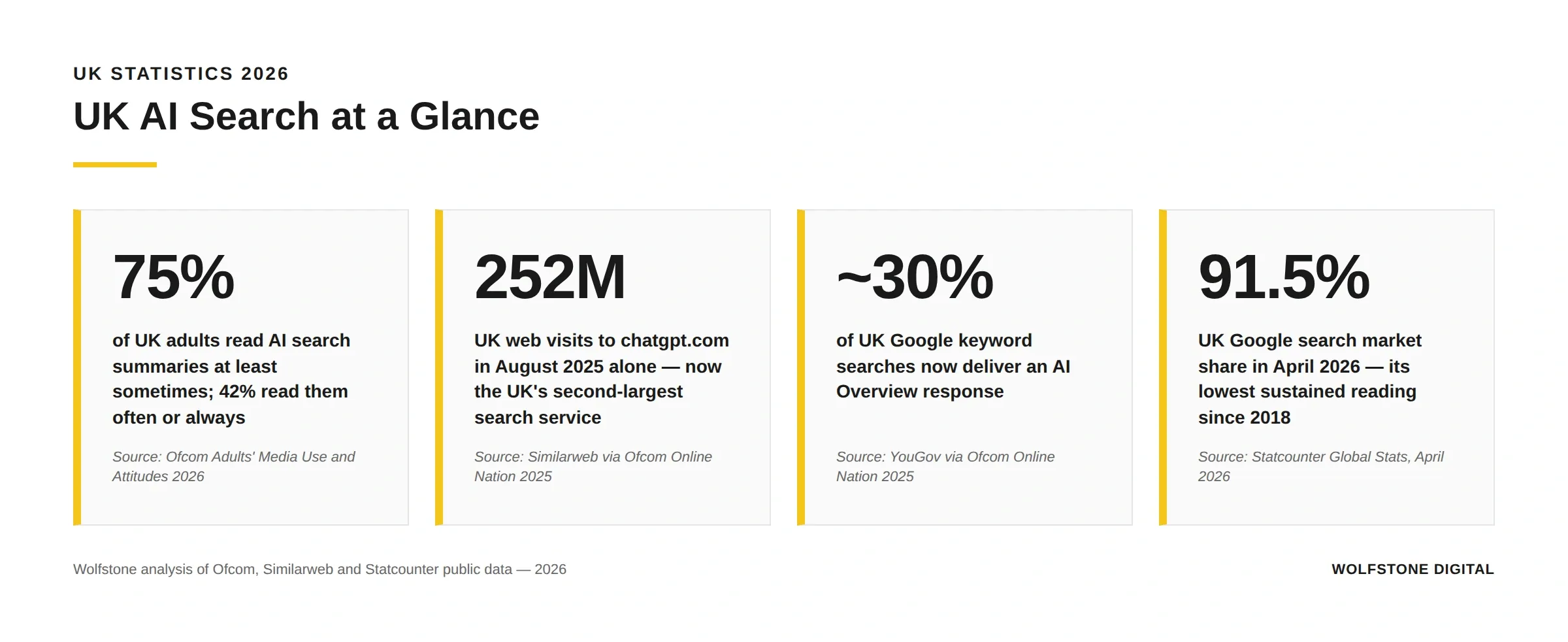
75% of UK adults aged 16+ read AI-generated search summaries at least sometimes, and 42% read them often or always, according to Ofcom's Adults' Media Use and Attitudes 2026 report (fieldwork September–November 2025, sample 7,533). 53% of UK adults say they "often see" AI summaries in their search results - a separate measure from YouGov data published in Ofcom's Online Nation 2025.
Three different things are being measured here, and they need to be kept apart on the page. "Reading AI search summaries" is passive exposure to Google AI Overviews and similar features. "Using ChatGPT to find information" is an active substitution behaviour. "Using AI for news" is a narrower information-seeking task. The Reuters Institute Digital News Report 2025 puts UK weekly AI chatbot use specifically for news at just 3% - among the lowest in the 48-market sample.
AI search reach is heavily age-skewed. Among UK 16–24-year-olds, 62% read AI search summaries; among 25–34s, 60%. Even among UK adults who have not used an AI chatbot, more than half encounter AI search summaries in the normal course of using Google.
AI-native search services are growing faster than any traditional engine
Year-on-year UK web-visit growth across the major AI search services dwarfs anything seen in conventional search. In the year to August 2025, UK web visits grew 156% to ChatGPT, 146% to Gemini, 138% to Claude, and 100% to Perplexity. By comparison, Brave Search - the highest-growth conventional engine - grew 37% over the same period. Google's UK volume was approximately flat.
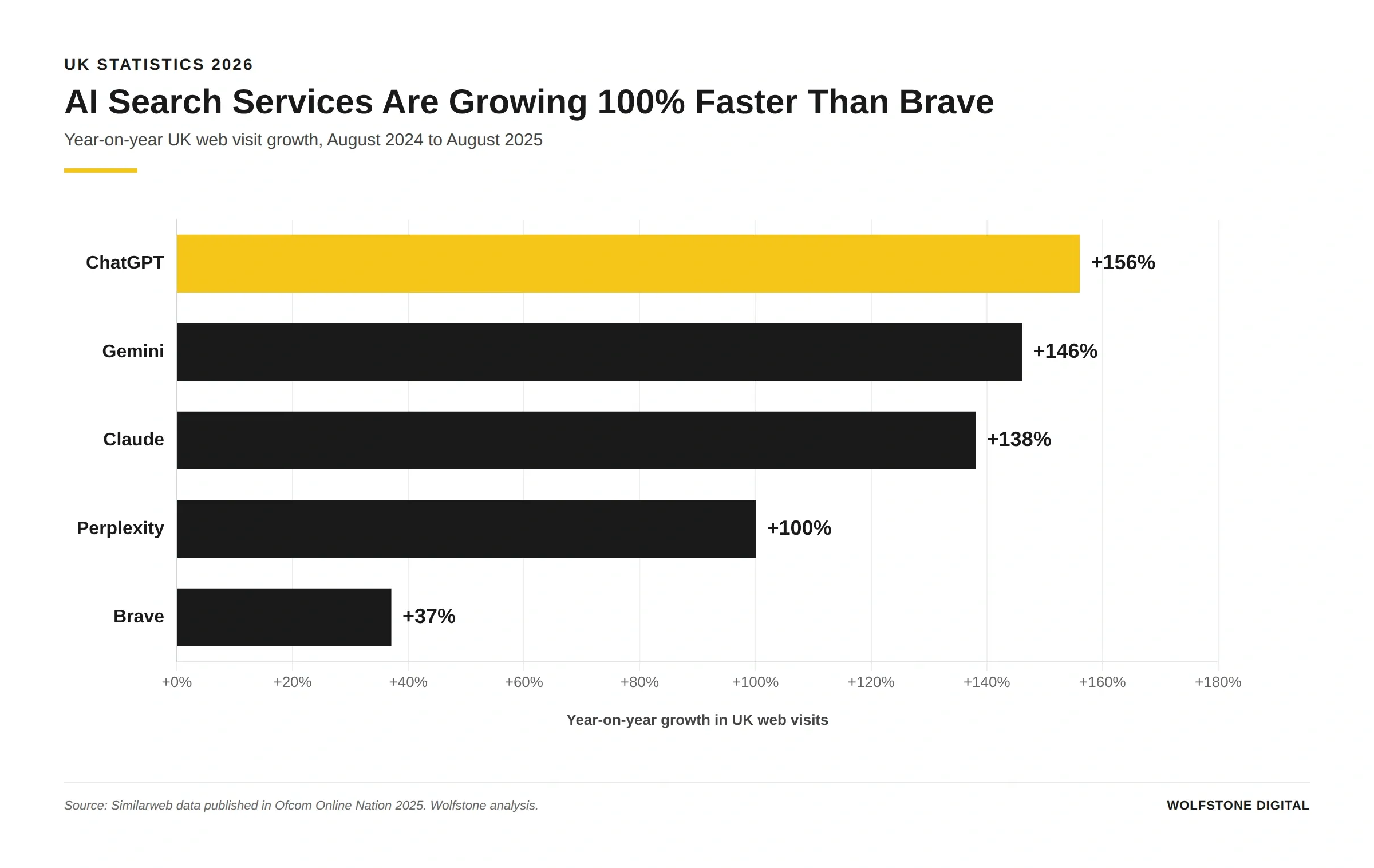
Year-on-year UK web-visit growth, AI services vs Brave Search, Aug 2024 to Aug 2025.
Similarweb data published in Ofcom Online Nation 2025.
In absolute terms ChatGPT remains in a category of its own. Ofcom's Online Nation 2025 records 252 million UK chatgpt.com visits in August 2025 alone, against estimated UK Google search query volume of around 3 billion per month. For the detailed reach picture see our ChatGPT-specific UK reach data. The CMA's SMS final decision adds an important nuance: AI assistant queries rose from 0–5% of Google Search query volume in December 2024 to 10–15% by June 2025 - but search-grounded AI queries specifically (i.e. AI used to retrieve answers from the open web) remained at 0–5% of Google's query volume. Most AI use today is conversational, not yet purely substitutive of Google search.
| Search engine | UK market share | 12-month change |
|---|---|---|
| 91.47% | Down from 93.35% (Aug 2025) | |
| Bing | 5.88% | Up from ~4% (Aug 2025) |
| Yahoo! | 1.37% | Stable |
| DuckDuckGo | 0.65% | Stable |
| Ecosia | 0.30% | Stable |
| Yandex | 0.28% | Stable |
When did Google AI Overviews and AI Mode launch in the UK?
Google AI Overviews launched in the UK on 15 August 2024, alongside India, Japan, Indonesia, Mexico and Brazil. By 28 October 2024 Google reported AI Overviews had expanded to more than 100 countries with over 1 billion monthly users globally. Google AI Mode - the standalone, conversational AI search experience - launched in the UK on 28–29 July 2025, four months behind India and three months behind the United States.
AI Overview coverage of UK keyword searches now sits at approximately 30% according to YouGov data published in Ofcom's Online Nation 2025, with up to 34% of non-branded UK searches showing an AI Overview. AI Mode adoption remains nascent: Google has cited around 75 million users globally and 1.25% of total search sessions worldwide. UK-specific AI Mode usage has not been disclosed.
UK publisher click-through rates halve when AI Overviews are present
The clearest UK-sample evidence of AI Overviews' commercial impact comes from Authoritas, the UK SEO analytics firm. Sampling 3,500 UK news keywords during 16–22 April 2025, Authoritas found that publisher click-through rates fell 47.5% on desktop and 37.7% on mobile when an AI Overview was present. The study has been submitted as evidence to the Competition and Markets Authority's investigation into Google's search services.
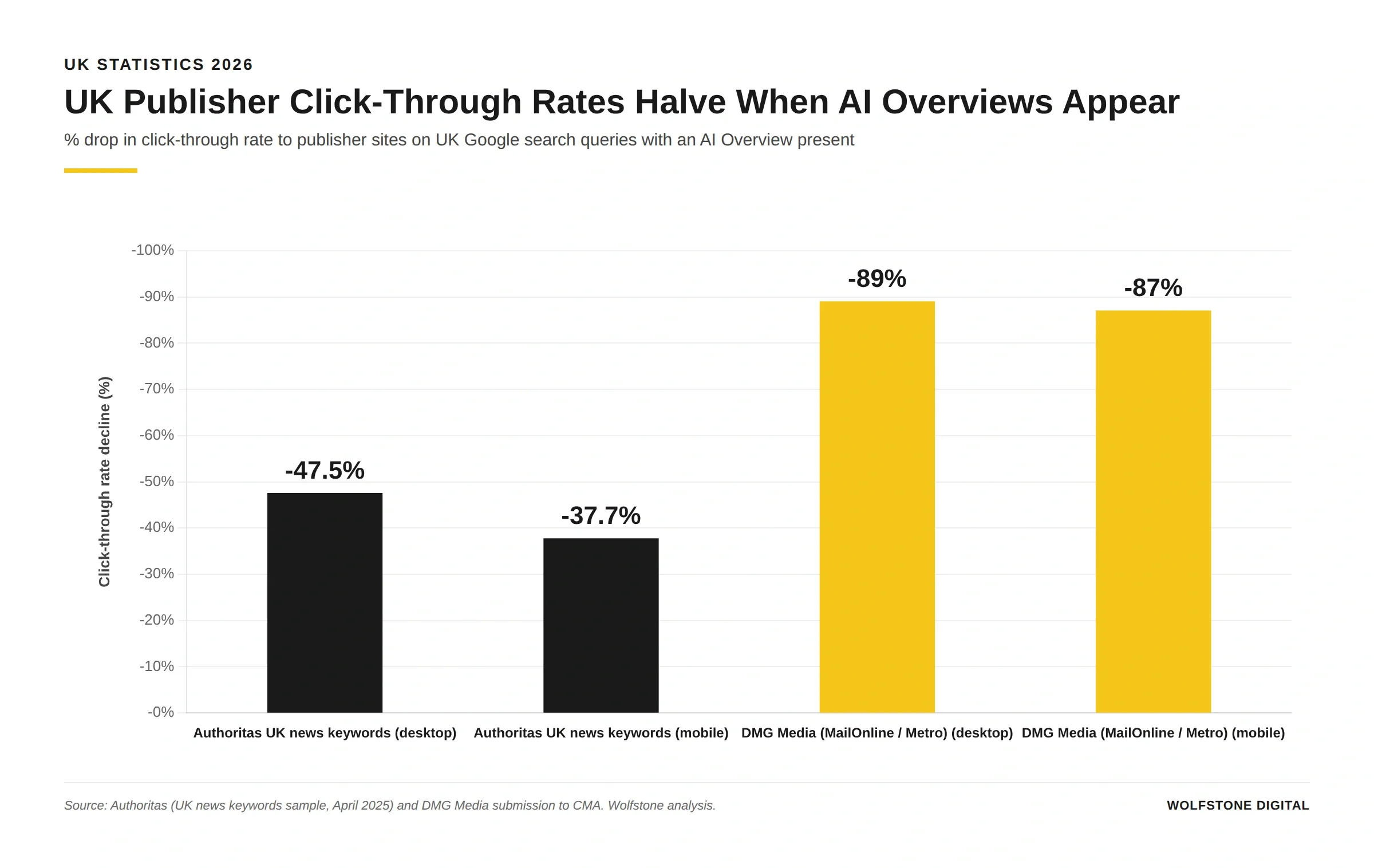
UK publisher CTR drops when AI Overviews are present.
Authoritas (3,500 UK news keyword sample, April 2025, submitted to CMA); DMG Media submission to CMA.
Worst-case publisher impact runs higher still. DMG Media - publisher of the Daily Mail, MailOnline and Metro - told the CMA its desktop CTR on AI-Overview-affected queries collapsed from 25.2% to 2.8%, an 89% reduction. Mobile fell 87%. Speaking at the Press Gazette Future of Media Technology Conference in September 2025, DMG Media's SEO director Carly Steven said 11% of mobile and 12% of desktop "most valuable" Mail keywords now showed an AI Overview - and that the equivalent figure in the United States was already 18–20%, suggesting where the UK is heading.
| Publisher / sample | CTR change | Scope |
|---|---|---|
| Authoritas (3,500 UK news keywords, desktop) | −47.5% | UK |
| Authoritas (3,500 UK news keywords, mobile) | −37.7% | UK |
| DMG Media (MailOnline / Metro, desktop) | −89% (25.2% → 2.8%) | UK |
| DMG Media (MailOnline / Metro, mobile) | −87% | UK |
| MailOnline (Foxglove research) | Desktop −56% / mobile −48% | UK |
| Authoritas worst-case (top-ranked link below AIO) | Up to −79% | UK / The Guardian |
| Pew Research (organic CTR with vs without AIO) | ~50% lower | US - proxy |
| Pew Research (clicks on AIO citations) | 1% click-through | US - proxy |
How has the decline in publisher traffic from Google played out?
In the year to November 2025, Google search traffic to publishers worldwide fell roughly a third, according to Chartbeat data published in the Reuters Institute's Journalism, Media and Technology Trends and Predictions 2026 report. The decline was 38% in the United States and 17% in Europe - the UK sits within that European average without a country-specific figure being publicly disclosed.
Two effects compound on the underlying CTR drop. First, AI Overviews push traditional organic results below the fold: independent SEO analysis suggests AIOs now occupy 42% of desktop screen real estate and 48% on mobile when present (US sample, treat as proxy). Second, Google Discover - Google's feed-based recommendation surface, not appearing in classical search results - has become the dominant referral surface for UK news. Chartbeat data published by Press Gazette puts Discover at 68% of all Google publisher referrals and 17% of total publisher traffic, against 8% from traditional search. Discover referrals were themselves down 21% year-on-year to November 2025.
AI platforms' direct contribution to UK publisher traffic remains tiny - collectively around 1% of all publisher traffic in late 2025, per Conductor data cited in industry reporting. ChatGPT outbound referrals to publishers globally totalled 1.2 billion in September–November 2025, up 52% year-on-year (Similarweb via Digiday) - but the absolute figure is still less than 1% of what Google sends in a normal week.
Why are UK adults so cautious about AI in news?
The UK is an outlier on AI news scepticism. The Reuters Institute Digital News Report 2025 found that just 3% of UK adults use AI chatbots weekly to access news, against a global average of 7% and 18% in India. UK comfort with AI-generated news (with human oversight) sits at 11%, the second-lowest in the 48-country survey. Only 25% of UK respondents in the Generative AI and News follow-up believed journalists "always" or "often" check AI outputs before publishing - the lowest of the six countries surveyed (UK, US, Argentina, Denmark, France, Japan).
Despite the scepticism, exposure is high: 64% of UK respondents said they had encountered AI-generated answers in the previous week - second only to Argentina at 70% and ahead of the US at 61%. The picture, then, is of a UK public that increasingly sees AI search summaries but actively distrusts them, particularly for news. That gap is structural rather than transitional, and it shapes how UK publishers should plan for the next two years of AI search rollout.
How is the UK regulating AI search?
On 10 October 2025 the Competition and Markets Authority designated Google with Strategic Market Status (SMS) for general search and search advertising under the Digital Markets, Competition and Consumers Act 2024. The 156-page final decision drew evidence from more than 80 stakeholders and 34 consultation responses. The five-year designation explicitly captures AI Overviews and AI Mode within Google Search infrastructure - but excludes the standalone Gemini AI assistant, which the CMA classified as accessed through dedicated interfaces and monetised through subscription rather than search advertising.
On 28 January 2026 the CMA opened a consultation on four proposed Conduct Requirements (the consultation closed 25 February 2026). The Publisher CR is the most directly relevant for UK media: it would allow publishers to opt out of AI Overviews and AI Mode grounding (and broader generative-AI training) without losing organic search visibility, and would require Google to provide transparency on how content is used, attribution and engagement metrics. The other three CRs cover fair ranking, user choice, and data portability.
The News Media Association (NMA) "strongly welcomed" the Publisher CR but called for full physical separation of crawlers between Search and individual AI products. The PPA called the proposals "a major step forward" while warning the wider value-exchange question remains unresolved. The Information Commissioner's Office, in its February 2025 response to the UK Government's AI and Copyright consultation, separately called for technical measures allowing publishers to discriminate between web crawlers by purpose - a position aligned with the CMA's eventual Publisher CR.
What the UK AI search data tells us about where SEO is heading
Three structural shifts are now visible in the UK AI search data, and each requires a separate response from any UK brand or publisher dependent on Google search referrals. First, AI Overview coverage of around 30% of UK keyword searches and 53% of UK adults seeing them often means generative search is no longer an emerging behaviour - it is the dominant feature of the modern UK SERP. Second, the publisher CTR collapse (47.5% desktop, 37.7% mobile in the Authoritas sample) means a top-ranked organic position no longer protects traffic the way it did in 2023. Third, the CMA's Publisher Conduct Requirement, if enforced as drafted, will give UK publishers a unilateral right to opt out of AI Overview grounding without losing search visibility - a regulatory remedy unmatched anywhere else in the world.
For UK SEO and content teams, the practical implication is that ranking on Google is now necessary but no longer sufficient. To earn a citation in an AI Overview, in ChatGPT search, in Perplexity, or in Google AI Mode, content has to be parseable into a snackable, source-cited statement that an LLM can extract.
This is the case Wolfstone makes for generative engine optimisation (GEO) - the underlying shift the data on this page describes, and the work that turns a well-ranked organic result into an AI-cited one.
Wolfstone analysis: UK publisher AI search exposure index
No public source has published a single figure for how much of a UK publisher's expected click-through is structurally exposed to AI Overviews. Wolfstone derives one by chaining three Tier-1 to Tier-4 figures: Statcounter's Google UK share, YouGov / Ofcom's estimate of AI Overview coverage, and the Authoritas UK CTR drop sample. The result: an estimated 11.0% structural reduction in UK publisher click-through across all UK Google search queries, before any additional substitution effects from ChatGPT, Perplexity, Gemini or Claude.
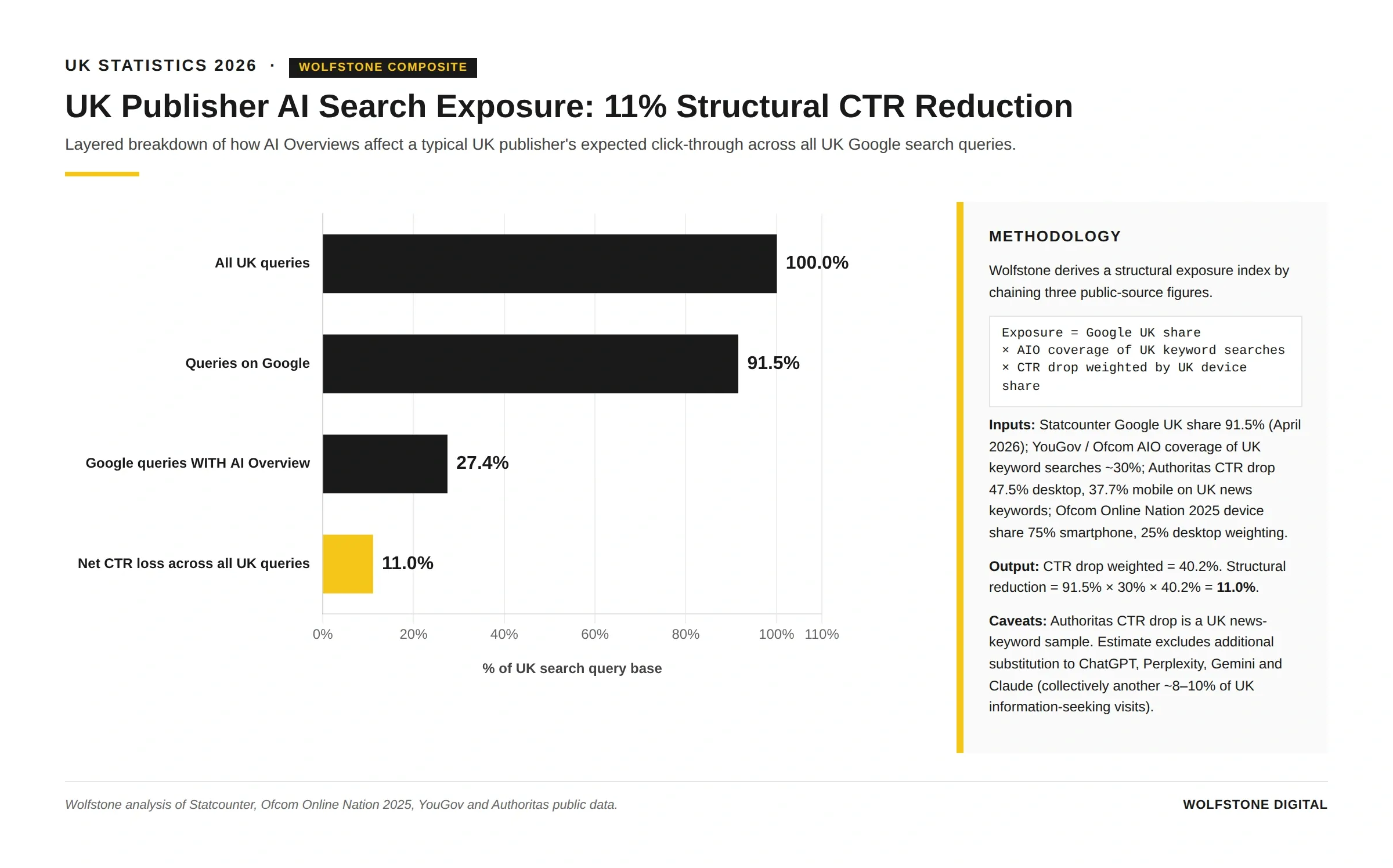
Wolfstone composite: 11% structural UK publisher CTR loss from AI Overview presence alone.
Wolfstone analysis of Statcounter, Ofcom Online Nation 2025, YouGov and Authoritas public data.
Methodology
Inputs: Statcounter Global Stats - Google UK search market share 91.47% (April 2026, all platforms). YouGov via Ofcom Online Nation 2025 - AI Overview coverage of UK keyword searches approximately 30%. Authoritas UK news keyword study - CTR drop 47.5% on desktop and 37.7% on mobile when an AI Overview is present (3,500-keyword sample, fieldwork 16–22 April 2025). Ofcom Online Nation 2025 - UK device split, 75% smartphone and 25% desktop weighting for online time.
Formula: Exposure = Google UK search share × AI Overview coverage of UK keyword searches × CTR drop weighted by UK device share. CTR drop weighted = (75% × 37.7%) + (25% × 47.5%) = 40.15%. Exposure = 91.47% × 30% × 40.15% = approximately 11.0%.
Output: Across all UK Google search queries, the typical UK publisher experiences a structural 11% reduction in expected click-through purely from AI Overview presence. This is a single-cause estimate. Real-world publisher referral declines (e.g. the 17% European Chartbeat figure) include additional effects from AI Mode rollout, Discover volatility, and substitution to AI-native services.
Limitations: Authoritas CTR drop is a UK news-keyword sample and may not generalise to commercial, transactional, or YMYL queries where AIO behaviour differs. Statcounter is referrer-based and underestimates AI-native chat substitution. The estimate excludes additional substitution to ChatGPT, Perplexity, Gemini, Claude and Copilot, collectively another 8–10% of UK information-seeking visit volume by Wolfstone's estimate. Treat the 11% figure as a lower-bound for AI search exposure.