

What are the UK search engine market share numbers in 2026?
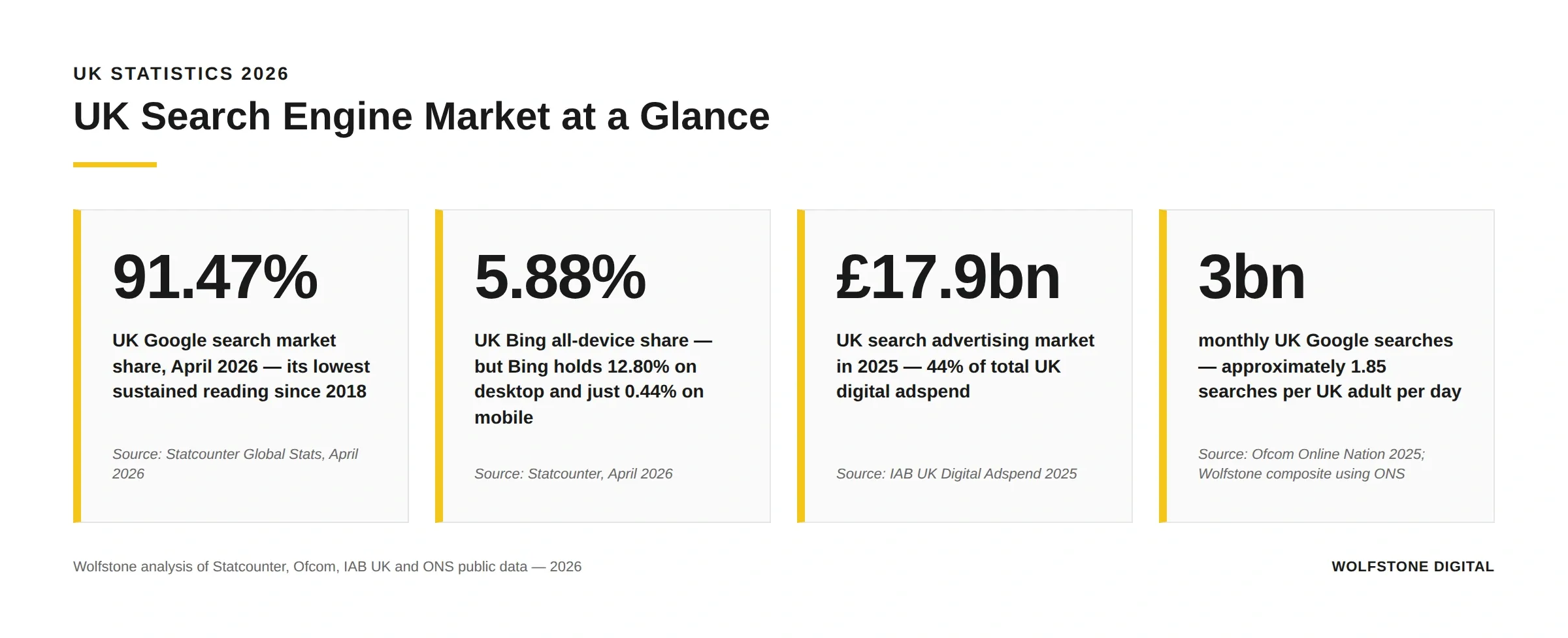
Google holds 91.47% of UK search referrals across all platforms in April 2026 according to Statcounter Global Stats. Bing is second at 5.88%, followed by Yahoo! at 1.37%, DuckDuckGo at 0.65%, Ecosia at 0.30% and Yandex at 0.28%. Together, the long tail of non-Google engines accounts for 8.53% of UK search referrals - the highest non-Google share in the UK since at least 2018.
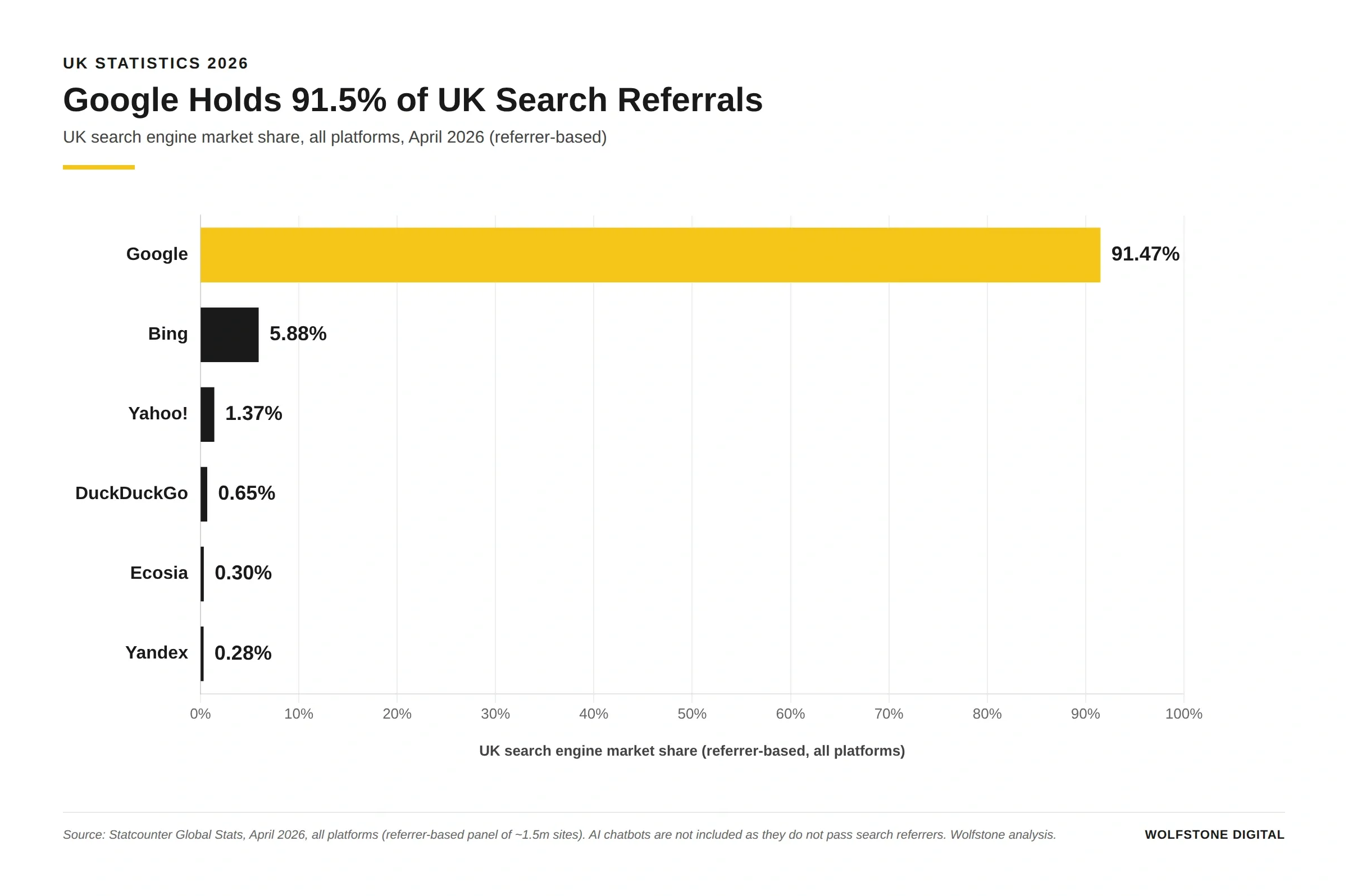
UK search engine market share, all platforms, April 2026.
Statcounter Global Stats UK, all platforms, April 2026.
The methodology matters. Statcounter measures referrer-based share - when a user clicks from a search engine to a tracked website. AI-native chat services like ChatGPT, Perplexity, Gemini and Claude do not appear in this data because their answers usually do not produce a referring click. Ofcom's Online Nation 2025 separately ranks ChatGPT as the UK's "second-largest search service" by visit volume (252 million UK web visits in August 2025 alone), but that is a visit-based, not referrer-based, metric. See our ChatGPT-specific UK reach data for the visit-based picture. The two figures measure different things and should not be added together.
| Search engine | All platforms | Desktop | Mobile |
|---|---|---|---|
| 91.47% | 82.51% | 97.76% | |
| Bing | 5.88% | 12.80% | 0.44% |
| Yahoo! | 1.37% | 2.90% | 0.62% |
| DuckDuckGo | 0.65% | 0.91% | 0.55% |
| Ecosia | 0.30% | 0.39% | 0.28% |
| Yandex | 0.28% | 0.27% | 0.29% |
Why does Bing's UK market share look so different on desktop?
Bing's 12.80% UK desktop share versus its 0.44% mobile share is the largest device platform gap of any major UK search engine. The structural reason is straightforward: Bing is the default search engine on Microsoft Edge, which ships with Windows, while Google Search is the default on Android, iOS Safari, Google Chrome and Apple's Spotlight search. Most UK desktop users sit in front of a Windows PC at work; most UK mobile users sit on an iOS or Android device with a non-Bing default.
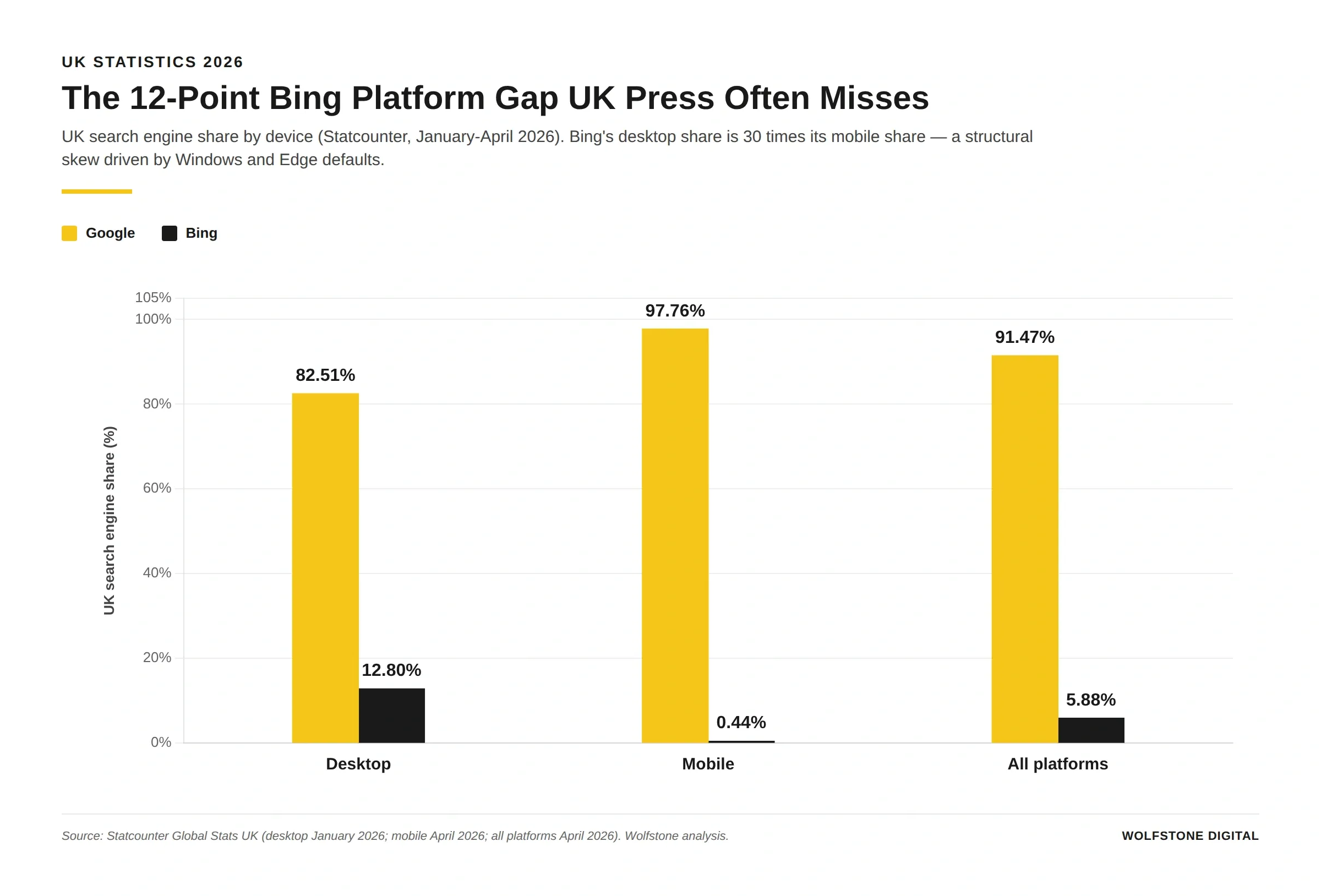
Google vs Bing UK share across device platforms, 2026.
Statcounter Global Stats UK; desktop January 2026, mobile and all platforms April 2026.
This is the single most-misreported UK search statistic in the press. Headlines that say "Bing has 13% UK share" almost always mean desktop only, but rarely specify the device basis. The correct reading is: 12.80% on desktop, 0.44% on mobile, 5.88% averaged across all platforms. Bing also leads outright on console - driven by Xbox and Microsoft Edge defaults - but UK-specific console data is sparse.
The desktop story has been quietly improving for Microsoft since the launch of Bing Chat in 2023 and the Copilot integration that followed. Microsoft's search and news advertising revenue (excluding traffic acquisition costs) reached $13.9 billion globally in fiscal year 2025, up 21% year-on-year - the highest growth rate in three years. In the first quarter of fiscal year 2026 Microsoft confirmed Bing reached 1 billion monthly active users for the first time, and Microsoft Edge has gained browser market share for 20 consecutive quarters. The Bing UK desktop share has risen from roughly 9–10% pre-Copilot in early 2023 to 12.80% in January 2026.
Is Google's UK market share falling?
Yes, slowly but measurably. Google's UK all-platforms share has fallen from a peak around 93.6% in early 2024 to 91.47% in April 2026. That is roughly 0.91 percentage points per year - a structural break from the 13 years to 2022, during which UK Google share held steady in the 92–94% band. Two forces are pushing the trajectory: gradual desktop erosion to Bing (boosted by Copilot integration) and AI search disruption from ChatGPT and other AI-native services that do not show up in Statcounter's referrer data but reduce the underlying volume of conventional Google searches.
The CMA's October 2025 Strategic Market Status decision is a third structural force that is not yet reflected in the data. The five-year designation runs to October 2030 and gives the CMA the power to impose conduct requirements on Google including default-search choice screens, fair-ranking rules and publisher fair-dealing obligations. The conduct requirement consultation closed in February 2026 and any remedies are likely to take effect from late 2026 onwards, with measurable impact on share data probably arriving in 2027.
How does the UK compare to other major Google markets?
The UK is consistently among the highest-Google-share large economies. UK Google share at 91.47% sits between France (around 91%) and Germany (around 89–93%), well above the United States (around 84–85%) and below India (around 97%). The Wolfstone composite UK Google over-index is +1.43 percentage points versus the global average of 90.04%. The US is the outlier on the low side - UK Google share runs roughly 6–7 percentage points above US share, reflecting the structurally weaker presence of Bing alternatives in the UK B2C market versus the US.
| Country | Google all-device share | Source month |
|---|---|---|
| India | ~97.18% | Jan 2026 |
| France | ~91% | Mar 2026 |
| United Kingdom | 91.47% | Apr 2026 |
| Australia | ~92% | Mar 2026 |
| Germany | ~89–93% | Jan–Mar 2026 (varies) |
| Worldwide | ~90.04% | Jan 2026 |
| United States | ~84–85% | Jan–Mar 2026 |
What do Statcounter, Ofcom, the CMA and Similarweb actually measure?
Four major sources publish "UK search market share" figures and they all measure different things. Statcounter is referrer-based - it counts clicks from search engines into a tracked panel of approximately 1.5 million sites. Similarweb (used by Ofcom Online Nation) is panel and clickstream-based - it counts visits to the search engine domain. The CMA's SMS decision is survey and filings-based - it draws on Google's own usage statistics submitted as evidence, plus consumer surveys. IAB UK's Digital Adspend is revenue-based - it counts UK digital advertising spend by channel.
These methodologies do not align. AI chatbots show up in Similarweb visit data (because they receive UK web visits) but barely register in Statcounter referrer data (because they generate few referring clicks). The CMA's "more than 90%" UK Google share figure draws on Google's own filings rather than Statcounter or Similarweb directly. IAB UK figures measure ad-revenue share, which heavily favours Google because Google's UK CPC is reportedly 30–40% higher than Bing's like-for-like. When citing UK search market share figures, always state which source and which methodology - the answer to "what is Bing's UK share" depends entirely on which dataset you use.
| Source | Basis | What it measures | AI chatbots included? |
|---|---|---|---|
| Statcounter | Referrer (page-views) | Clicks out of search engines into tracked sites | No (no referrer header) |
| Similarweb / Ofcom | Panel + clickstream | Visits to search engine domain | Yes (counted as visits) |
| CMA / Ofcom survey | Survey-based | Self-reported usage in past week or month | Sometimes (depends on survey) |
| IAB UK / WARC | Ad-revenue-based | Share of UK search-ad spend | Partial (Bing AI Copilot ads only) |
The UK search engine long tail: DuckDuckGo, Ecosia, Brave and Yandex
Below the Google–Bing–Yahoo top three, four services account for the rest of measured UK search referrals. DuckDuckGo holds 0.65% of UK all-platform share but reaches 0.91% on desktop. The privacy-focused engine handles approximately 3 billion monthly searches globally, with the UK as the third-largest source country (after the US at around 53% of global DuckDuckGo traffic and Germany at around 8%). DuckDuckGo's own choice-screen study (cited in the CMA's Mobile Ecosystems Market Study) found that introducing a four-option default search menu on Android increased DuckDuckGo's UK mobile share by 1,180% - a key empirical anchor for the CMA's interest in default-screen interventions.
Ecosia, the Berlin-based not-for-profit search engine that uses ad revenue to plant trees, holds 0.30% UK share. Ecosia is structurally Bing-syndicated for most queries (with a partial Qwant European Search Perspective index added in August 2025). The company reported €43.2 million revenue and around 20 million global active users in 2025, and had planted approximately 250 million trees globally by April 2026. Ecosia's UK partnership with the NHS, established in 2020, reportedly funded around 1 million UK-planted trees by September 2025.
Brave Search does not appear in Statcounter UK referrer data because Brave's privacy-by-design defaults prevent referrer headers being passed through reliably. Brave reported 1.6 billion monthly searches globally in September 2025 - approximately 50 million daily queries - with the Brave browser at 100 million-plus monthly active users. Ofcom Online Nation 2025 separately notes Brave UK web visits grew 37% year-on-year in the year to August 2025, from a small base.
Yandex holds 0.28% UK share. The Russian-origin engine's UK share has structurally declined since the February 2022 invasion of Ukraine and the July 2024 sale of Russian assets. Yandex's Dutch parent became Nebius Group; the Russian Yandex business was sold to Russian investors for around $5.3 billion. Yandex remains structurally tied to Russian-language users; UK share is largely Russian-speaking residents and is below mainstream-engine relevance.
What determines default search engine settings on UK devices?
UK search defaults are determined by the device and operating system combination. Google Search is the default on iOS Safari, Android (across Pixel, Samsung, Xiaomi and other major OEMs), and Google Chrome. Bing is the default on Microsoft Edge, which ships with Windows. The Apple–Google deal is the largest single distribution payment in technology: US Department of Justice antitrust documents unsealed in May 2024 confirmed Google paid Apple approximately $20 billion in 2022 for Safari default placement globally - equivalent to around 36% of search-ad revenue from Safari traffic.
The CMA's 2022 Mobile Ecosystems Market Study described this default arrangement as "a significant obstacle to growth and entry" for rival search engines. The CMA's October 2025 Strategic Market Status designation of Google's search business, plus the separate SMS designations of Apple's and Google's mobile platforms (22 October 2025), opens the regulatory door to potential UK choice-screen interventions during the 2026–2030 designation period. DuckDuckGo's own evidence - that a four-option choice screen lifted its UK mobile share by 1,180% - suggests such interventions could materially reshape the market.
What the UK search engine market share data tells us about SEO strategy
For UK SEO and digital marketing teams, the 91.47% Google share figure is both reassuring and misleading. Reassuring because Google still dominates UK search referrals to a degree unmatched in any major Western economy except France. Misleading because it understates two structural shifts: AI search behaviour change (covered on our AI search page) and the steady accumulation of Bing share on desktop, which now matters for any UK B2B campaign whose audience reaches Bing through Windows and Edge defaults.
The practical implication is that UK search marketing now has three distinct workstreams. First, classical Google SEO - still the highest-volume traffic channel by an order of magnitude, but with click-through rates structurally compressed by AI Overviews.
Second, Microsoft Advertising and Bing SEO - meaningful for desktop B2B audiences and increasingly for AI Copilot citation visibility, particularly given Bing's 12.80% UK desktop share and the steady accumulation of Microsoft Edge usage.
Third, AI search optimisation, or GEO - earning citations in ChatGPT, Perplexity, Gemini and Claude responses. The AI search disruption is covered in detail on the companion page; this page provides the conventional-search denominator that lets UK businesses size each workstream.
For wider context see the wider state of UK AI tool adoption.
Wolfstone analysis: UK Google share trajectory and linear projection
No public source has published a single UK Google share decline rate. Wolfstone derives one by chaining Statcounter's monthly UK time-series from January 2024 (93.51%) through August 2025 (93.35%) to April 2026 (91.47%). The annualised decline rate is approximately 0.91 percentage points per year. Linear projection at the same rate would put UK Google share at 90.6% by April 2027 and 89.7% by April 2028 - but this is a directional estimate, not a forecast: the 2009–2022 UK Google share was essentially flat, the recent decline is a structural break, and the CMA's conduct-requirement consultation plus AI search disruption are non-linear forces that could bend the curve in either direction.
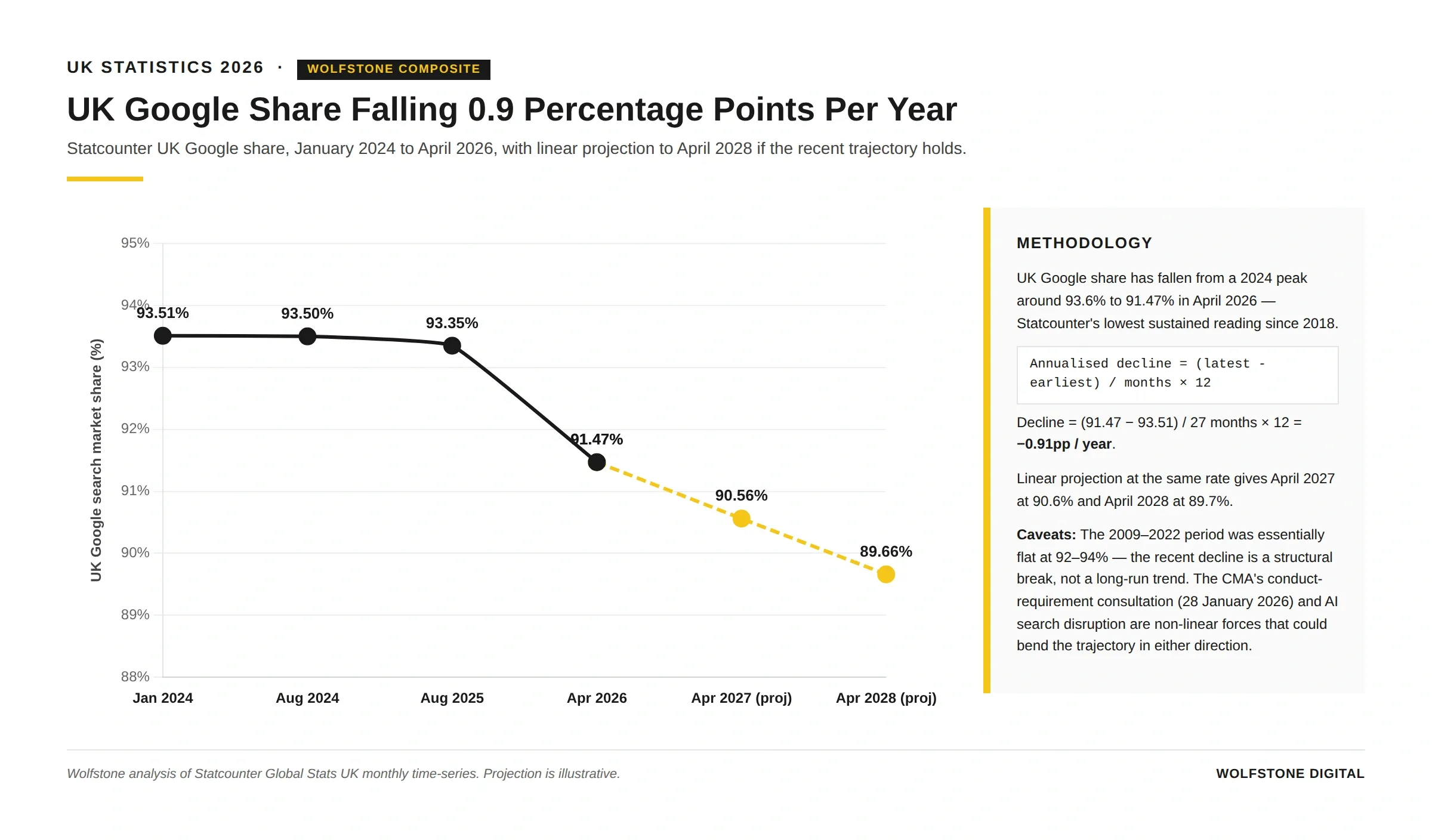
UK Google share trajectory, January 2024 through April 2026, with linear projection to 2028.
Wolfstone analysis of Statcounter Global Stats UK monthly time-series.
Methodology
Inputs: Statcounter Global Stats UK monthly time-series - January 2024 (93.51%), August 2024 (93.50%), August 2025 (93.35%), April 2026 (91.47%). Methodology is referrer-based panel observation across approximately 1.5 million tracked websites.
Formula: Annualised decline = (latest share − earliest share) ÷ months elapsed × 12. Decline = (91.47% − 93.51%) ÷ 27 months × 12 = approximately −0.91 percentage points per year.
Output: Linear projection at the same decline rate would give UK Google share at approximately 90.56% in April 2027 and 89.66% in April 2028.
Limitations: The 2009–2022 period was essentially flat in the 92–94% band; the 2024–2026 decline is a structural break, not a long-run trend. The CMA's SMS designation (October 2025) and conduct requirement consultation (closed February 2026) are likely to introduce default-search choice screens and other interventions that would accelerate the decline. AI search disruption is non-linear and could either accelerate or arrest the trajectory depending on whether AI substitution displaces Google search volume or merely changes the user experience inside Google. Treat the projection as illustrative, not predictive.