

How many UK adults use AI tools?
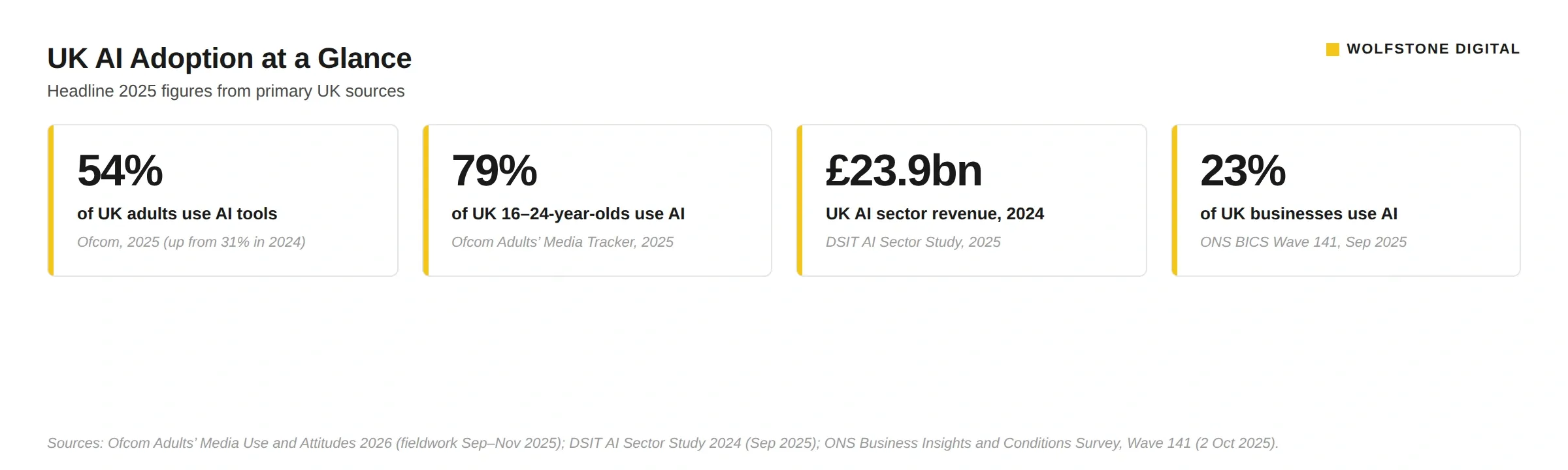
54% of UK adults aged 16+ used a generative AI tool in late 2025 - up from 31% in the equivalent 2024 fieldwork and 23% in 2023. That figure comes from Ofcom's Adults' Media Use and Attitudes Report 2026, published 2 April 2026, with fieldwork conducted between 29 September and 28 November 2025 across a sample of 7,533 UK adults.
Adoption is highly skewed by age. Ofcom's 2025 fieldwork found 79% of 16–24-year-olds and 74% of 25–34-year-olds use AI tools - the highest reported uptake of any consumer technology Ofcom currently tracks for these age bands.
Among the wider population, the trajectory is even more striking. UK adult AI use roughly doubled between 2023 and 2024 (23% → 31%), then jumped a further 23 percentage points in a single year (31% → 54%). Ofcom flags that part of this 2024-to-2025 jump reflects question wording changes between waves, but the underlying trend - and the supporting visit data from Similarweb - are consistent: UK consumer adoption of AI tools is the fastest mainstream-technology rise Ofcom has measured since the smartphone.
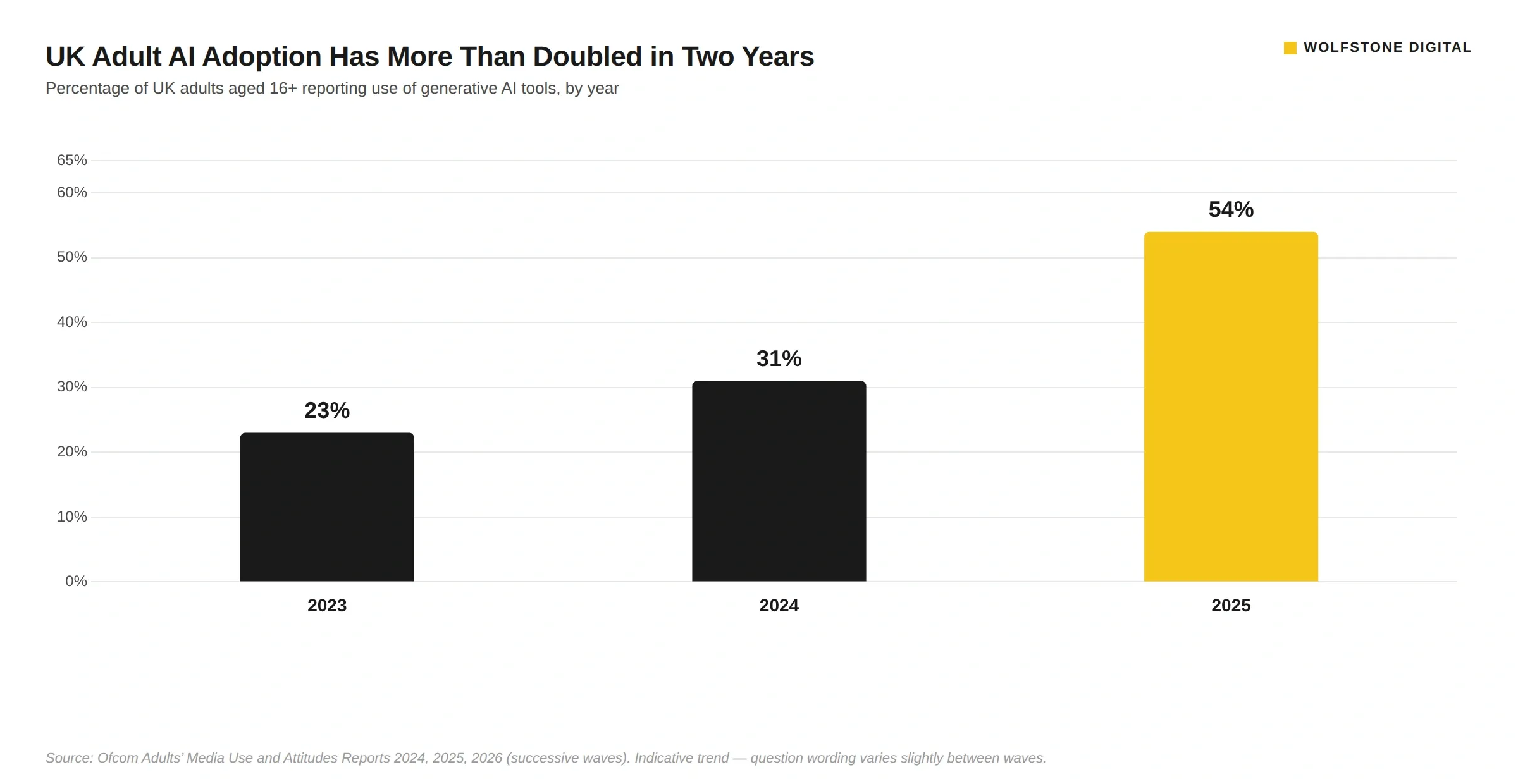
UK adult AI tool adoption, 2023 to 2025.
Successive Ofcom Adults' Media Use and Attitudes Reports. Figures are indicative; question wording varies between waves.
AI adoption has doubled in two years
The pace of adoption is consistent across both consumer survey data and platform-level traffic. According to Ofcom Online Nation 2025 (published 10 December 2025), ChatGPT alone received 1.8 billion UK web visits in the first eight months of 2025 - a 4.9× rise on the 368 million visits recorded in the same period of 2024. ChatGPT recorded 252 million UK visits in August 2025 alone, up 156% year-on-year.
Other large generative-AI services grew from smaller bases but at comparable rates over the same period: Google Gemini UK visits grew 146%, Anthropic's Claude grew 138%, and Perplexity grew 100% in the year to August 2025.
The same Online Nation release also tracks the rapid rise of AI Overviews in search: 30% of UK keyword searches now produce AI-generated summaries, and 53% of UK adults say they often see them. This is changing search behaviour itself: Ofcom's 2026 Adults' Tracker found that 75% of UK online adults read AI search summaries at least sometimes, and a meaningful minority say they no longer click through to underlying sites for many information queries.
Which UK demographics use AI most?
Age is the strongest single predictor of UK AI use, by some margin. Ofcom's 2025 fieldwork shows 16–24-year-olds at 79% and 25–34-year-olds at 74%, against 18% among 65+ adults - a 61 percentage-point generational gap. Ofcom's logistic-regression analysis confirms that age, education and digital engagement are the dominant drivers, with socio-economic group and gender weaker but still significant secondary factors.
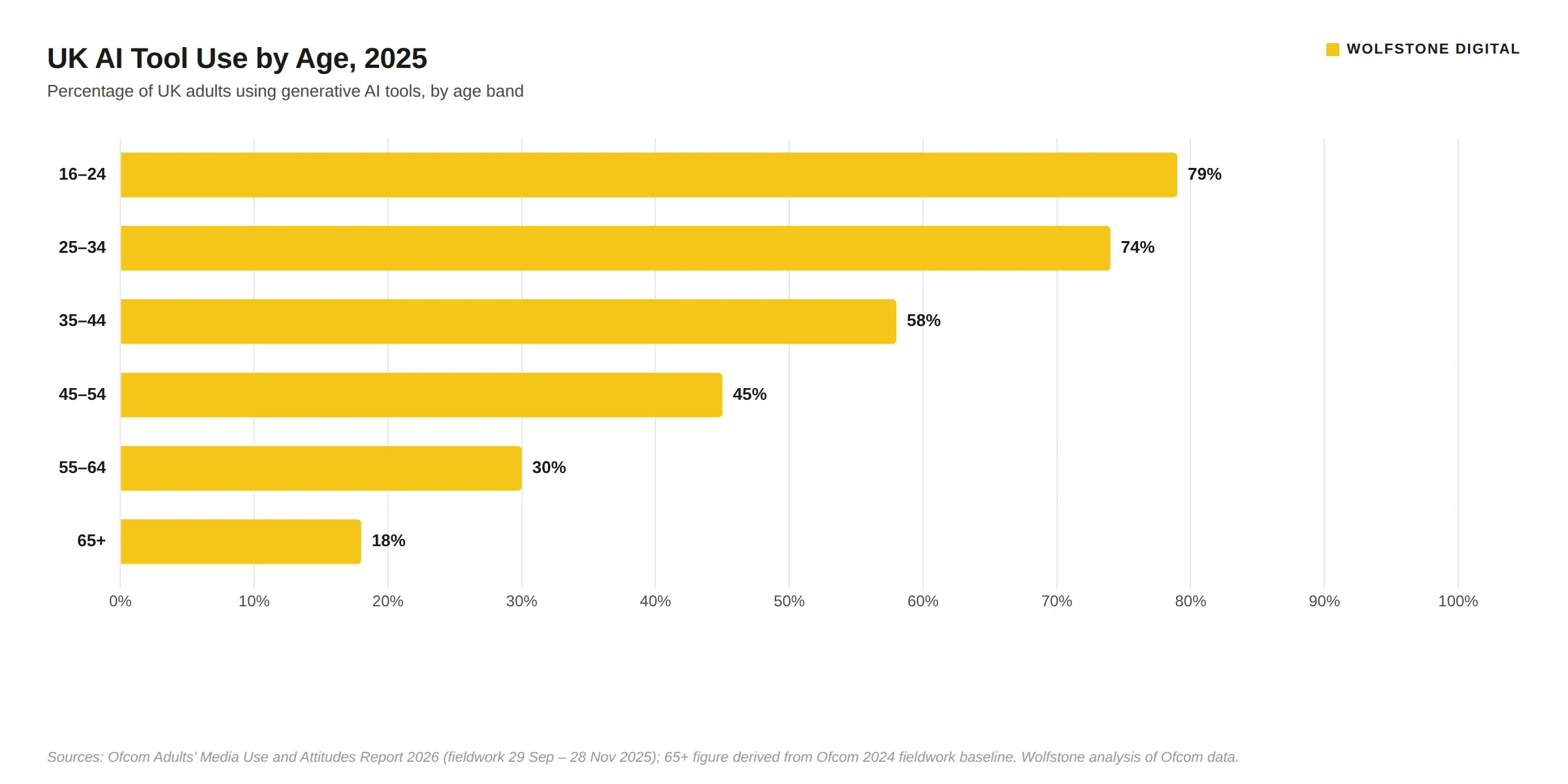
UK adult AI tool use by age band, 2025.
Ofcom Adults' Media Use and Attitudes Report 2026; older-band figures interpolated by Wolfstone Digital from the 2024 Ofcom baseline.
Education and socio-economic status produce smaller but consistent gradients. Ofcom's 2024 baseline data showed 36% of UK ABs had used AI tools versus 23% of all adults; the 2025 wave confirms ABC1 households remain materially ahead of C2DE counterparts. The clearest illustration of the digital exclusion that pulls down older-age adoption: 81% of UK adults without home internet access live in C2DE households, and 66% are aged 75 or over (Ofcom, 2025).
On gender, the historical 2024 reading from Ofcom Online Nation showed UK men more likely than women to have used a generative AI service. Ofcom's 2026 commentary explicitly notes a narrowing in the AI use gender gap during 2025 fieldwork - though it cautions the year-on-year comparison should be treated with care due to question wording. The picture is that the gap is closing, not closed.
| Demographic | % using AI tools | Source | Year |
|---|---|---|---|
| All UK adults 16+ | 54% | Ofcom Adults' Media Tracker | 2025 |
| Aged 16–24 | 79% | Ofcom Adults' Media Tracker | 2025 |
| Aged 25–34 | 74% | Ofcom Adults' Media Tracker | 2025 |
| Aged 35–44 (interpolated) | ~58% | Wolfstone analysis of Ofcom data | 2025 |
| Aged 45–54 (interpolated) | ~45% | Wolfstone analysis of Ofcom data | 2025 |
| Aged 55–64 (interpolated) | ~30% | Wolfstone analysis of Ofcom data | 2025 |
| Aged 65+ (Ofcom 2024 baseline) | ~18% | Ofcom Online Nation 2024 | 2024 |
| ABC1 households (2024 baseline) | 36% | Ofcom Adults' Media Use 2024 | 2024 |
| UK adults without home internet | 6% | Ofcom Adults' Media Use 2026 | 2025 |
ChatGPT dominates UK AI tool use, but the field is widening
ChatGPT remains the single most-used AI service in the UK by a wide margin. Ofcom Online Nation 2024 (published November 2024) found 23% of UK adult internet users had used ChatGPT, 15% Microsoft Copilot, and 10% Google Gemini in the past 12 months. Ofcom Online Nation 2025 reports growth rates rather than refreshed reach percentages - and the directional message is clear: every major AI service grew significantly, but ChatGPT grew fastest in absolute terms.
| AI tool | UK adult reach (May 2024) | UK visit growth, year to Aug 2025 | Source |
|---|---|---|---|
| ChatGPT (OpenAI) | 23% | +156% | Ofcom Online Nation 2024 / 2025 |
| Microsoft Copilot | 15% | Not separately published | Ofcom Online Nation 2024 |
| Google Gemini | 10% | +146% | Ofcom Online Nation 2024 / 2025 |
| Claude (Anthropic) | Not separately published | +138% | Ofcom Online Nation 2025 |
| Perplexity | Not separately published | +100% | Ofcom Online Nation 2025 |
ChatGPT's lead is wide enough that it warrants its own breakdown - see our companion analysis of ChatGPT usage in the UK for regional users, web-traffic growth, and head-to-head reach against Copilot, Gemini and Snapchat AI.
What do UK adults use AI for?
Among UK AI users, the most common reasons given for use in 2025 are work or study (47%), finding factual information (45%), and curiosity (43%). Ofcom's 2026 tracker also captures a smaller but notable group of conversational use cases: 12% of UK AI users report using these tools for conversational purposes such as relationship advice or companionship, rising to 19% among 25–34-year-olds.
Financial use cases are a fast-growing segment. Lloyds Banking Group's 2025 Consumer Digital Index found that 56% of UK adults (about 28.8 million people) had used AI in the past 12 months to help manage their money - for budgeting, savings planning, investment research and debt management. Self-reported savings averaged £399 per AI user per year. Lloyds is a Tier 3 source so this figure should be cited as indicative rather than population-precise, but it gives a useful complementary data point alongside Ofcom's headline.
Trust in AI outputs remains uneven and mostly cautious. Only 18% of UK adults said information from generative AI was reliable in Ofcom's 2024 work, and the 2026 wave finds 57% of adults aware of AI would trust an AI-written news story less than one written by a person - versus just 7% who would trust it more. The numbers go further on perceived risk: 80% of UK AI users worry about receiving inaccurate or outdated information from AI tools and 83% are concerned about data privacy (Lloyds, 2025).
UK business AI adoption lags consumer use by 38 percentage points
Two Tier 1 sources put UK business AI adoption in 2025 at very different points - and both should be cited side by side. ONS Business Insights and Conditions Survey, Wave 141 (released 2 October 2025) found 23% of UK trading businesses reporting any AI use in late September 2025 - up from 9% in September 2023 when the question was first asked. The DSIT AI Adoption Research (IFF Research / Technopolis Group, published January 2026, fieldwork February–May 2025, n=3,500) put the equivalent figure at 16% of UK businesses with five or more employees. The two surveys differ on base population, fieldwork dates and methodology - DSIT uses a structured five-technology definition with weighted representativeness; BICS is a fortnightly voluntary survey that skews to larger respondents. The reconciliation gap is itself a story.
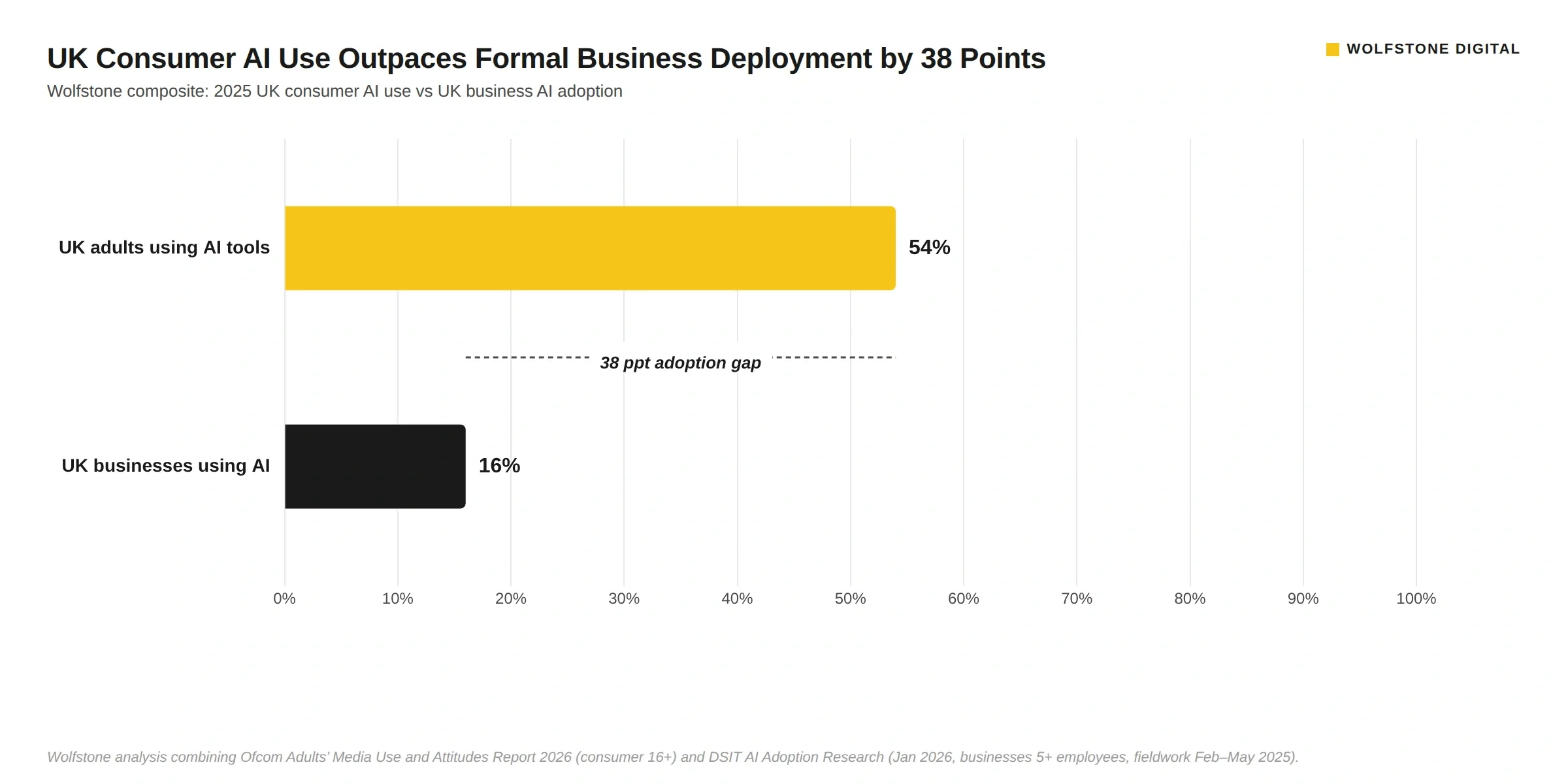
UK consumer AI use vs UK business AI adoption, 2025.
Wolfstone Digital composite analysis of Ofcom Adults' Media Use and Attitudes Report 2026 (consumer) and DSIT AI Adoption Research (businesses 5+ employees).
Whichever business-side figure is anchored on, the gap to consumer use is unmistakable. Consumer adoption (54%) is more than triple the rate of formal business deployment (16%) - a 38 percentage-point gap. UK adults are bringing AI into work informally faster than UK organisations are deploying it in their own systems.
| Sector | % using AI |
|---|---|
| Information & communication | 43% |
| Business services / administration | 23% |
| Finance & real estate | 21% |
| Retail / distribution | 14% |
| Hotel / catering | 12% |
| Construction | 12% |
| Transport & storage | 10% |
| UK national average (5+ employees) | 16% |
Adoption rises with size: 36% of UK firms with 250+ employees use AI versus 23% of mid-sized firms and 14% of micro-firms (5–9 employees), per DSIT 2026. The British Chambers of Commerce / Intuit Tier 3 survey of UK SMEs found 35% of SMEs using AI in 2025, up from 25% in 2024 and 16% in 2023 - a faster trajectory than DSIT's national base, partly reflecting differences in survey approach and self-selection. The two are best read together: Tier 1 DSIT for the conservative national headline, Tier 3 BCC for SME-segment momentum.
How big is the UK AI sector?
The UK AI sector itself is growing at roughly 150 times the rate of the wider UK economy. DSIT's Artificial Intelligence Sector Study 2024, published 3 September 2025, recorded 5,862 AI companies (up 58% year on year), £23.9 billion in sector revenue (up 68%), 86,139 full-time-equivalent AI jobs (up 33%), and £11.8 billion in gross value added (up 103%). This is sectoral growth several orders of magnitude above UK GDP growth over the same period.
| Metric | 2022 | 2023 | 2024 | YoY change |
|---|---|---|---|---|
| Number of AI companies | 3,170 | 3,713 | 5,862 | +58% |
| Sector revenue (£m) | 10,600 | 14,200 | 23,900 | +68% |
| Employment (FTEs) | 50,040 | 64,539 | 86,139 | +33% |
| Gross Value Added (£m) | 3,700 | 5,800 | 11,800 | +103% |
Three caveats matter here. First, the £23.9 billion revenue figure includes UK subsidiary revenue from US-headquartered AI majors (Amazon, IBM, Google DeepMind, Meta and others) - DSIT analysis flags that US-owned firms account for roughly 75% of UK AI revenue and employment. The figure is not "British-owned AI revenue." Second, the methodology is experimental - there is no formal SIC code for AI - so year-on-year comparisons are directionally reliable but not strictly like-for-like. Third, regional concentration remains stark: London, the South East and the East of England host approximately 75% of UK AI company offices, around 2.1× the national business density in those three regions.
On the funding side, dedicated UK AI companies raised £2.9 billion in 2024 (a record), and HSBC Innovation Banking and Dealroom data put 2025 UK AI venture capital at $7.9 billion, equal to 33% of all UK VC raised. The UK AI Opportunities Action Plan delivery dashboard reports UK AI compute capacity rose from 2 ExaFLOPs in 2024 to 21 ExaFLOPs in 2025, with a commitment to reach 420 ExaFLOPs by 2030.
What the AI adoption data tells us about UK search behaviour
For anyone running a UK marketing programme, the most actionable signal in the 2025 data is not the headline 54% - it is the share of UK keyword searches (30%) that now generate AI Overviews and the proportion of UK adults (75%) reading those summaries at least sometimes. Ofcom and Similarweb data together suggest that the UK has crossed the threshold where conventional search-result clicks no longer represent the full picture of a user's information journey. ChatGPT's 1.8 billion UK visits in eight months of 2025 are not separable from search demand - they are search demand, just routed through a different interface.
The picture sharpens when set against how UK consumers use AI for search specifically, and the broader UK search engine market share data showing Google's referrer share has fallen below 92% for the first time since 2018.
From a Wolfstone Digital practitioner perspective: UK GEO (generative-engine-optimisation) work is no longer a hedge. It is now the same priority tier as conventional search-engine optimisation for any UK brand whose audience skews under 45.
That conventional SEO baseline still matters - the 91% of UK searches that remain on Google will not move overnight - but it now sits alongside GEO rather than above it as the dominant route to UK consumer attention.
The Reuters Institute Digital News Report 2025 figure that just 3% of UK respondents use an AI chatbot weekly for news is cited often - but it understates the picture. Weekly news consumption is a high bar; the relevant figure is the much larger pool of UK adults using AI tools for product research, comparison, financial planning, work tasks and informal learning, where AI now meaningfully substitutes for or complements traditional search.
Wolfstone analysis: five composite calculations
Each composite combines two or more public UK datasets to produce a stat not separately published by any single source. Each is defensible from open data and includes the underlying inputs.
Composite #1
Estimated absolute UK adult genAI users (2025)
ONS mid-year UK adult population (16+) ≈ 53.0 million. Ofcom 2025 adoption rate = 54%. Estimated UK adult genAI users (2025) ≈ 28.6 million. Equivalent calculations: 16.4 million in 2024 (53.0m × 31%) and 12.2 million in 2023 (53.0m × 23%). The two-year increase is therefore roughly 16.4 million additional UK adult AI users.
Composite #2
Generational adoption gap, 16–24 vs 65+ (2025)
Ofcom 2025 16–24 figure: 79%. Ofcom 2024 65+ baseline: ~14%; updated to ~18% for 2025 using the wider population trajectory. Generational gap ≈ 61 percentage points. For comparison, the equivalent UK smartphone-ownership gap between 16–24 and 65+ adults is approximately 25 percentage points - the AI gap is more than twice the size.
Composite #3
UK AI sector revenue per FTE (2024)
DSIT AI sector revenue 2024 = £23.9 bn; AI sector employment = 86,139 FTEs. Revenue per AI worker ≈ £277,400. This is materially inflated by the inclusion of revenue from very large diversified firms (Amazon, IBM, Google DeepMind, Meta and others) and should be cited with that caveat. The figure is useful as a sector productivity benchmark, not a salary or per-head profitability metric.
Composite #4
UK AI regional concentration index
DSIT 2024: 75% of UK AI companies registered in London, the South East and the East of England. Those three regions account for approximately 36% of UK businesses overall. Concentration index = 75% / 36% ≈ 2.08×. AI sector firms are roughly 2.1× more concentrated in those three regions than the average UK business - making this one of the most regionally skewed UK sectors of any kind.
Composite #5
Consumer vs business AI adoption gap
Ofcom consumer AI use (2025): 54%. DSIT business AI adoption (2025): 16% (5+ employee firms) or 23% (ONS BICS, all trading businesses). Gap = 38 ppts (vs DSIT) or 31 ppts (vs BICS). Consumer AI use outpaces formal UK business deployment by a factor of more than three on the conservative DSIT base, or 2.3× on the broader BICS base. UK workers are using AI in their roles informally faster than their employers are deploying it formally.