

Ask any sales leader to rank their lead sources and referrals win every time. A referred buyer arrives with trust already built. Someone they respect has done the vetting for them, so the conversation starts halfway down the funnel rather than at the top of it.
There is now a second channel that behaves the same way, and most B2B businesses have not noticed it exists yet. When ChatGPT, Perplexity or Gemini recommends your business by name, the buyer who clicks through arrives almost as warm as a personal referral. I know because it happens to us every week.
The clip above was recorded on 3 July 2026. It shows a live ChatGPT session in which we asked for agency recommendations for AI search optimisation and SEO in our market. No leading prompts, no retakes, no editing. Wolfstone comes back in the answer. That recommendation did not happen by accident, and this article explains the thinking behind it, with the data to show why it matters.
TL;DR: is B2B AI referral traffic worth it?
When ChatGPT, Perplexity or Gemini recommends your business by name, the visitor arrives pre-sold, like a referral. It converts at 5.8%, higher than any other channel (Ruler Analytics, 2026). Earn those recommendations through deliberate AI search optimisation, and the advantage compounds every month.
What is B2B AI referral traffic?
AI referral traffic is the stream of visitors who land on your website after an AI platform such as ChatGPT, Perplexity, Gemini or Copilot recommends your business in an answer. In B2B, these visitors are usually decision makers who asked the AI who they should shortlist.
Buying behaviour has shifted. A growing share of research that used to start with a Google search now starts with a question typed into an AI assistant. The important difference is what comes back. Google shows ten results and leaves the choice to the searcher. An AI platform weighs the options and recommends one or two brands by name. If your business is one of them, the visitor arrives carrying the AI’s endorsement with them.
Why referrals are the highest-converting lead source in B2B
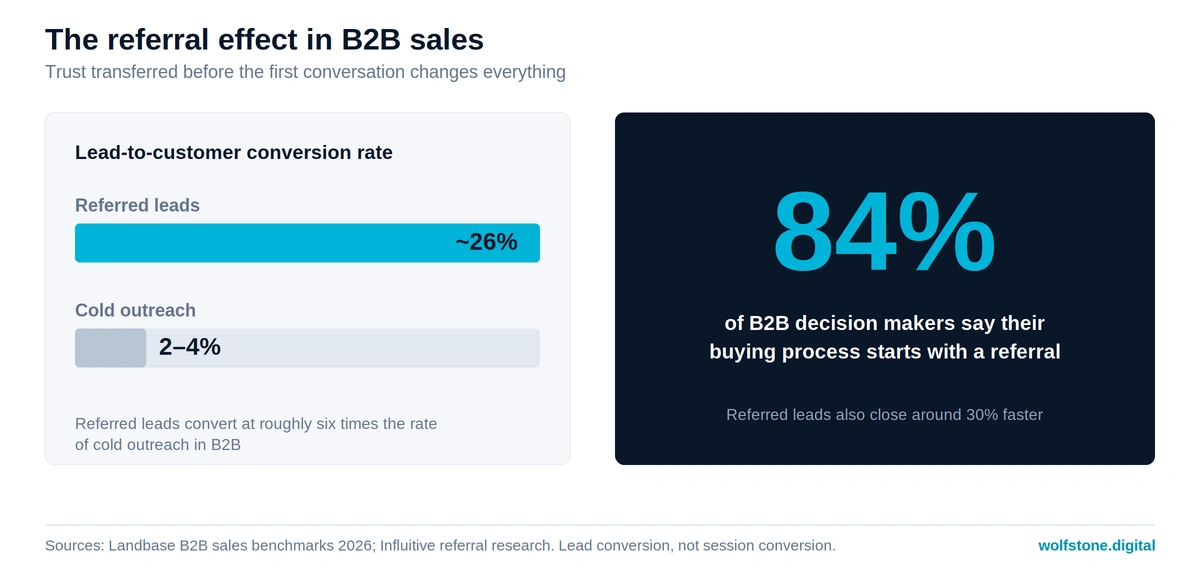
Referred leads convert at around 26 per cent, the highest rate of any lead source. By comparison, cold outreach typically converts at 2 to 4 per cent.
The numbers behind referrals have been consistent for years. Some 84 per cent of B2B decision makers say their buying process starts with a referral, and referred leads close roughly 30 per cent faster than leads from other channels. The reason is simple. Trust is transferred before the first conversation happens. The referrer has staked a little of their own credibility on you, and the buyer arrives having already decided you are worth talking to.
How well does AI referral traffic convert?
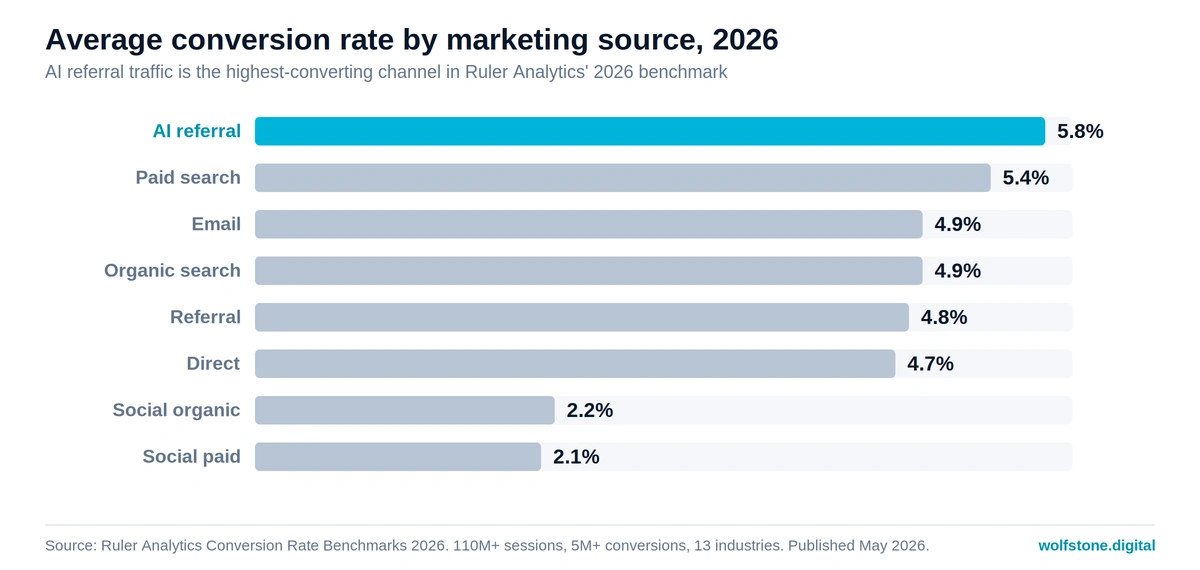
AI referral traffic converts at 5.8 per cent, the highest rate of any marketing source in Ruler Analytics’ 2026 benchmark. That puts it ahead of paid search at 5.4 per cent, email and organic search at 4.9 per cent, referral at 4.8 per cent and direct at 4.7 per cent.
These figures come from a single study: Ruler Analytics’ Conversion Rate Benchmarks 2026, published in May 2026 and built on more than 110 million tracked sessions and 5 million conversions across 13 industries. Every channel in the comparison is measured the same way, using the same definition of a conversion, which is a qualified lead or sale rather than a soft goal like a page view.
The dataset covers both B2B and B2C sectors, and the B2B-heavy verticals hold the pattern up well. Software converts AI referral traffic at 7.9 per cent, construction and engineering at 6.3 per cent, professional services at 6.0 per cent and finance at 5.6 per cent. In each case the visitor arriving from an AI answer is among the most likely to convert of any source.
The mechanism matters more than the decimal points. By the time a buyer clicks a link inside an AI answer, the platform has already read their question, weighed the options and made a recommendation. The click is the end of the research, not the start of it. That is why the visitor converts like a warm lead rather than a cold one.
An AI recommendation is a referral at scale
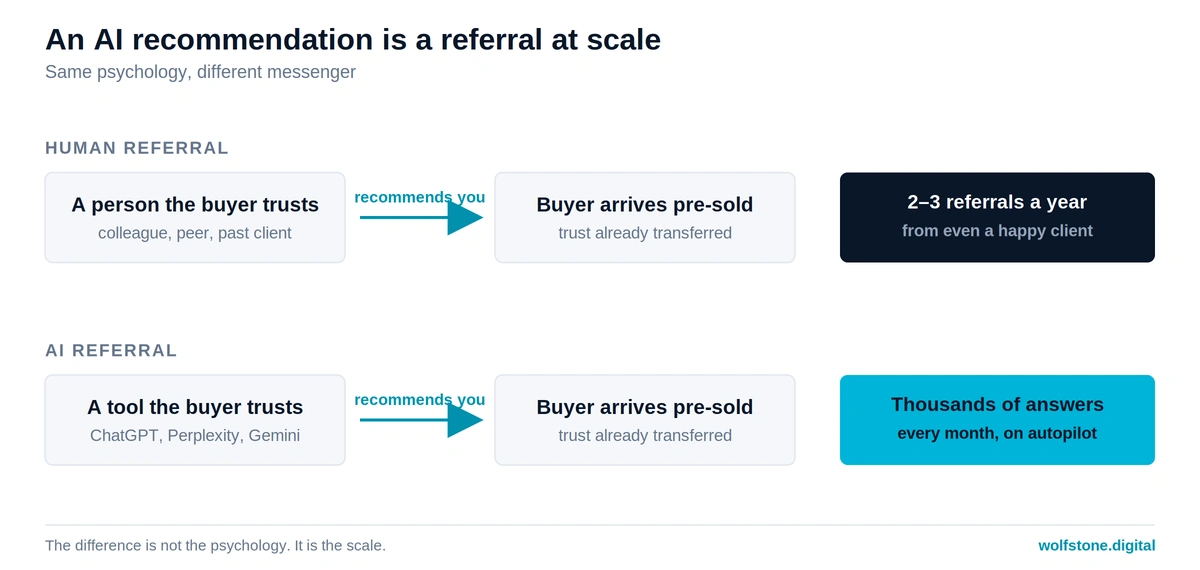
The psychology of the two channels is identical. A human referral borrows trust from a person the buyer respects. An AI referral borrows trust from a tool the buyer relies on every day. In both cases the vetting happens before the buyer ever reaches your website, which is exactly what makes the lead so valuable.
The difference is volume. Even a delighted client might refer two or three people a year. An AI platform answers the same buying question thousands of times a month, every month, without being asked. Get your brand into those answers and you have built a referral engine that never sleeps and never forgets to mention you.
Most businesses are ignoring this channel
Here is the strange part. Only around three in ten B2B companies run a formal referral programme, despite referrals being their best-converting source. The number deliberately building AI visibility is far smaller again. Most businesses have simply not connected the two ideas: that an AI recommendation is a referral, and that it can be earned through deliberate work.
I can tell you from direct experience that the work pays for itself. Wolfstone is a young brand. We only incorporated in March 2026, yet we are already the recommendation for our core services in our target market, as the clip above shows. High-intent leads land in our inbox every week off the back of it. We do no cold outreach for these. They arrive having already been told we are the answer to their question.
This is not our first time doing it either. Before Wolfstone, we spent three years building the AI presence of The Investors Centre, a finance platform we co-founded. It is now retrieved by AI models more often than any other source in its competitive set, with more than 1,800 citations across five platforms. We brought this offering to market because we had watched it work on our own brands first.
How do you get recommended by ChatGPT and other AI platforms?
AI platforms recommend brands that look credible everywhere they check: authoritative backlinks, consistent entity signals, genuine community presence and content that shows first-hand expertise. Building those signals deliberately is what we call AI search optimisation.
There is no single trick, and anyone selling one should be treated with caution. The platforms lean on many of the same signals Google does, plus a few of their own. Authority links from trusted publications tell the model your brand is real and respected. Consistent business information across directories and profiles confirms you are who you say you are. Mentions in the communities the models read, places like Reddit and specialist forums, show that real people talk about you. And content written with genuine first-hand experience gives the model something worth citing.
None of this happens quickly, which is precisely why it is worth starting now. AI citations compound. Every mention strengthens the next one, and early movers build a position that gets harder to displace with every month that passes.
B2B AI referral traffic FAQs
Is AI referral traffic better than organic search? On conversion rate, yes. AI referral traffic converts at 5.8 per cent against 4.9 per cent for organic search in Ruler Analytics’ 2026 benchmark, because the AI pre-qualifies the visitor before they click. Organic search still delivers far more volume today, so the two channels work best together rather than as alternatives.
How do I track AI referral traffic in GA4? Build a custom channel group or an exploration filtered on session source. Traffic from chatgpt.com, perplexity.ai, gemini.google.com and copilot.microsoft.com identifies most AI referrals. Some visits arrive as direct traffic when the platform strips the referrer, so treat your reported figure as a floor rather than a ceiling.
Which AI platforms send the most referral traffic? ChatGPT sends the most for most B2B sites, simply because it has the largest user base. Perplexity punches above its weight because its answers are heavily linked. Google’s AI Overviews sit inside normal search results, so their clicks usually appear as organic traffic rather than AI referrals.