

Why we ran this study
Suffolk's 100 largest private companies turn over £6.09 billion between them. Food manufacturers, motor dealers, construction groups, logistics operators, law firms, retailers. Businesses that have traded for decades, employ thousands of people, and are household names across East Anglia.
We wanted to know whether the care those companies put into everything else reaches their websites. We work with businesses across the county, so this is our own market: what we do there is set out on our SEO in Suffolk and Bury St Edmunds page.
So we took the Suffolk LTD. 2025 Report, Grant Thornton and Birketts' annual ranking of the county's biggest private businesses, found every website we could, and crawled all of them in full. No sample, no page cap, no cherry picking.
What came back was a consistent picture of digital infrastructure that has been quietly falling behind for years.
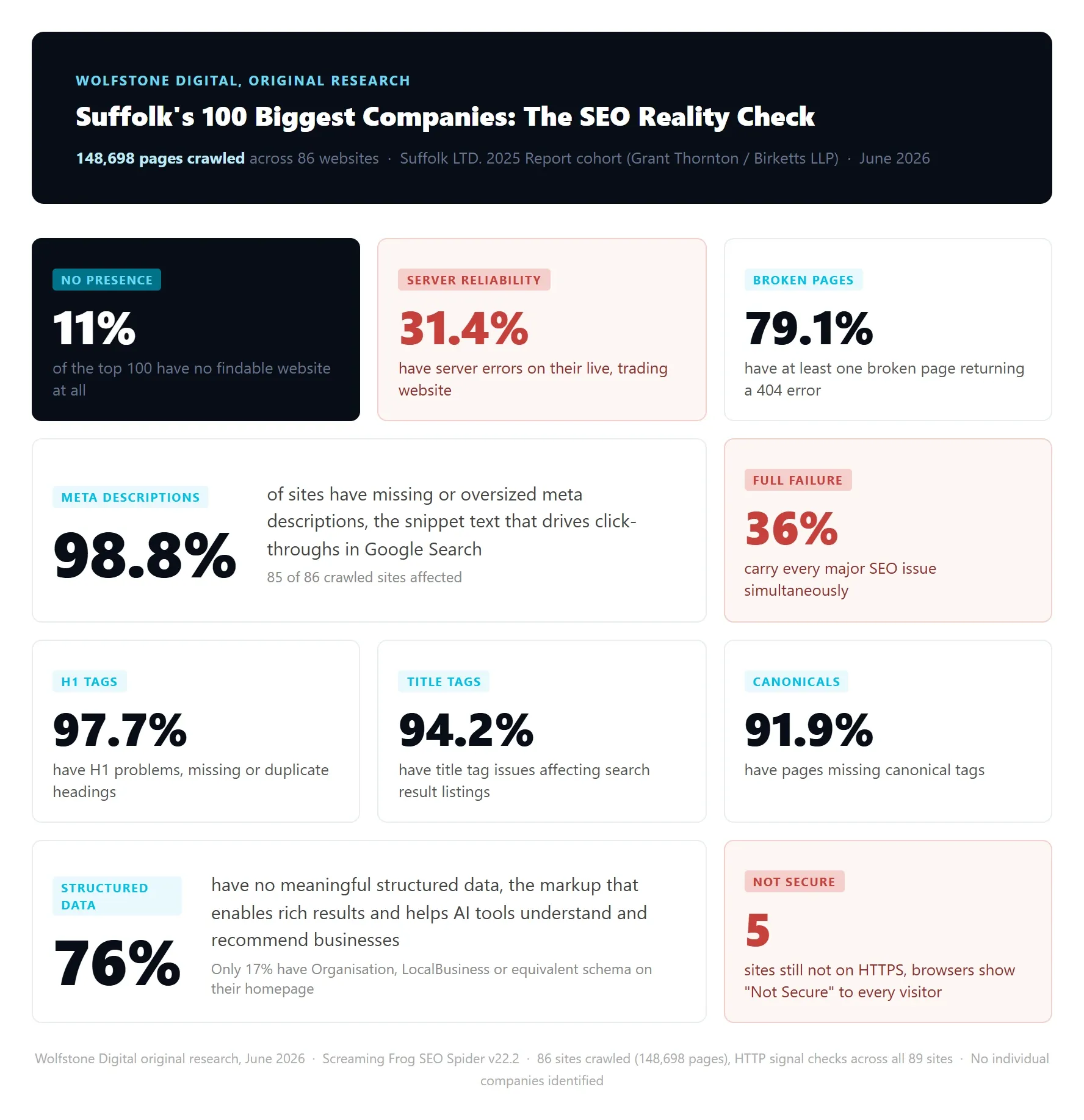
Six findings from the audit of Suffolk's 100 largest private companies, June 2026.
Wolfstone Digital, Suffolk Top 100 SEO Audit, June 2026
What we measured, and how
We crawled 148,698 individual pages across 86 sites using Screaming Frog SEO Spider v22.2, in full crawl mode with no page limit. HTTP checks covering HTTPS, robots.txt and AI crawler policy ran across all 89 sites we found. Mobile performance came from Lighthouse, the same tool Google uses to measure Core Web Vitals.
The largest site in the dataset runs to over 50,000 pages. Several exceed 10,000. Three were too large to finish inside our 25 minute crawl threshold and are excluded from crawl-based figures.
We have not named a single company. The published dataset is anonymised to SITE_001 through SITE_086. This was never about embarrassing anyone. It was about establishing what normal looks like.
Eleven of them have no website at all
The first finding was not a technical fault. It was an absence.
Eleven of the hundred companies have no findable website. Not a dated website. Not a thin one. Nothing.
These are not micro-businesses. They appear in a Grant Thornton ranking of the county's largest private firms by turnover. They employ people, they win contracts, and when somebody searches for them there is nothing to find.
In established sectors with long trade relationships that can feel survivable, and often it is, for a while. But every procurement manager who cannot find you, every candidate who searches your name before applying, and every customer who wants to check you exist before ringing, all hit the same dead end. The conversation ends before it starts.
The problems we found
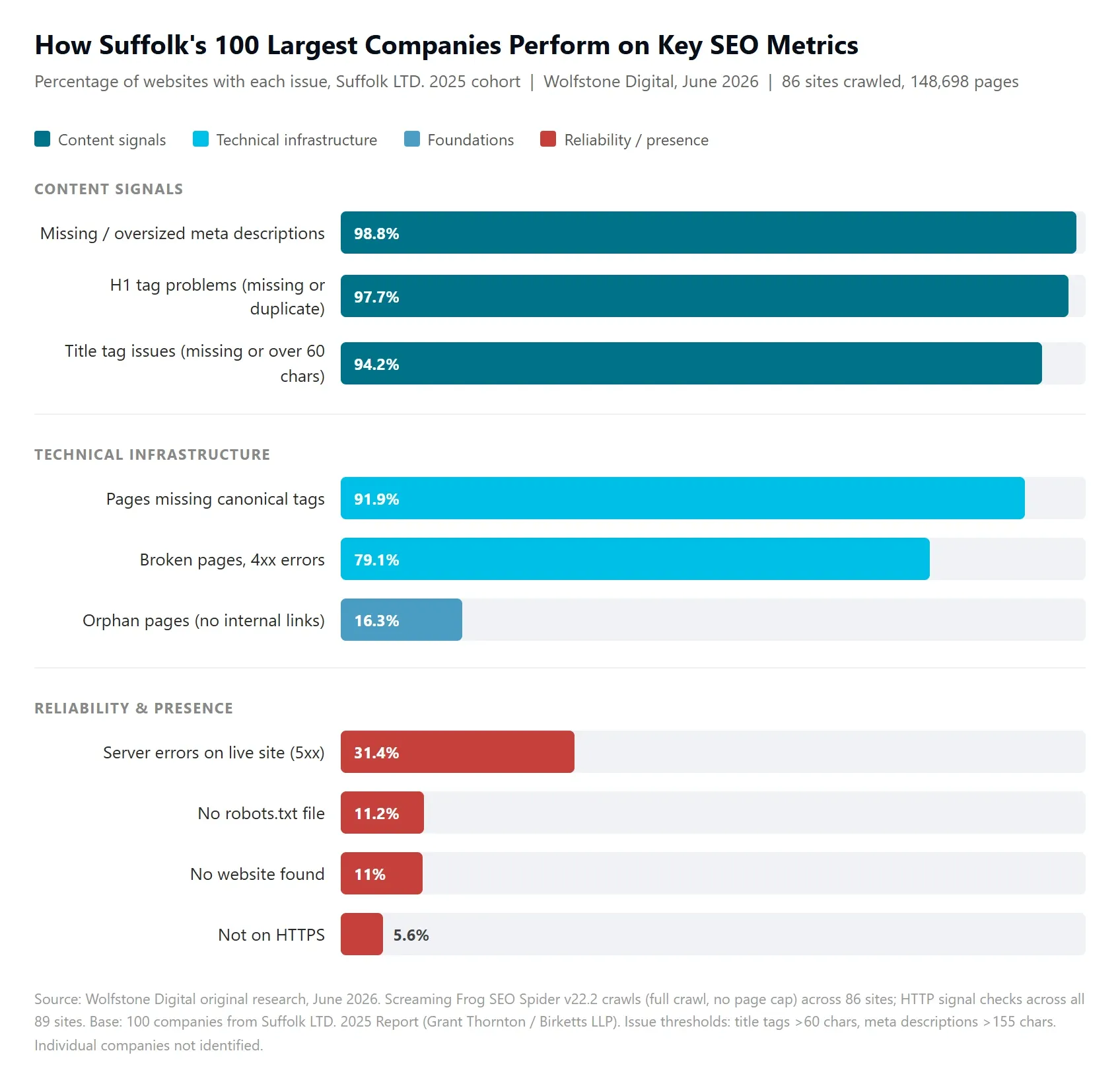
Percentage of the 86 crawled websites carrying each fault. Content signals first, then technical infrastructure, then reliability.
Wolfstone Digital, Suffolk Top 100 SEO Audit, June 2026
Nearly every site has basic content signals missing
98.8% have a meta description problem. That is 85 sites out of 86. For some it was a handful of pages. For others it was total: one site had no meta descriptions across 37,000 pages, another across 454, a third across 444.
97.7% have an H1 problem, either missing or duplicated. At one motor dealer, 68% of pages had no H1 at all, 707 out of 1,031. At a facilities management group it was more than half the site.
94.2% have title tag problems. The most common cause is templating. Sites that append " | Location | Brand Name" to every page routinely push titles past the 60 character limit where Google truncates them. One dealer had 177 pages where the template added 25 to 35 characters to a title that was fine on its own.
The thing worth noticing is that almost none of this needs a developer. It needs somebody to decide it matters.
Titles that are identical across tens of thousands of pages
Separate from length, duplicate titles mean multiple pages sharing the same title tag. When every page looks the same to Google, the engine has no way to tell which one answers a given query.
- One large retailer: 98.5% of 53,724 pages have duplicate titles
- An auction house: 94.1% of 37,183 pages
- A motor dealer: 87.1% of 5,161 pages
That pattern usually means titles were never set at page level and defaulted to the site name.
Technical faults that accumulate quietly
91.9% have pages with no canonical tag, which tells Google which version of a URL is the master copy. Without it, sites with tracking parameters or filtered views end up with dozens of versions of the same page competing against each other.
79.1% have at least one broken page. One agricultural equipment dealer had 755 pages returning HTTP errors.
31.4% returned server errors during the crawl. That is worth separating from a 404. A 404 means a page is not there. A 5xx means the server failed to answer at all, on a live trading website. Companies that would never tolerate a 30% failure rate in any operational system are running websites that fail at roughly that rate when a crawler visits.
Sites that are hiding from Google without knowing it
This was the most unexpected finding in the whole audit.
Several large sites have the majority of their pages tagged noindex, which actively instructs Google not to list them. That is occasionally deliberate for staging or admin areas. At these scales it almost certainly is not.
- One site: 98.3% of its 291 pages are noindexed. Google can see five of them
- A printing company: 98.2% of 57 pages. Google can see one
- An auction house with over 37,000 pages: 93.6% noindexed, which is 34,814 pages invisible to Google
- A motor dealer: 88.1% of 5,161 pages
- A steel stockholder: 84.5% of 2,841 pages
The auction house is the one that stays with you. Thirty seven thousand pages, and Google is permitted to see about 2,300. That company almost certainly has no idea. It is the kind of setting that gets applied once, usually through template inheritance, and never looked at again.
Most of them are slow, and some are extraordinarily slow
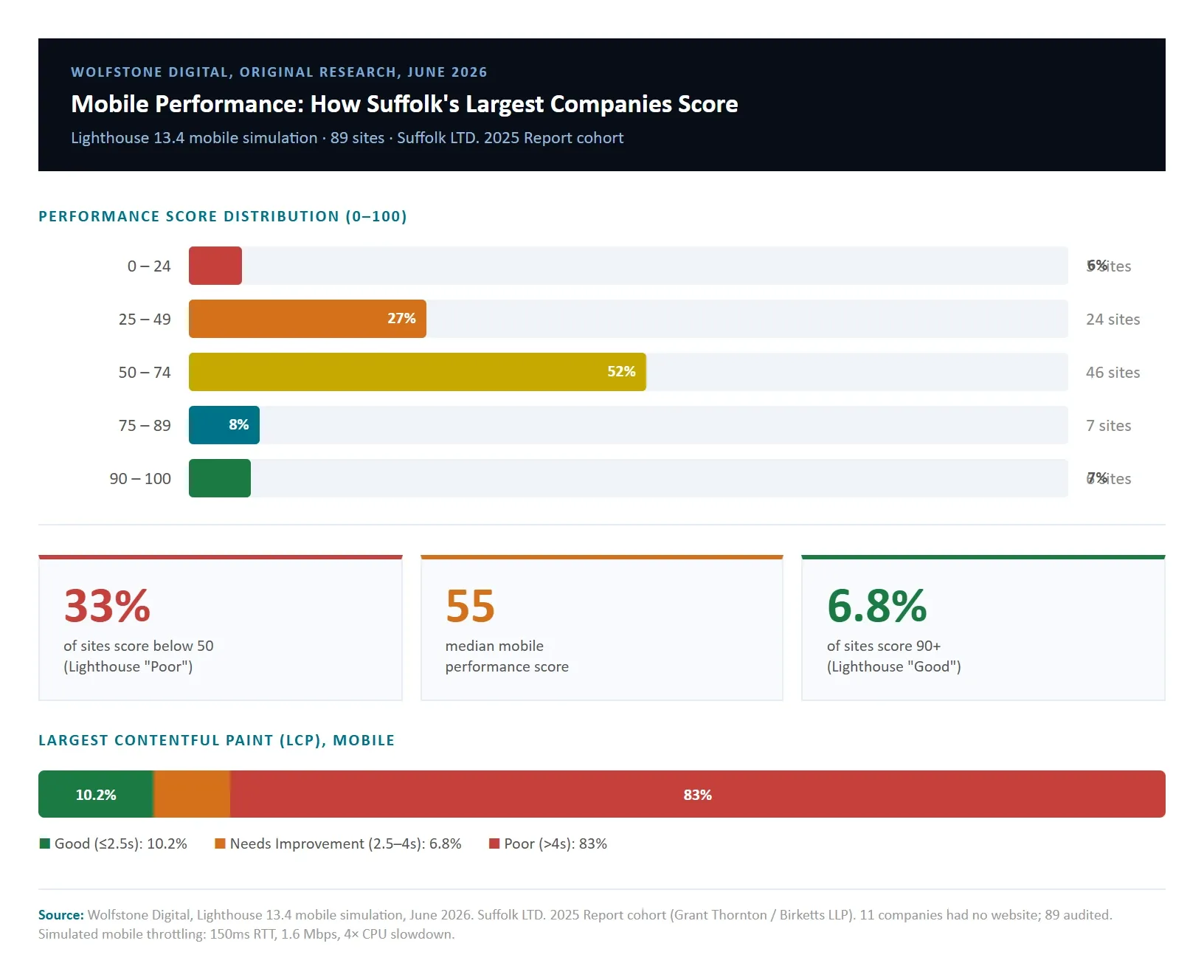
Lighthouse mobile scores and Core Web Vitals across the audited sites. The median site scores 55 out of 100.
Wolfstone Digital, Suffolk Top 100 SEO Audit, June 2026
33% score below 50 for mobile performance, which is the band Google classes as poor. The median across the dataset is 55 out of 100. Only 6.8% score 90 or above.
The detail is worse than the headline.
Largest Contentful Paint measures how long the main content takes to appear. Google's threshold for poor is four seconds. 83% of the sites we audited were above four seconds on mobile, and the median site took 11.4 seconds. Not the worst site. The middle one. In the most extreme case we recorded, it reached 42 seconds on a live trading website.
29.5% had a Total Blocking Time above 600ms, meaning visitors sit waiting for a page to become usable. 20.5% had a server response time above 800ms, before any content had loaded at all.
Speed compounds twice. It affects whether a visitor stays, and Google uses Core Web Vitals as a ranking signal, so a slow site is algorithmically disadvantaged for the same query.
The basics that nobody checked
11.2% have no robots.txt file. One site's robots.txt returns an HTML page instead of plain text, so any crawler reading it will either ignore it or misread the instructions.
Five sites are still not fully on HTTPS. Google has used HTTPS as a ranking signal since 2014, and modern browsers put a visible warning next to sites without it. These are companies with substantial revenues running websites that Chrome labels as potentially unsafe.
What we found on structured data
Structured data is the machine readable layer that tells a search engine, or an AI model, what a business actually is: its name, what it sells, where it operates, its opening hours.
Only 17% of the sites we checked have anything meaningful, meaning Organisation, LocalBusiness or Place markup. 27% have none at all.
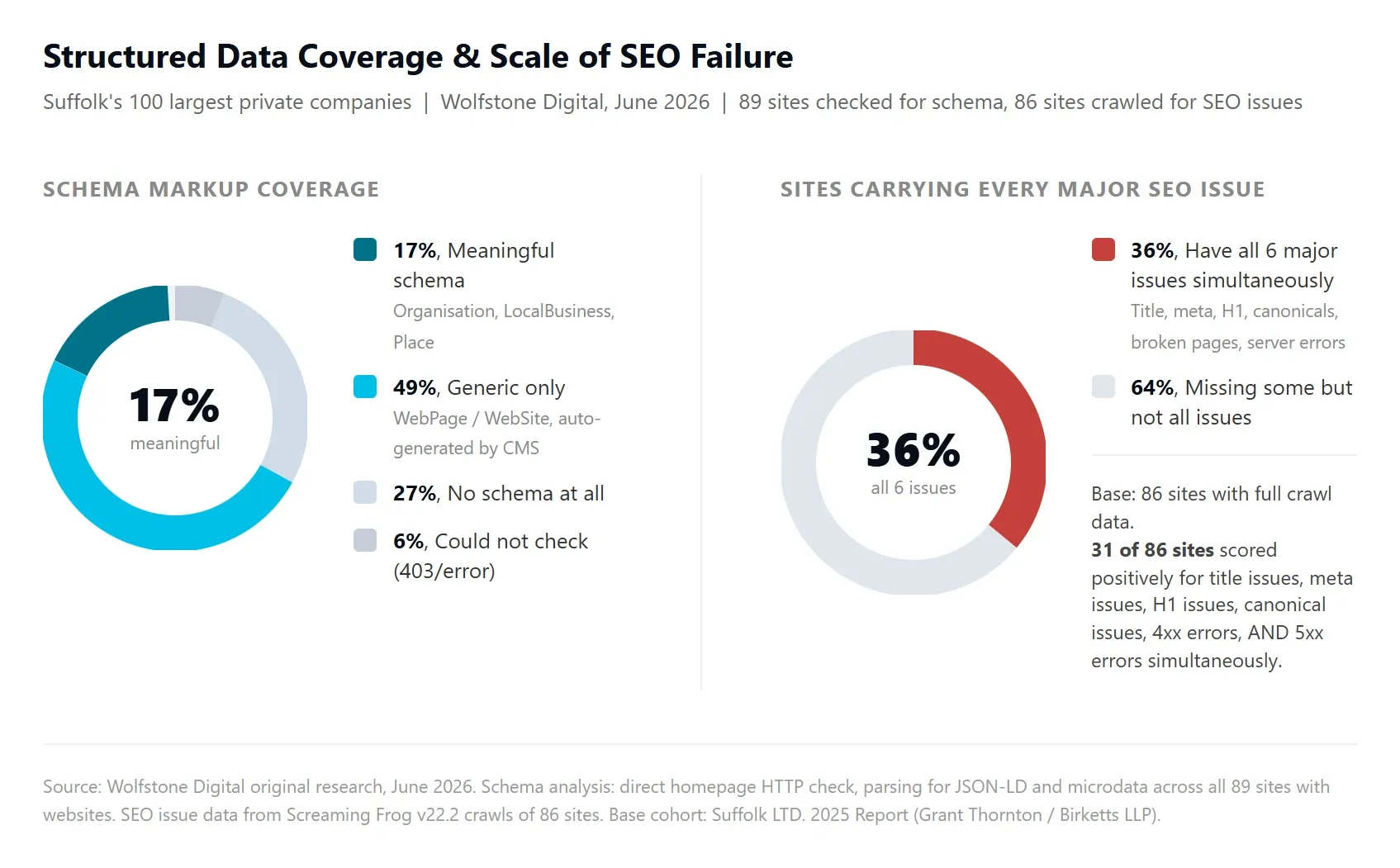
Half the cohort has structured data that its CMS generated automatically, describing the page as a WebPage and nothing more.
Wolfstone Digital, Suffolk Top 100 SEO Audit, June 2026
The interesting number is the 49% in between. Half of Suffolk's biggest companies have structured data that their content management system generated automatically, describing the page as a WebPage or a WebSite. Technically present. Tells Google nothing it could not already work out.
That matters more every month. When someone asks an AI assistant for a supplier in a category, the businesses that get named are the ones whose sites can be read and understood without guesswork. Generic markup does not do that job. It is the same gap we measured from a different angle in the Regional Digital Time Warp Study, where nearly one in five high street businesses turned out to be unreadable by AI search.
What 36% of them have in common
Running across every metric, 31 sites out of 86, or 36%, carry every single major technical fault at the same time: title problems, missing meta descriptions, H1 failures, broken pages, server errors and missing canonicals.
More than a third of the dataset is not carrying one or two things to fix. It is carrying years of accumulated neglect across the whole stack.
What this means if you run a business in Suffolk
None of this happens overnight. Broken pages build up as products change. Meta descriptions get lost in a CMS migration. Title templates break when somebody updates a theme. A noindex tag gets applied to a section and nobody removes it. This is simply what a website looks like when no one has audited it for a few years.
Most of these companies audit their accounts annually. Many hold ISO certifications, run health and safety reviews, maintain fleet schedules and operate compliance frameworks. That same rigour is not reaching the thing most people encounter first.
There are two ways to read this if your business is here.
The pessimistic reading is that the county's largest firms are collectively behind, and that is true.
The useful reading is that the bar is low, and it is measurable. Almost everything in this study is fixable without a rebuild. Meta descriptions, title templates, canonical tags and noindex settings are configuration, not construction. The businesses that fix them now compound the advantage, because the same foundations that decide whether you appear in Google also decide whether an AI model can find you and describe you.
If you want to know where your own site sits against these numbers, that is what an SEO audit is for, and it is the same crawl we ran here. If the answer turns out to be a rebuild rather than a tidy, our web design in Suffolk page sets out what we measure on every build.
Cite this data
Free to cite with attribution. Standard credit:
Wolfstone Digital, Suffolk Top 100 SEO Audit, June 2026. Based on the Suffolk LTD. 2025 Report (Grant Thornton / Birketts LLP).
Download the anonymised dataset (CSV). 86 sites, more than 30 variables, keyed SITE_001 to SITE_086. No company is named in it.