

Why we ran the study
Every month, more of your customers ask ChatGPT and Google's AI Overviews the questions they used to type into Google: the best estate agent in Maidstone, a garden centre open on Sunday near King's Lynn, a pub with parking in the New Forest. The businesses those tools recommend are the ones whose websites AI can actually read. So we went and measured how much of the local high street is invisible to AI - the shift we track in detail on our UK AI search statistics page.
We audited 210 prominent, independent, consumer-facing businesses across Kent, Cambridgeshire, Suffolk, West Norfolk, West Berkshire, Hampshire (New Forest) and the Herts/Essex border. Thirty businesses per county, drawn from five sectors local people use every week: estate agents, solicitors, garden centres and farm shops, hotels and pubs, and family trades like garages, builders merchants and funeral directors. No opinions, no scoring by feel. Every website took the same four tests. Pass or fail.
The four tests
- The Pinch and Zoom test (mobile). Does the site adapt to a phone screen, or do you have to pinch and squint? Fail if the site has no responsive setup.
- The Frozen Clock test (abandonment). What year does the site's own footer say it is? Fail if the copyright is stuck in 2023 or earlier.
- The AI Blind Spot test (AI readability). Can AI search engines actually read the site? Fail if it blocks AI crawlers, serves almost no readable text, or carries no structured data and no machine-readable opening information anywhere AI can find it.
- The Padlock test (basic trust). Does the site load securely, or does the browser warn visitors it is Not Secure? Fail if there is no valid HTTPS.
A business that fails two or more is classified as a Digital Time Warp case. Fail one and it is Fading. Pass all four and it is Fully Modern. Overall, 34.3% of scored businesses failed at least one test, 13 (6.4%) were full Digital Time Warp cases, and 31 carry copyright footers frozen in 2023 or earlier - the oldest still says 2013.
The regional league table
We scored every county out of 100: tests passed as a percentage of all definitive tests taken. Suffolk takes the crown as the digital champion of the East. West Norfolk finishes bottom - and, as the AI Invisibility Index shows, it is bottom for the most modern reason possible.
| Rank | County | Digital Health Score /100 |
|---|---|---|
| 1 | Suffolk | 92.0 |
| 2 | West Berkshire | 90.7 |
| 3 | Hampshire (New Forest) | 89.6 |
| 4 | Cambridgeshire | 88.7 |
| 5 | Kent | 87.6 |
| 6 | Herts/Essex border | 86.5 |
| 7 | West Norfolk | 84.8 |
The AI Invisibility Index
This is the number we think matters most, because it is the one getting worse fastest as customers move to AI search. It is the share of businesses in each county whose websites fail basic AI readability.
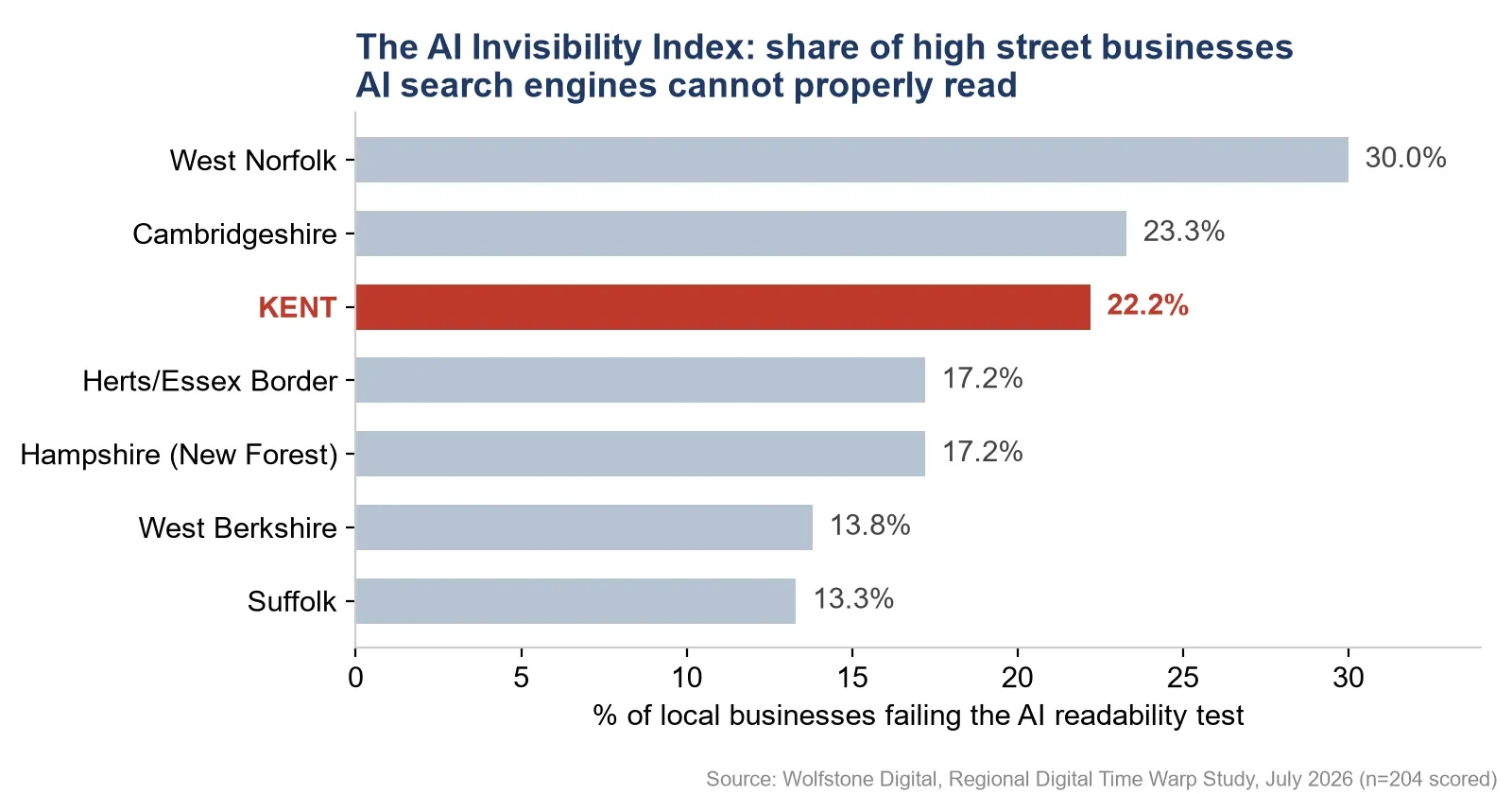
Share of high-street businesses AI search engines cannot properly read, by county.
Wolfstone Digital, Regional Digital Time Warp Study, July 2026 (n=204 scored).
| Rank | County | AI-invisible businesses |
|---|---|---|
| 1 | West Norfolk | 30.0% |
| 2 | Cambridgeshire | 23.3% |
| 3 | Kent | 22.2% |
| 4 | Herts/Essex border | 17.2% |
| 5 | Hampshire (New Forest) | 17.2% |
| 6 | West Berkshire | 13.8% |
| 7 | Suffolk | 13.3% |
In West Norfolk, ask an AI assistant about the local high street and nearly one in three businesses simply do not come up properly. In Kent it is more than one in five - and that figure is conservative: Kent is the only county where we found two live websites configured to turn away every automated visitor, AI crawlers included. Count those and Kent's true rate is 27.6%.
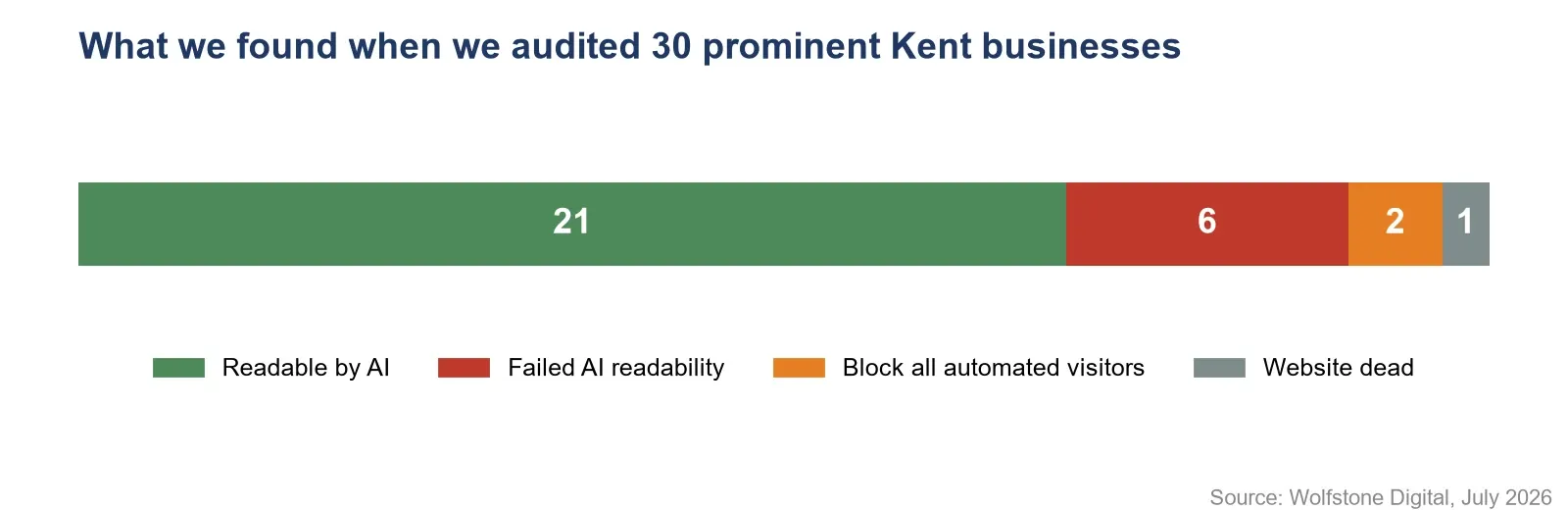
AI-readability breakdown of 30 prominent Kent businesses.
Wolfstone Digital, Regional Digital Time Warp Study, July 2026.
The sector story: estate agents have a problem
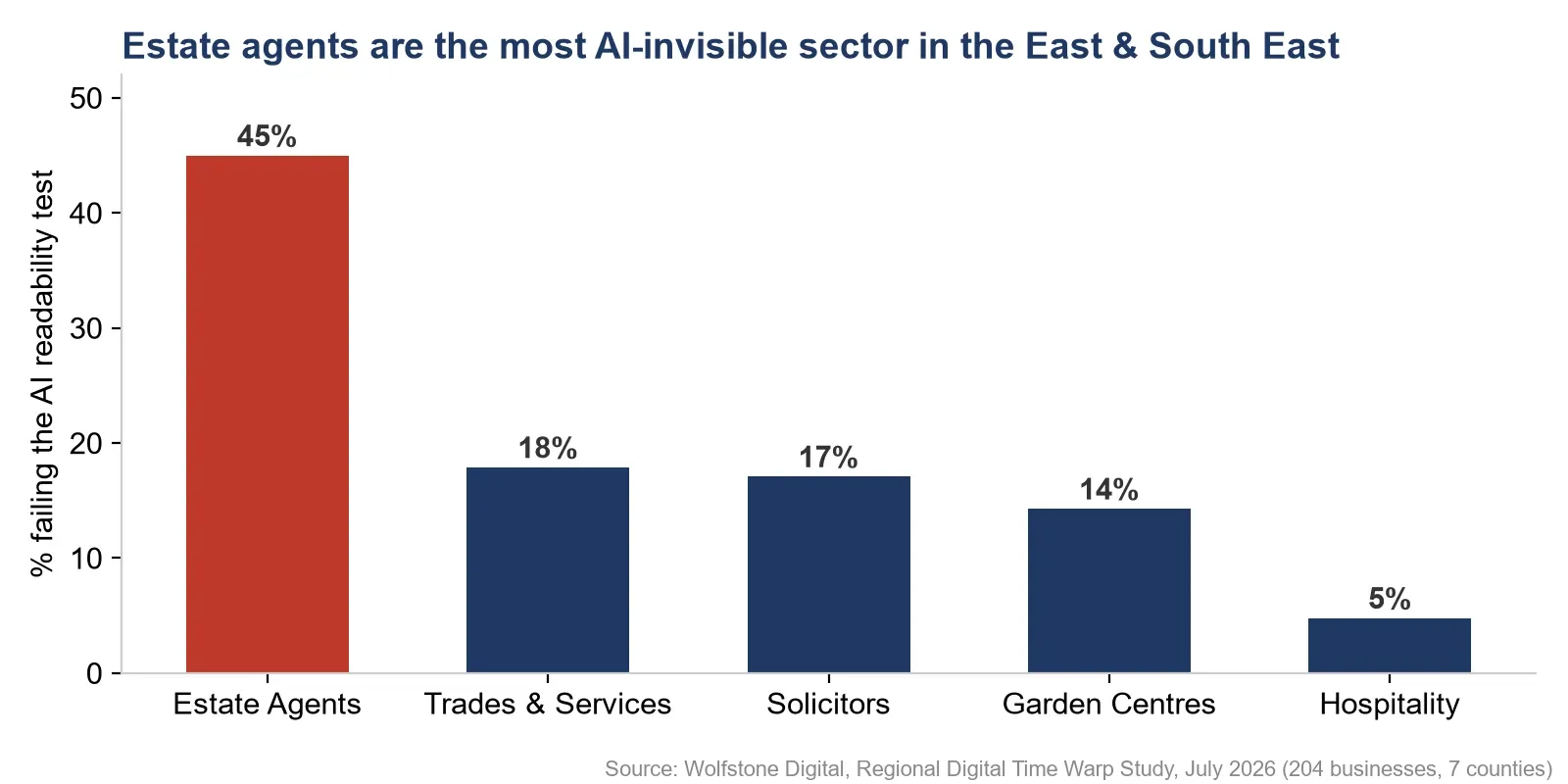
Share of each sector failing the AI readability test.
Wolfstone Digital, Regional Digital Time Warp Study, July 2026.
| Sector | Failed the AI test | Time Warp cases |
|---|---|---|
| Estate agents | 45% | 6 |
| Trades and services | 18% | 2 |
| Solicitors | 17% | 4 |
| Garden centres | 14% | 1 |
| Hospitality | 5% | 0 |
Nearly half of the independent estate agents we audited are unreadable by AI search. Of the eight businesses in the entire study that actively block AI crawlers in their site code, four are estate agents. In a sector where being found first is the whole game, that is remarkable. Hospitality, for the record, was the best sector in the study: not a single pub, hotel or restaurant was a full Time Warp case. When your customers book tables from their phones, you evolve or you close.
What this actually means if you run a local business
None of this is about shaming anyone, and we have deliberately not named any business in this study. Most of the failures we found have the same root cause: the website was built for how people searched in 2015, and how people search changed. The pattern shows up town by town across the region, from Bury St Edmunds to King's Lynn.
A site that fails our AI test usually has no structured data - the machine-readable layer that tells Google and ChatGPT what you do, where you are and when you are open - no readable opening information, and sometimes a line of code actively telling AI crawlers to go away, often left there by a developer years ago without the owner ever knowing.
We found the same pattern at the other end of the scale: auditing Suffolk's 100 largest private companies turned up 11% with no website at all, so this is not only a small-business problem. The fix is rarely dramatic. It is usually a website rebuild done properly: responsive, secure, structured data in place, content AI can read and cite. That is the work we do every day - and it is why we run our own numbers as hard as we run our clients', from UK AI adoption to search behaviour.
Want to know if AI can see your business?
Run your website through the same AI-readability test at the heart of this study. Our free AI Visibility Checker shows whether ChatGPT, Gemini, Perplexity and Google AI Overviews can actually read and cite your site - results in plain English, no obligation.
Check your AI visibility, freeMethodology
Sample: 210 independent, consumer-facing businesses (30 per county across 7 counties, 6 per sector across 5 sectors), audited in July 2026. Businesses were selected from prominent web search results for each sector and town within each local news patch; national chains and franchises were excluded.
Tests: each live website was tested with an automated technical audit - responsive viewport declaration, latest copyright year, HTTPS certificate validity, robots.txt AI-crawler rules, rendered text volume, structured data and machine-readable opening information - supplemented by manual browser checks. Sites with no displayed copyright year were not penalised on that test.
Scoring: the Digital Health Score is definitive tests passed as a percentage of all definitive tests taken. Six sites unreachable by automated tools were excluded from scoring rather than counted as failures, so every headline figure in this study is conservative.
Note: the AI Blind Spot test is a technical proxy for AI readability. No businesses are named in this study; the anonymised dataset is available to journalists on request.