

How big is the UK digital marketing industry?
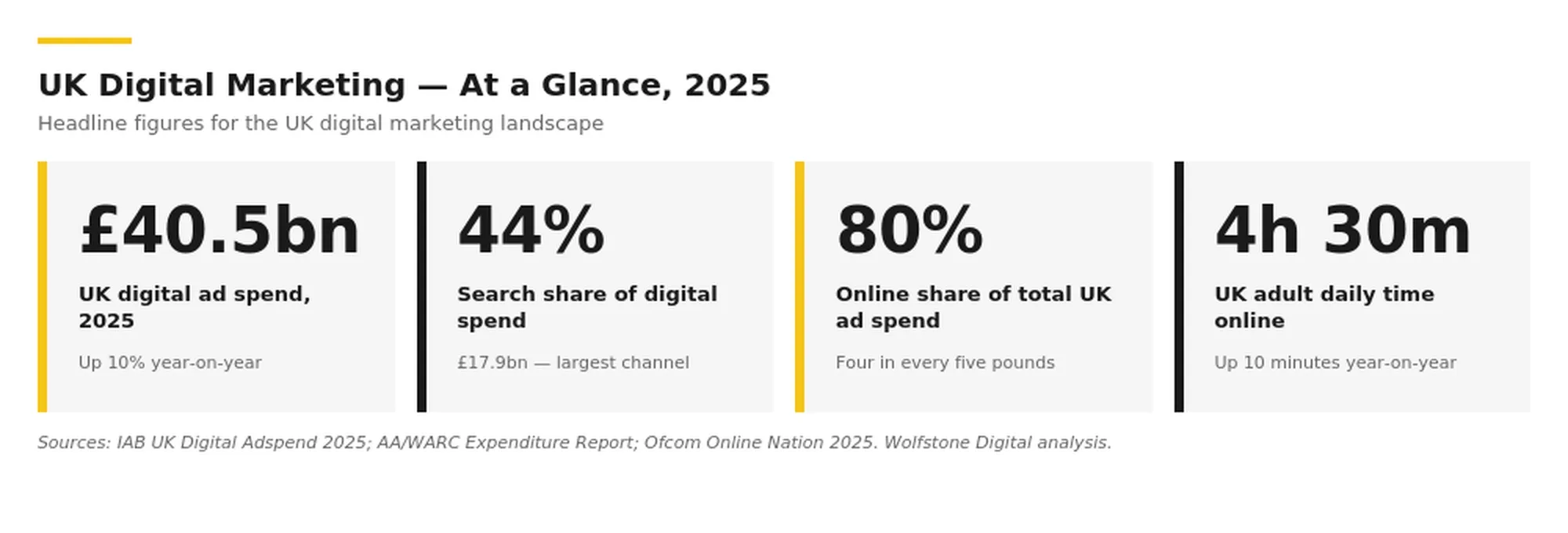
The UK digital advertising market was worth £40.5 billion in 2025, an annual increase of 10% according to IAB UK's Digital Adspend 2025 report - produced with Oliver Wyman and treated as the official UK digital ad spend figure by the Advertising Association since 1997. That growth rate ran approximately fourteen times faster than UK GDP, which grew 1.4% over the same period.
Total UK advertising spend across all media reached £42.6 billion in 2024, growing 10.4% year-on-year, with online channels taking around 80% of that total - four in every five pounds of UK advertising investment now flows through digital. AA/WARC forecast UK total ad spend will rise to approximately £47.8 billion in 2026, while IAB UK projects the digital share alone will reach £44.7 billion in 2026 and £49.1 billion by 2027.
Beyond paid media, the wider advertising and marketing sub-sector contributed £24.3 billion in Gross Value Added to the UK economy in 2024, according to DCMS provisional estimates published in February 2026. That makes advertising and marketing the second-largest sub-sector within the UK creative industries - behind only IT, software and computer services at £62.4 billion - and a £2.8 billion increase in real-terms value-added over 2023.
UK digital ad spend has more than doubled since 2020
UK digital ad spend has expanded from £16.4 billion in 2020 to £40.5 billion in 2025 - a five-year compound annual growth rate of approximately 20% based on the historical IAB UK series. The trajectory shows accelerating growth post-pandemic, with year-on-year increases of 43% in 2021, 11% in 2022, 13% in 2023, 20% in 2024, and 10% in 2025.
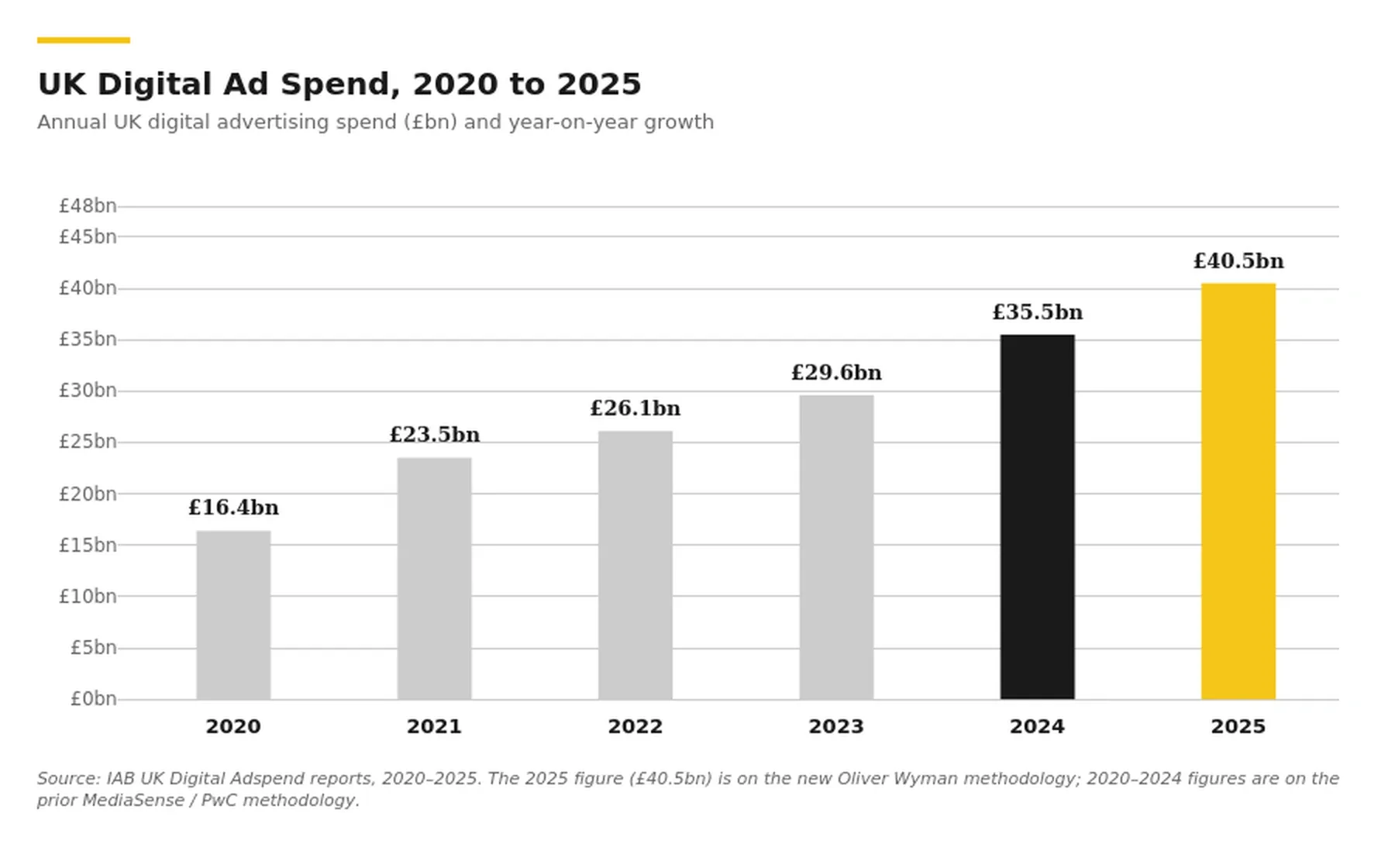
UK digital ad spend trend, 2020 to 2025.
IAB UK Digital Adspend reports 2020–2025.
Methodology note: from H1 2025, IAB UK switched its delivery partner from MediaSense (formerly PwC) to Oliver Wyman, introducing an updated methodology. The 2024 full-year figure has been restated within the 2025 release for year-on-year comparability, but the new series is not directly reconcilable with editions published before April 2025. Pre-2024 figures shown here are on the legacy MediaSense methodology.
| Year | UK digital ad spend | Year-on-year growth | Methodology |
|---|---|---|---|
| 2020 | £16.4bn | - | MediaSense / PwC |
| 2021 | £23.5bn | +43% | MediaSense / PwC |
| 2022 | £26.1bn | +11% | MediaSense / PwC |
| 2023 | £29.6bn | +13% | MediaSense / PwC |
| 2024 | £35.5bn | +20% | MediaSense / PwC |
| 2025 | £40.5bn | +10% | Oliver Wyman (new) |
Which channels dominate UK digital advertising?
Search advertising remains the largest channel in UK digital marketing, taking £17.9 billion or 44% of digital ad spend in 2025 - driven by Google's continued dominance of the UK search market.
Social media advertising was the second-largest channel at £11.5 billion (28%), and posted the strongest growth rate of any major channel at +21% year-on-year, with video formats accounting for 59% of all social ad spend.
Video display advertising - covering social video, broadcaster VOD, streaming services and publisher inventory - reached £9.3 billion in 2025, up 20% year-on-year. The video category overlaps with social media: a significant share of social ad spend is itself video. Retail media emerged as a discrete reporting line in 2024 (£1.4 billion, +23%) and continued growing in 2025, while gaming-environment ads added £1.1 billion in 2024 with continued 2025 expansion.
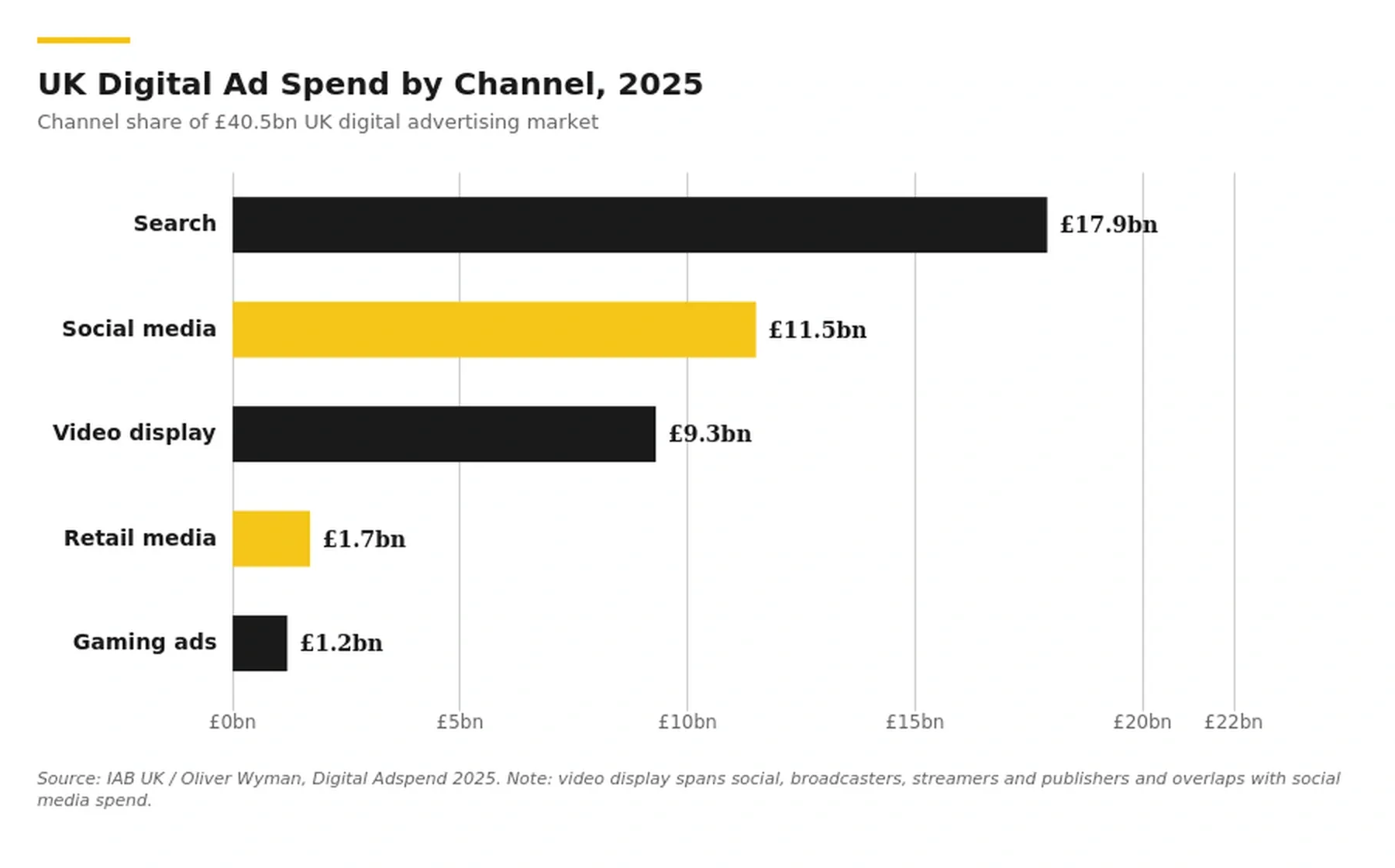
UK digital ad spend by channel, 2025.
IAB UK / Oliver Wyman Digital Adspend 2025.
| Channel | Spend (£bn) | Share of digital | YoY growth |
|---|---|---|---|
| Search | £17.9bn | 44% | +6% |
| Social media | £11.5bn | 28% | +21% |
| Video display (all) | £9.3bn | 23% | +20% |
| Retail media | ~£1.7bn | ~4% | Strong double-digit |
| Gaming-environment ads | ~£1.2bn | ~3% | +9% (2024 baseline) |
Are UK marketing budgets growing in 2026?
Yes - UK marketing budgets recorded their strongest growth sentiment in nearly two years in Q1 2026, with a net balance of +7.3% according to the IPA Bellwether Report. That reading marks the recovery from a flatline at the end of 2025 and signals a return of marketer confidence following a sustained period of caution through 2024 and 2025.
Main media advertising - the category covering paid media of all kinds, including digital and traditional - posted a net balance of +4.5% in Q1 2026, its first positive reading in four quarters and the strongest since Q3 2023. Within main media, video budgets bounced back to +5.7% (from −5.0% the previous quarter), while out-of-home advertising remained sharply negative at −11.3%. Events led all categories at +14.7%, with PR at +6.0% and direct marketing at +3.9%.
The strength of the PR reading reflects what UK brands are leaning into as third-party trust signals rise in importance alongside AI search disruption - a context that has put digital PR back at the top of many UK marketing agendas heading into 2026.
The Bellwether's fieldwork ran from 2 to 24 March 2026, surveying around 300 UK marketers; net balance is calculated as the percentage reporting increased budgets minus the percentage reporting decreases. S&P Global Market Intelligence subsequently revised its 2026 UK ad spend forecast up to +2.5% growth, from a previous projection of +1.5%, with continued positive growth expected through 2028.
Marketers' outlook for the 2026/27 financial year is cautiously positive: 28.7% of firms expect to increase budgets while 25.6% expect cuts, producing a net balance of +3.0%. Own-company financial prospects turned positive for the first time in several quarters at +0.6%, though industry-wide sentiment remained negative at −21.0% - a five-quarter high, but still indicating broad industry pessimism.
Wolfstone analysis: UK digital ad spend intensity per internet user and online hour
To translate the headline £40.5 billion figure into intensity metrics that show how UK digital advertising lands per person and per minute of online attention, Wolfstone has combined IAB UK adspend data with Ofcom and ONS audience data. The resulting composite calculations recombine public data sources into figures that no single primary publisher produces.
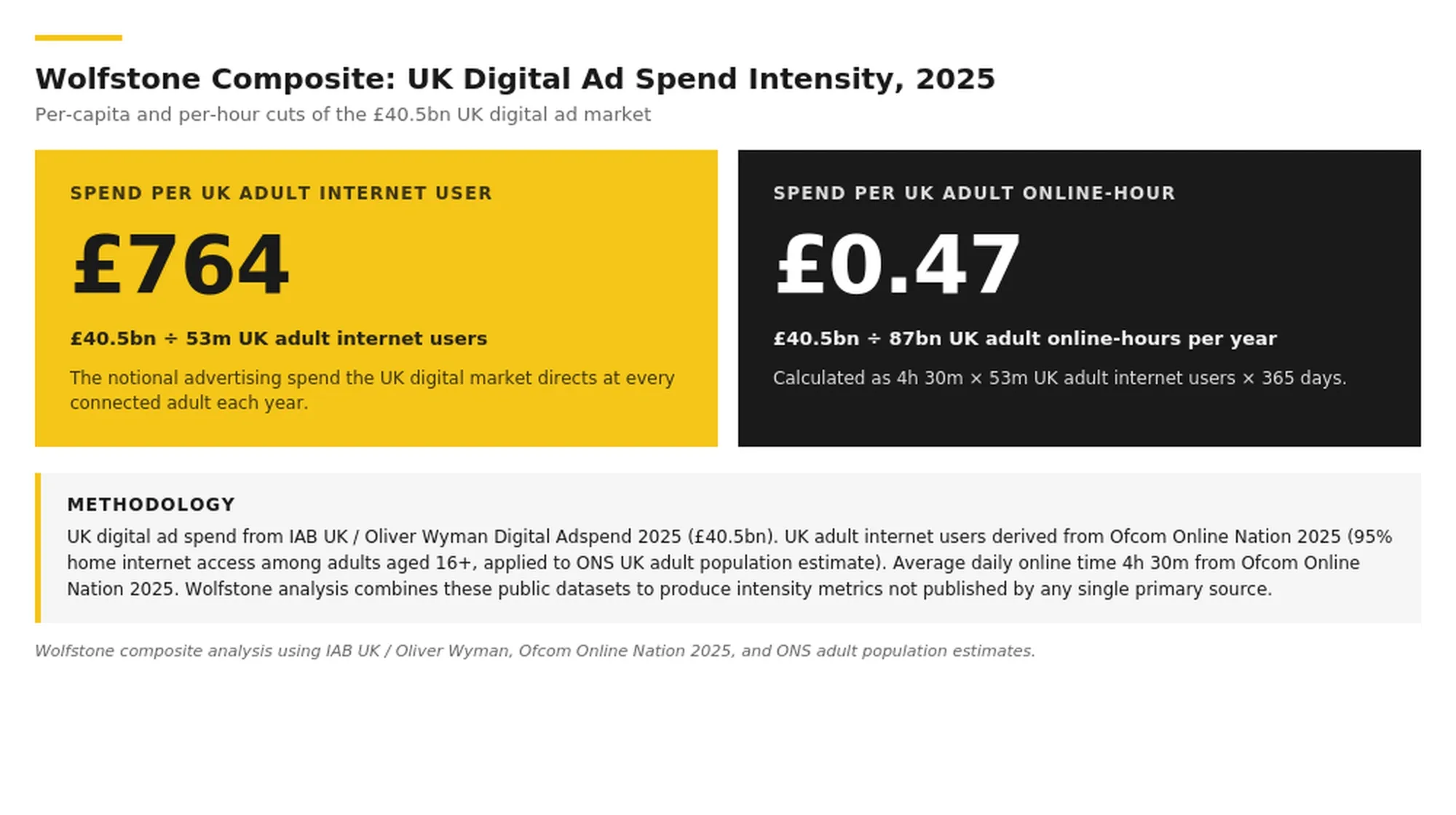
Wolfstone composite: UK digital ad spend intensity per adult internet user and per online-hour, 2025.
Wolfstone analysis of IAB UK Digital Adspend 2025, Ofcom Online Nation 2025, and ONS adult population estimates.
Methodology
Spend per UK adult internet user - £764 per year. Calculated as £40.5 billion total UK digital ad spend divided by approximately 53 million UK adult internet users (Ofcom Online Nation 2025 reports 95% home internet access among adults aged 16+, applied to ONS UK adult population estimate). This figure represents the notional advertising spend the UK digital market directs at every connected adult each year.
Spend per UK adult online-hour - £0.47. Calculated as £40.5 billion divided by approximately 87 billion UK adult online-hours per year (4 hours 30 minutes average daily online time × 53 million UK adult internet users × 365 days). This intensity metric anchors UK digital advertising to attention rather than population - useful for benchmarking the price marketers pay to compete for each hour of online consumer attention.
Inputs: UK digital ad spend figure (£40.5bn) from IAB UK / Oliver Wyman Digital Adspend 2025. UK adult internet user count derived from Ofcom Online Nation 2025 (95% home internet access among adults aged 16+, applied to ONS mid-year UK adult population estimate of approximately 56 million, giving 53 million). Average daily online time (4 hours 30 minutes) from Ofcom Online Nation 2025, fieldwork May 2025. Annual online-hours calculated as average daily time × adult internet users × 365 days.
UK marketing industry size and economic contribution
The UK advertising and marketing sub-sector contributed £24.3 billion in Gross Value Added to the UK economy in 2024 - a 2.1% real-terms increase on 2023 according to DCMS provisional estimates released in February 2026. It is the second-largest creative industries sub-sector, behind IT, software and computer services (£62.4 billion). The wider DCMS sectors collectively generated £247.6 billion of GVA in 2024, representing 9.4% of total UK Gross Value Added.
DCMS sector employment reached 4.0 million filled jobs from April 2024 to March 2025, representing 11.7% of all UK jobs and an 11.1% increase versus the 2019 baseline. Within the creative industries specifically, 2.4 million jobs were recorded in the calendar year January to December 2024 - broadly flat on 2023.
Statistical caveat: DCMS sector employment estimates were temporarily de-accredited on 4 August 2025 due to response-rate problems in the underlying ONS Annual Population Survey. The estimates are now classified as official statistics in development, with confidence intervals published alongside the figures. Year-on-year changes in DCMS employment data should be interpreted with care.
| Indicator | Value | Year | Source |
|---|---|---|---|
| Advertising & marketing GVA | £24.3bn | 2024 (provisional) | DCMS Feb 2026 |
| Real-terms growth on 2023 | +2.1% | 2024 | DCMS |
| Share of creative industries GVA | ~19% | 2024 | DCMS |
| Share of total UK GVA | ~0.9% | 2024 | DCMS / ONS |
| DCMS sector total GVA | £247.6bn | 2024 (provisional) | DCMS Feb 2026 |
| Creative industries jobs | 2.41m | Jan–Dec 2024 | DCMS |
How much time do UK adults spend online?
UK adults spent an average of 4 hours 30 minutes online per day in 2025, up 10 minutes year-on-year according to Ofcom's Online Nation 2025 report published in December 2025. The figure varies sharply by age: 18 to 24-year-olds spent 6 hours 20 minutes online daily, compared with 3 hours 20 minutes for adults aged 65 and over. Women spent more time online than men on average - 4 hours 43 minutes versus 4 hours 17 minutes.
Around 51% of UK adult online time is spent on Alphabet and Meta services combined, with Meta narrowly overtaking Alphabet on a daily average basis (1 hour 10 minutes versus 1 hour 7 minutes). YouTube reaches 94% of UK adult internet users, Facebook plus Messenger reaches 93%, WhatsApp 90%, and Instagram 78%. Mobile devices account for 77% of UK adult online time.
On the search side, Google Search reaches 82% of UK online adults and handles approximately three billion UK web searches per month, with roughly 30% of those searches now displaying AI overviews. Generative AI is becoming a routine search behaviour: ChatGPT received 1.8 billion UK web visits in the first eight months of 2025, with August 2025 alone recording 252 million visits. See our coverage of growth of AI search in the UK and the wider picture of UK adult AI tool adoption for the deeper analysis.
Online retail in the UK: 28.7% of all sales
Online retail accounted for 28.7% of all UK retail sales in March 2026, up 0.5 percentage points on February 2026, according to the ONS Retail Sales bulletin published on 24 April 2026. Online sales values rose 11.7% in Q1 2026 compared with Q1 2025, with growth outpacing total retail sales. This sustained shift towards online channels underpins the structural demand for digital marketing capabilities among UK retailers and brands.
UK regulatory picture for digital marketing
Three regulatory developments are reshaping the UK digital marketing environment in 2026: the Information Commissioner's Office gained materially stronger enforcement powers over electronic marketing under the Data (Use and Access) Act 2025; the Competition and Markets Authority designated Google with Strategic Market Status under the new Digital Markets, Competition and Consumers Act regime; and the Advertising Standards Authority continued to ramp up proactive monitoring of online ads using AI tools.
ICO direct marketing enforcement
Between March 2022 and mid-2025 the ICO issued 49 monetary penalty notices totalling £4.63 million for unsolicited direct marketing breaches under the Privacy and Electronic Communications Regulations (PECR), with claims management, lead generation, energy and home improvements the most-fined sectors. The Data (Use and Access) Act 2025 (DUAA), which received royal assent on 19 June 2025, raised the maximum PECR fine from £500,000 to £17.5 million or 4% of global turnover - aligning electronic marketing penalties with UK GDPR levels and signalling a structural increase in regulatory risk for non-compliant marketers.
CMA designation of Google under DMCCA
The competition and digital-markets provisions of the Digital Markets, Competition and Consumers Act 2024 came into force on 1 January 2025, with direct consumer-protection enforcement powers following on 6 April 2025. On 10 October 2025 the CMA designated Google's general search and search advertising services with Strategic Market Status - the first SMS designation under the new regime. In January 2026 the CMA published proposed conduct requirements covering choice screens, non-discriminatory ranking, publisher control over AI-overview use of indexed content, and transparency of AI-generated responses. A second SMS investigation into the Apple and Google mobile ecosystems is ongoing.
ASA proactive enforcement
The Advertising Standards Authority published approximately 270 rulings across 2024, with an upheld rate of around 92% - the majority of cases concerning online and social media advertising. A growing share of ASA actions originate from the regulator itself rather than consumer complaints: proactive ASA-initiated cases rose to 36% of rulings in Q4 2024, up from 15% in Q2 2024, driven by Active Ad Monitoring tools that use AI to scan digital ad inventory at scale.
UK search engine and device market context
Google holds approximately 89% to 90% of UK search engine market share across all devices, with Bing on 5% to 7%, and DuckDuckGo, Yahoo and Ecosia combining for the remainder, according to Statcounter's UK-specific page-view panel. The Google dominance is the structural driver of the CMA's Strategic Market Status designation and the proposed conduct requirements covering UK search. For the full breakdown see our UK search engine market share data.
On the device side, mobile accounts for around 77% of UK adult online time according to Ofcom Online Nation 2025, with UK smartphone users now using an average of 41 apps per month - up three apps year-on-year. The continued mobile shift means UK digital marketing investment is increasingly mobile-first by default rather than by design.