

The short answer
TLDR. How much does a website cost in the UK? For most of the sites we come across we budget around £3,000, give or take a thousand depending on size, and usually two weeks for the full set of deliverables. You will find quotes from a few hundred to forty thousand. This is our opinion on what is actually worth paying, and why the range is that wide.
What does a website cost in 2026, at a glance?
| Route | Typical UK cost | What you are really buying |
|---|---|---|
| DIY builder | £0 to £400 a year | Your own time, and a lot of it |
| Freelancer | £800 to £3,000 | One person’s skill set, whatever that happens to cover |
| Small agency | £2,000 to £6,000 | A team, and hopefully someone who understands search |
| Large agency | £10,000 to £40,000+ | Process, account management, and a longer timeline |
Our own number sits at around £3,000 for most builds. The rest of this page is why.
Why is the price range so wide?
Because you are not buying pages. You are buying time, and time goes on two things.
The first is scale. One page is not ten pages, and ten pages is not five hundred. That is obvious enough, but it is not linear either, because the tenth page usually takes twenty minutes and the first one took a fortnight of deciding what the business actually is.
The second is how much optimisation is in scope. A site that is designed, built and handed over is one job. A site that is designed, built, crawled, measured, fixed, and handed over with the numbers on it is a different job, and it is the difference between a site that is ready to rank and a site that needs three months of remedial work before anyone can start.
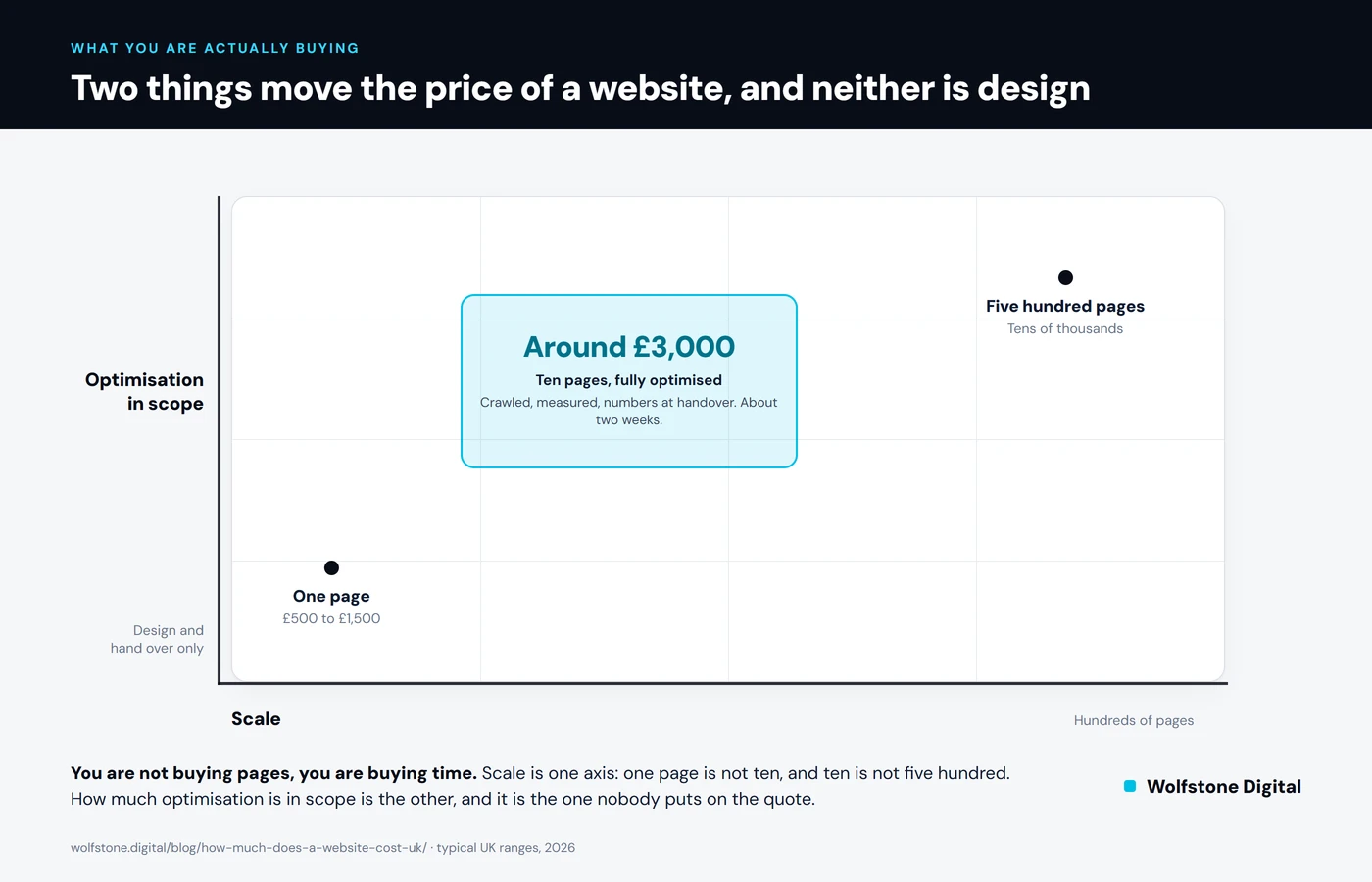
Everything in that diagram is in the copy above and below it. The forty thousand pound example further down is deliberately not plotted on it, because the money there did not go on scale or on optimisation. It went on process, which is the whole point of that section.
How much does a one page website cost?
Realistically £500 to £1,500 done properly, and you can do it yourself for the price of a domain.
A single page is the one case where a builder like Squarespace or Wix genuinely makes sense. What you are paying a professional for is not the page, it is the thinking: what the one thing on it should be, and what happens when somebody clicks. If you know both of those already, build it yourself and spend the money on something else.
How much for a 10 page website?
This is the sweet spot and it is where our £3,000 sits.
Ten pages is enough to need a structure, which means somebody has to decide what each page is for, how they link to each other, and which one is supposed to rank for what. That is the work. The building is comparatively quick.
It is also the point where getting it wrong starts to cost you. Ten pages with no plan will cannibalise each other in search, which is the polite way of saying Google will not know which one to show and will often show none of them. We have fixed that on our own site and we have fixed it on clients’ sites. It is much cheaper to avoid.
How much does a 500 page website cost?
Tens of thousands, and at that size the price stops being about design entirely.
A five hundred page site is a data problem. The questions that decide the cost are how the pages are generated, how they are kept from duplicating each other, how the internal linking works at scale, and what happens to the old URLs. Nobody is hand building five hundred pages, and if someone quotes you as though they are, that is worth asking about.
If you are in this bracket, the build cost is the small number. The migration is where it goes wrong.
What is a fair price to pay for a website?
A fair price is one where you can see what the money bought.
Our test is simple. Ask for the numbers at handover. Lighthouse scores on mobile, the crawl report, the Core Web Vitals. If the agency can produce those without flinching, the money went into the site. If the answer is a shrug, or “it will be fine once Google indexes it”, the money went into the design and the search side was nobody’s job. The median mobile load time across the Suffolk Top 100 audit was 11.4 seconds, which is what many businesses are actually paying for.
That is not an argument for cheap. It is an argument for knowing what you paid for. We have seen £3,000 spent well and we have seen a great deal more than that spent badly, which brings us to the part of this page people actually want.
What do you get for £40,000 that you do not get for £3,000?
Sometimes a great deal. Sometimes a longer wait.
We know of a business that recently paid £40,000 for a ten page website. It took six months. Ten pages, half a year, forty thousand pounds. We are not going to pretend we know every constraint that project was under, but we have looked at enough of these to have a view, and the view is that the number was mostly process.
Here is the thing that makes this worth saying now rather than two years ago. Not using AI on a build in 2026 would be close to criminal. The tooling has moved. What used to be three weeks of scaffolding is now an afternoon.
But there is a catch, and it is the whole reason agencies still exist. AI and vibe coding get you eighty to eighty five per cent of the way there, fast. Getting from eighty five to a hundred, where it actually works, actually converts, and actually looks like something you would be proud to put your name on, is genuinely difficult. That last fifteen per cent is the job.
So the honest answer to what £40,000 buys over £3,000 is: occasionally a much bigger and more complex piece of work, and occasionally six months of somebody else’s process. Ask which one you are buying.
Could you just build it yourself?
Yes. Honestly, yes. Log on to Lovable and you will have something live this afternoon.
We would know, because that is roughly what we did. The first version of The Investors Centre was built on Squarespace, and we chose Squarespace by googling “best beginner website builders”, because we had no idea how to build a website. Adam spent somewhere between twenty and thirty hours on YouTube tutorials, working every Saturday and Sunday, until it existed.
It looked alright. About six months later we worked out that the platform itself was holding the SEO back, and we had to move the whole thing to WordPress.
So yes, you can do it yourself, and for plenty of businesses that is the right call. What we would say is this: putting something live is not the same as it being optimised. Those are two different achievements and only one of them brings you customers.
You can also do real damage. A site that goes live before it is ready, with the wrong canonicals, no redirects from the old URLs, or a robots file quietly blocking the crawlers, teaches Google things about your business that take months to un-teach. The build being free does not make that cheap.
What actually drives the cost?
How many pages, and how different is each one?
Ten near-identical service pages is a fraction of the work of ten genuinely different ones. Templates are not a dirty word, they are most of why a build comes in on time.
How much has to be decided before anyone designs
This is the one that surprises people. If you know what you sell, to whom, and what the site should make them do, the build is fast. If those conversations happen during the build, every one of them costs a week.
How much optimisation is in scope
Ask explicitly. “SEO friendly” means nothing. “Lighthouse mobile above ninety, full crawl at handover, structured data on every template” means something, and it is a fair thing to ask for at any budget.
Migration and redirects
If you have an existing site with any history, this is the line item that protects everything you have already earned. Skipping it is the single most expensive mistake in this whole document, and it is usually skipped because nobody put it on the quote.
Does it cost money to keep a website running?
Yes, but less than most people expect.
A domain is around £15 a year. Hosting for a small business site runs from nothing to about £30 a month depending on the platform. If you are on WordPress, budget for plugin and core updates, because an unmaintained WordPress site is a security problem rather than a website.
The bigger ongoing cost is not hosting, it is content. A site nobody touches for three years starts to look like a site nobody touches, to visitors and to Google.
Can I host my own website for free?
Technically yes. Netlify, Vercel, GitHub Pages and Cloudflare all have free tiers that will serve a small site perfectly well, and they are genuinely fast.
The catch is that free tiers come with a subdomain, limits, and no support when something breaks at nine on a Friday. For a personal project or a portfolio, free hosting is the correct answer. For a business that takes enquiries through the site, thirty pounds a month buys you someone to shout at.
DIY, freelancer or agency: which is right for you?
DIY if the site is a formality, you have time, and nobody is finding you through search anyway.
A freelancer if you have a clear brief and you can judge the work. You are buying one person’s skill set, so find out where its edges are. A brilliant designer who has never run a crawl is not a problem, as long as you know that before you start.
An agency when the site has to earn. The question to ask is not how big the agency is, it is which discipline they came from. A design shop and a search shop will build you two very different websites for the same money.
What should you ask before hiring a web designer?
- What will the Lighthouse scores be on mobile at handover? A real answer is a number. A vague answer is your answer.
- Who handles the redirects from my old URLs? If this produces a pause, budget for fixing it later.
- Can I see the crawl report for a site you built? Anyone doing this properly has one.
- What happens if I want to change something myself? Find out before you are locked into a monthly retainer for text edits.
- Who owns the site when it is finished? The answer should be you, without conditions.
If you want to see what that looks like when someone actually answers those questions, our web design service page lists what we measure on every build, and the Haverhill garage case study shows a four page site from first call to live in a fortnight, with the scores on it.
Frequently asked questions
How much does a website cost per month?
If you are paying monthly, you are usually paying for hosting and support, which is fifteen to fifty pounds for most small business sites. Be careful with deals that spread the build cost over a monthly fee, because they often mean you never own the site.
Is it cheaper to redesign than rebuild?
Usually, and it is often the better answer too. If the structure underneath is sound, new design on the existing foundations is faster and keeps your search history intact.
Why do agencies not put prices on their websites?
Some of it is genuine, because scope really does vary. Some of it is not. We put ours on the page because the question is the first one everybody has, and refusing to answer it is a strange way to start.
Key takeaways
- Around £3,000 covers most small business sites properly, in about two weeks.
- You are buying time, not pages. Scale and optimisation scope are what move the number.
- AI gets a build eighty five per cent of the way. The last fifteen per cent is the job you are paying for.
- Ask for Lighthouse scores and a crawl report at handover. A real answer is a number.
- Putting a site live is not the same as it being optimised.