
The short version
TLDR. SEO web design means building a site so that search engines and AI models can read it properly from day one, rather than bolting that on afterwards. It is mostly invisible work: structure, speed, markup and crawlability. Done right, nothing about the build stands between you and ranking.
What is SEO web design?
It is designing and building a website with search as a constraint rather than an afterthought.
In practice that means the structure is decided before the visuals, the page can be read without running any JavaScript, the markup describes what the business actually is, and the whole thing loads fast enough that a visitor on a phone with one bar does not give up.
None of that shows up in a design mock-up, which is exactly why it gets skipped. A client cannot see crawlability in a PDF. They can see a hero image, so that is what gets discussed for three weeks.
What is SEO in web design?
The same question phrased the other way round, and worth answering separately because the emphasis shifts.
SEO within a web design project is the set of decisions that determine whether the finished site can compete at all. What the URL structure is. Whether each page has one job or three. Whether the navigation tells a search engine what the site is about. Whether the old URLs still resolve.
Those decisions are cheap while the site is being built and expensive afterwards. Changing a URL structure on a live site means redirects, lost equity and a recovery period. Getting it right first time costs an hour of thinking.
Why do most new websites launch invisible?
Because nobody in the build was responsible for it, and because a site can look completely finished while being unreadable to everything except a human with a browser.
We learned this the hard way and it is worth telling properly.
The first version of The Investors Centre was built on Squarespace. We picked Squarespace because we googled “best beginner website builders” and it came up, which is exactly as scientific as it sounds. Adam spent twenty to thirty hours on YouTube tutorials and every weekend for months getting it live.
It worked, visually. About six months in we realised the platform was capping what we could do on the SEO side, so we moved to WordPress and paid an agency somewhere in the region of £6,000 to £7,000 to handle the migration and optimisation. They said a month. It took six. We went through something like fifty iterations of that site, and at various points it was properly broken, visually and on the back end.
What came out of it was not a website. It was the decision to learn WordPress and technical SEO ourselves so we never had to depend on anybody else for it again. That period taught us more than any course would have, and it is the reason we can look at a site now and know within ten minutes what is wrong with it.
We have rebuilt that site twice since. It is now one of the most cited sources in UK personal finance, with more than four thousand AI answers naming it and over twenty thousand organic visits a month, on zero ad spend. The full story is in the trading and broker comparison case study.
What do we check before a site goes live?
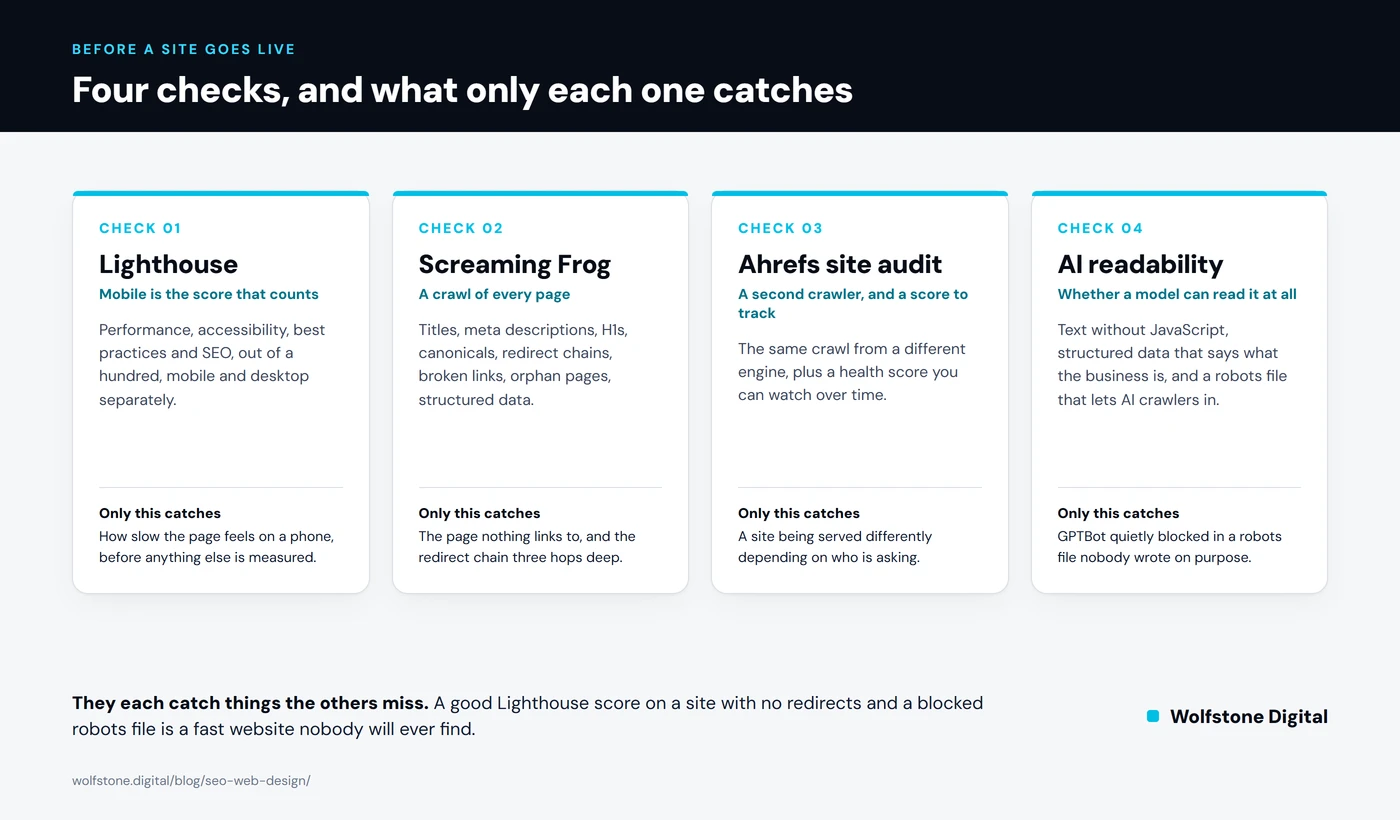
Four tools, and they each catch things the others miss.
What does Lighthouse actually measure?
Performance, accessibility, best practices and SEO, scored out of a hundred, on mobile and desktop separately. Mobile is the score that matters, because it is both where your customers are and the harder test. Lighthouse is a lab result rather than real user data, so treat it as a smoke alarm: a bad score is definitely a problem, a good score is not a guarantee.
What does a Screaming Frog crawl find?
Everything structural. Missing and duplicate titles, meta descriptions, H1s, canonicals, redirect chains, broken internal links, orphan pages that nothing links to, and whether structured data is actually present.
One warning from experience: Screaming Frog reports zero structured data across an entire site unless you explicitly enable extraction first. We have seen that produce a confident, completely wrong conclusion. Always confirm schema by looking at the page source on a couple of templates.
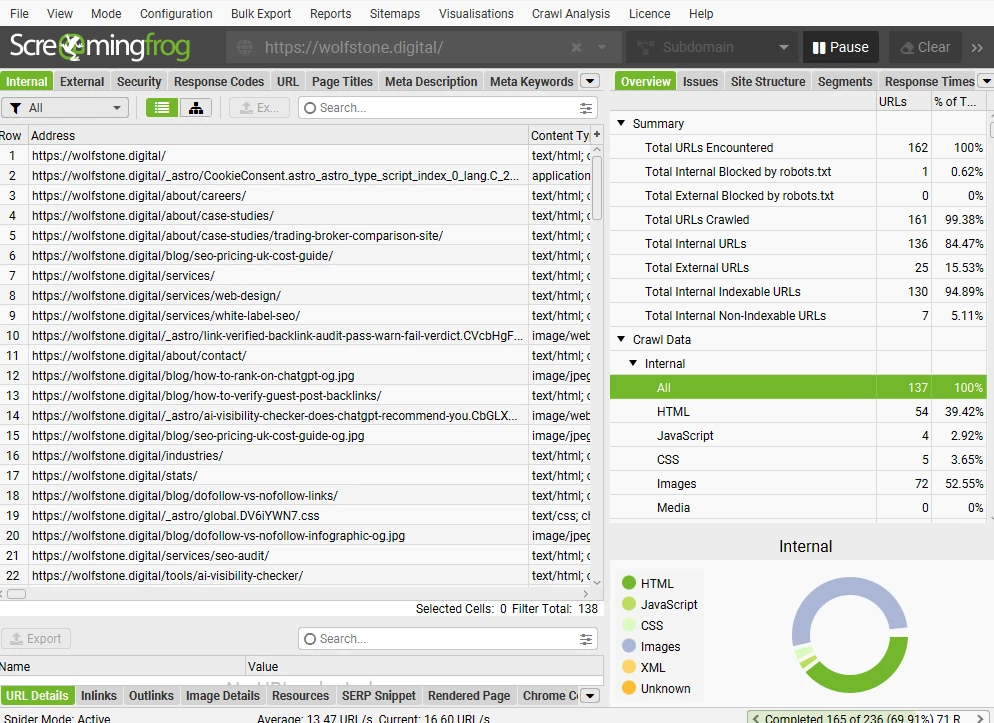
That is a crawl of this site, mid-run. 161 URLs, 130 indexable, seven not, and one blocked by robots.txt that we put there deliberately. Most people outside the industry have never seen what this work actually looks like, which is half the reason it is easy to sell badly.
What does an Ahrefs site audit add?
A second opinion from a different crawler, plus a health score you can track over time. Two crawlers disagreeing about a site is itself useful information. It usually means something is being served differently depending on who is asking.
What does a site need before an LLM will cite it?
Text a machine can read without executing JavaScript. Structured data that says what the business is, where it is and what it sells. Clear question and answer structure, because that is the shape of the thing being extracted. And a robots file that is not quietly turning away GPTBot and the other crawlers that feed AI answers.
That last one catches people. In our audit of Suffolk’s hundred largest companies, nearly seven per cent were blocking at least one major AI crawler, almost certainly without knowing. If you want to check your own, our AI crawlability checker will tell you in about a minute.
What makes a great website?
One that gets found, and then does the job the business needs when someone arrives.
Those two halves fail separately. A beautiful site nobody can find is a brochure in a drawer. A findable site that confuses people is worse, because you are paying for the traffic and losing it at the door.
The version we aim for is unglamorous: fast, clear about what you do within one sentence, easy to act on, and structurally sound underneath. We would rather build that than something that wins an award and takes four seconds to load.
How do I get my business on Google?
Three things, in order.
Make sure Google can reach the site at all. Check the robots file is not blocking anything important, submit a sitemap in Search Console, and use the URL inspection tool to confirm your key pages are actually indexed. A surprising number of invisible sites are simply not in the index.
Then claim and fill in your Google Business Profile, properly, especially if you serve a local area. For a local trade that listing does more work than the website in the first few months, which is why it is the first thing our local SEO work touches.
Then earn the rankings with content and authority, which is the slow part and the part no build can shortcut.
Can a beginner do SEO on their own website?
Yes, and a determined business owner can get a long way. The information is all public and none of it is secret.
What we would flag is the learning curve, because it does not flatten quickly. We spent two years and a five figure sum learning this on our own brand, and we had the advantage of it being our full time obsession.
The honest split is this. If you have time and no budget, learn it. Start with the technical basics and your Google Business Profile, which is where the fastest wins are. If you have a budget and no time, buy it, and use the questions in our guide to what a website should cost to work out whether the person you are buying it from actually knows what they are doing.
Can ChatGPT do SEO?
It can do parts of it very well and it cannot do the parts that matter most.
It is genuinely good at drafting, at structuring an outline, at spotting gaps in a page against a competitor, and at writing schema markup. We use AI throughout our own work and, as we say elsewhere, not using it in 2026 would be close to negligent.
What it cannot do is know your business, verify a claim, judge whether a keyword is worth chasing, or tell you that the thing you asked for is the wrong thing. It will confidently produce a plausible answer to a bad question.
The same rule applies here as to building: AI gets you most of the way, quickly. The last stretch, where it becomes correct rather than plausible, is the job.
What are the most common mistakes we see?
- No redirects after a rebuild. The most expensive mistake on this list and the most common. Every old URL that returns a 404 is history you paid for and threw away.
- Two pages competing for one term. Google will not know which to show and will often show neither. We had this on our own site and fixing it moved a page from eleventh to sixth.
- Text baked into images. A machine cannot read a picture. If your services are in a graphic, they do not exist as far as search is concerned.
- A robots file blocking AI crawlers. Usually inherited, almost never deliberate.
- Nothing measured at handover. If nobody ran a crawl, nobody knows what shipped.
Does a redesign hurt your rankings?
It can, and the damage is almost always self inflicted rather than inevitable.
Rankings drop after a redesign when URLs change without redirects, when content is cut without checking what it was ranking for, or when the new build is slower than the old one. All three are avoidable and all three are common.
Done properly, a redesign should improve rankings, because you are fixing years of accumulated structural debt at the same time. The rule we work to is simple: pull the full list of queries the site currently ranks for before touching anything, and treat that list as a protected asset.
That is the standard we build to on every web design project, and the reason the audit comes before the quote.
Frequently asked questions
How long after launch before a new site ranks?
Weeks for your own brand name, months for anything competitive. A brand new domain has no history, and no amount of technical work substitutes for that. Anyone promising fast rankings on a new domain is selling something.
Is WordPress good for SEO?
It can be excellent and it can be dreadful, and the platform is rarely the deciding factor. What matters is how it is configured, how many plugins are loading, and whether anyone is maintaining it.
Do I need to know how to code?
No. You need to know what to ask for and how to tell whether you got it, which is most of what this page is for.
Key takeaways
- SEO web design means search is a constraint from the start, not a bolt-on.
- A site can look finished and be unreadable to everything except a human.
- Four checks before launch: Lighthouse, Screaming Frog, an Ahrefs audit, and whether an LLM can read it.
- Missing redirects after a rebuild is the most expensive common mistake.
- AI gets you most of the way. The last stretch is where the work is.